What students learn
1. Quality beats money
Ad Rank is bid × quality (a simplified version*), so a strong ad with a small bid can beat a weak ad with a big one.
2. You pay just enough to win
Each ad pays only enough to beat the ad below it: a simplified generalised second-price auction.
3. The top spot is not always the best deal
Profit depends on what a click is worth to you, not on position alone.
4. AI Overviews change the maths
Round 3 halves every position's clicks. Half is a simplified, round number*: Pew Research Center (2025) found 8% of visits with an AI summary led to a click on a result, against 15% without; Seer Interactive found drops of 38% (organic, 2026) to 68% (paid ads, 2025).
Good for digital marketing, search marketing, e-commerce and microeconomics classes. You need a laptop on the classroom screen and paper for bids; students do not need devices.
Five golden rules
- Do not reload, close the tab, or click a link on the game page once you start.The game keeps everything in the open page only. A reload, or clicking a footer link, clears all profits.
- There is no back button.Once you bang the gavel, that round's profit is banked. Read the four bids back before you press it.
- Timers never start themselves and never move the game on.Press Start timer. At 0:00 three bells chime and the clock turns pink.
- "Restart game" needs two taps within 3 seconds.One accidental tap does nothing.
- Once loaded, the page runs without Wi-Fi.Open it before the lesson, and do not reload.
The auction rules
The four shops
| Team | Shop | Quality | Worth per click | Bid shown at the start |
|---|---|---|---|---|
| A | Shop A, big national chain | 3/10 | £6 | £4.00 |
| B | Shop B, indie shop in town | 9/10 | £4 | £2.00 |
| C | Shop C, online-only store | 5/10 | £5 | £3.00 |
| D | Shop D, discount website | 6/10 | £3 | £1.50 |
"Worth per click" is what one click earns the shop on average. For example, if 1 in 20 visitors buys and each sale makes £80, a click is worth £4. The bids shown at the start are an example: any bid you do not overwrite is used as it is. Before Round 1 only, the small − and + buttons let you change a shop's quality or worth.
Minimum Ad Rank to appear = 2
Price per click = (Ad Rank of the ad below ÷ your quality) + 1p, never more than your bid
The lowest ad shown pays a floor price of £0.10
Clicks: position 1 = 100, 2 = 60, 3 = 35, 4 = 15 (Round 3: 50, 30, 18, 8)
Profit = clicks × (worth per click − price per click)
*These rules are a simplified version for teaching. They follow the standard economics model of search ads as a quality-weighted generalised second-price auction, where ads are ranked by bid × predicted click-through rate and each pays just enough to beat the ad below (Edelman, Ostrovsky and Schwarz, 2007; Varian, 2007; Varian, 2009). Google does not publish its exact formula: real Ad Rank also weighs auction context, ad assets and minimum thresholds, and the 1 to 10 Quality Score is a diagnostic rather than the live auction input (Google Ads Help). Halving clicks in Round 3 is a round number within published estimates.
- Bids are capped at £10. Ties in Ad Rank go to the higher quality.
- Profit can be negative if a team pays more per click than a click is worth.
- Rounds 2 and 3: each team may pay £40 once to fix its landing page: quality +2, up to 10. The £40 comes off its profit at once. Tapping the button again before the gavel undoes it.
- The winning team is the one with the highest total profit after three rounds, not the #1 position most often. A green "How to win" banner keeps this on screen in every round.
Results you can predict
All of these come from the game itself, with the other shops on their starting bids.
| Position | Shop | Ad Rank | Pays per click | Clicks | Profit |
|---|---|---|---|---|---|
| #1 | Shop B (£2.00 × 9) | 18 | £1.68 | 100 | £232.00 |
| #2 | Shop C (£3.00 × 5) | 15 | £2.41 | 60 | £155.40 |
| #3 | Shop A (£4.00 × 3) | 12 | £3.01 | 35 | £104.65 |
| #4 | Shop D (£1.50 × 6) | 9 | £0.10 | 15 | £43.50 |
The biggest bidder comes third and pays the highest price per click. You can use this table as a paper version if the technology fails.
Shop A: raise the bid or fix quality?
Bid £5.50: Ad Rank 16.5, position #2, pays £5.01 a click.
Keep £4, fix the page (quality 5): Ad Rank 20, position #1, pays £3.61 a click, profit £239 (£199 after the £40 fix).
"We won and lost money"
If Shop A bids £10 in Round 1, it takes #1 but pays £6.01 a click (18 ÷ 3 + 1p) for a click worth £6: profit −£1.00. Pause the class on this one.
Round 3, same bids
Positions and prices stay the same, but clicks halve, so profits roughly halve (Shop B £116 instead of £232). Is the top spot still worth paying for?
Shop B and the fix
At quality 9, the £40 fix only adds 1 point (the maximum is 10). A good prompt: who gains most from improving quality?
Solo mode
Students can also play on their own phone or laptop. They open lab.yingwu.co.uk/ad-auction/#solo (or choose 🎯 Solo on the start screen), pick one of the four shops and bid against three computer-run shops. The computer's bids stay sealed until the gavel. The rules, rounds and twists are the same as in class.
- Homework or revision: a 5 to 8 minute replay before an assessment on search advertising.
- Catch-up: for students who missed the class game.
- Challenge: "Play again as Shop A. Can you win with the low-quality chain?"
- Why results vary: each computer shop has a bidding personality. The national chain tends to overbid; the indie shop bids cautiously. No two games are the same, so students can replay.
- Badges: finishing in either mode earns Auction run; winning solo earns Smart bidder. Badges are saved only on the student's own device, with no login.
Before the lesson
- Open lab.yingwu.co.uk/ad-auction/ in Chrome or Edge on the classroom computer.
- Press Full screen. Esc leaves full screen.
- From the back of the room, zoom with Ctrl + + (Mac: Cmd + +) if needed. Zooming does not reset the game.
- Test the sound: the button at the top right shows the current setting (🔊 Sound is on). Click it twice: off, then on again, which plays a test knock. Check the computer's volume and that sound goes to the room speakers.
- Do a quick dry run, then reload (fine before the real game starts).
- Prepare a slide or board showing the four shops, their quality and worth per click.
- Give each team paper for its sealed bids.
How long will it take?
Every time in this guide is a range. The low end is a tight run; the top end is what most classes take once teams discuss, decide and react to the results.
In class: 15 to 25 minutesSolo: 5 to 8 minutes
What moves you up or down the range
- How strictly you run the clock. Stopping each round when the timer ends keeps you near the low end; letting teams finish talking moves you to the top.
- Size of teams. There are always four teams; bigger teams take longer to agree on a sealed bid.
- How much discussion you want. Quick bids, or asking each team to explain its bid before you bang the gavel.
- Getting started. Forming teams, explaining the rules and first-time players all take a few minutes.
- Interaction in between. Questions, cheering at the reveal, the landing-page decision, the AI Overview twist or a tech hiccup.
- The debrief. One question, or a full discussion of what the game showed.
- Your group. Familiarity with the topic, reading in a second language, and the room layout.
Short on time? Use the timers, keep teams to three or four students, and take one debrief question. Want the richest discussion? Plan for the top of the range.
Step by step
15 to 25 minutes in total.
0 Explain the rules and form teams
2 to 4 min- Say
- "Every time you search, the ads you see have just won an auction in a split second. And the biggest wallet doesn't always win. Ad Rank is your bid times your quality. Never pay more than a click is worth to you. The winner has the most profit after three rounds."
- Students
- Split into four teams, one shop each (rows work well). Each team picks a runner.
- Note
- Tell students it is a classroom model: Google's real Ad Rank also weighs ad assets, context and thresholds, and Quality Score is a diagnostic, not a live auction input.
1 Round 1: sealed bids
2 to 4 min · timer 1:30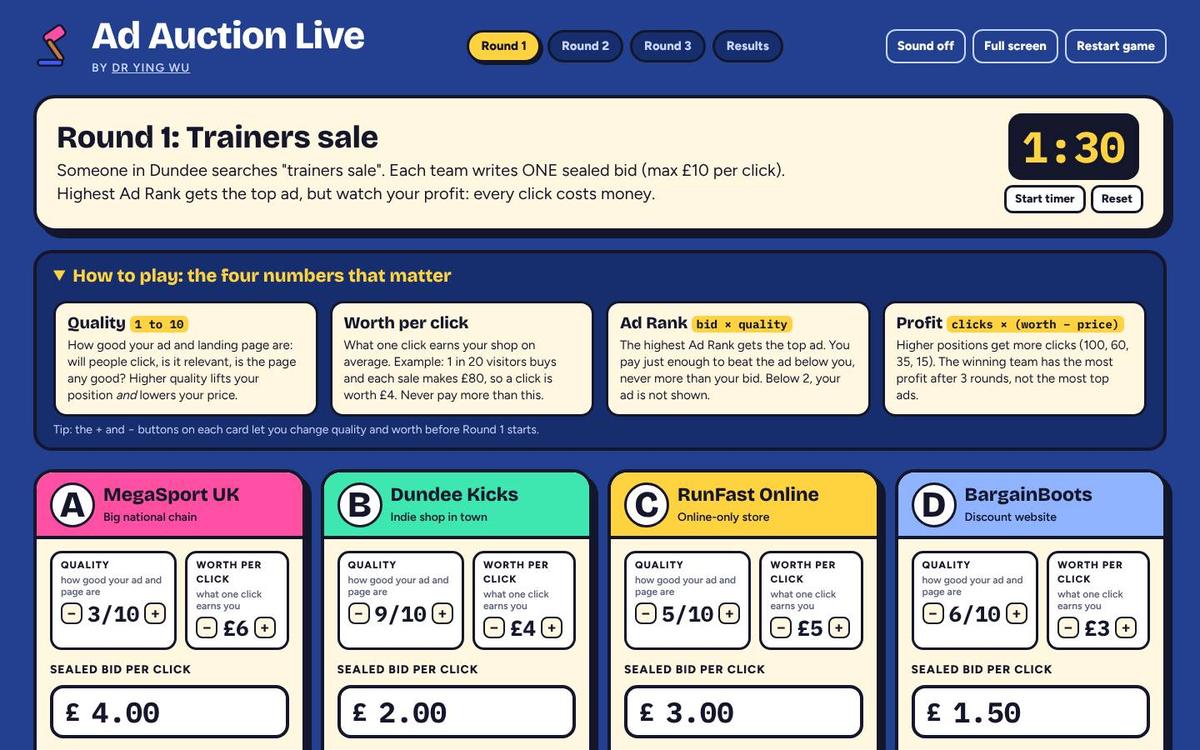
Round 1 opens with the rules panel expanded. - Click
- Optional: use the Quick check box first. Ask the room "who wins?" and click their answer; the game explains why profit is the score. It disappears once you bang the gavel.
- Press Full screen, then Start timer.
- When time is up, all four runners hold up their bids at the same time.
- Click each Sealed bid per click box, select all (Ctrl+A) and type the bid. Enter jumps to the next shop.
- Read the four bids back, then press Bang the gavel.
- Watch for
- Type numbers only, with a full stop: 2.50. No £ sign and no comma: "£2" is read as £0 and "2,50" as £2.
- An empty box or 0 means the ad is not shown.
- Leave the small − and + buttons alone unless you deliberately want to change a shop.
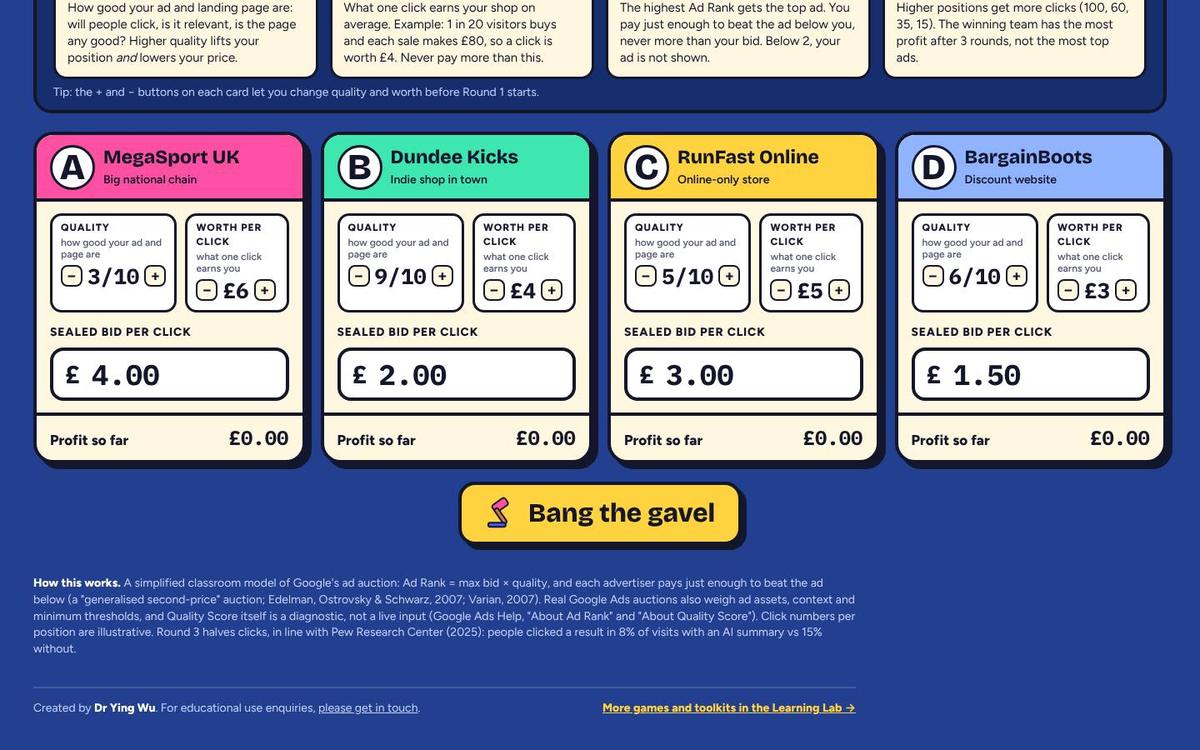
The bid boxes start with example bids. Overwrite all four. 2 The reveal
1 to 2 min- Screen
- Ad Rank bars with the sum under each (left); what the searcher sees, with each ad's price, clicks and profit (right); a scoreboard with the price and profit maths; and a yellow lesson banner. Any ad under Ad Rank 2 is listed in red as not shown.
- Say
- Read the banner. Then: "Who bid the most? Where did they land? What did they pay per click compared with the winner?"
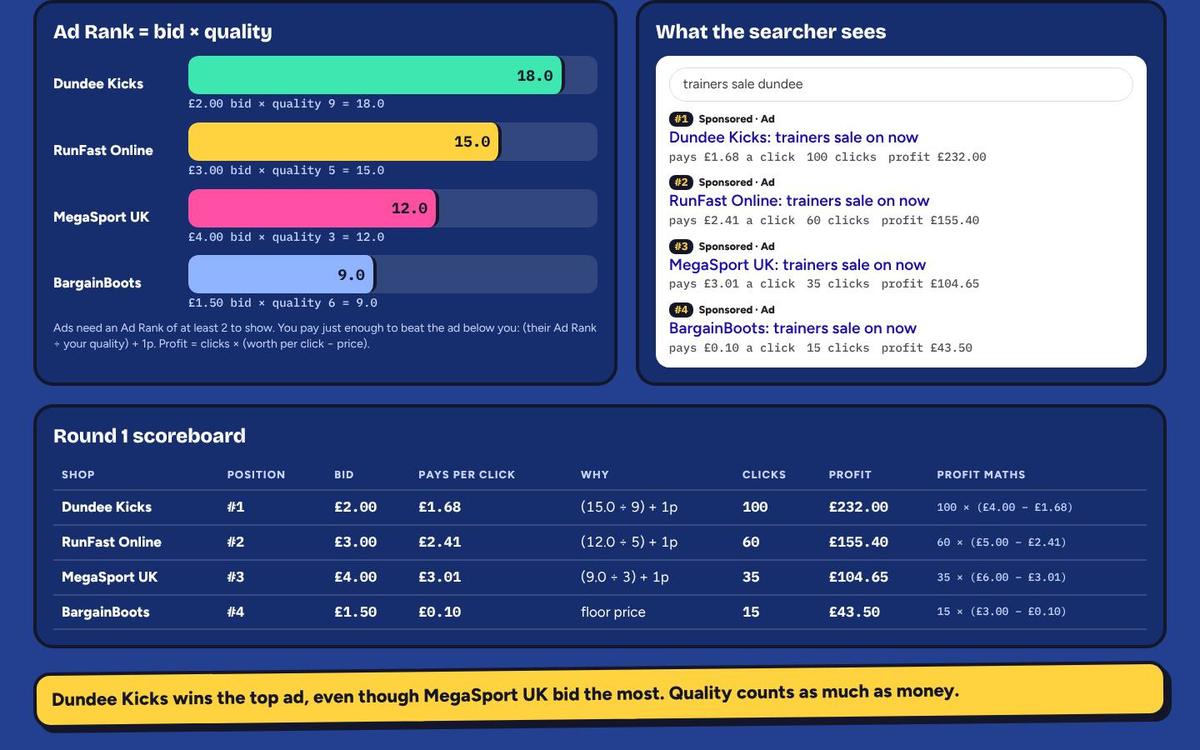
Round 1 with the example bids: Shop B wins with £2. 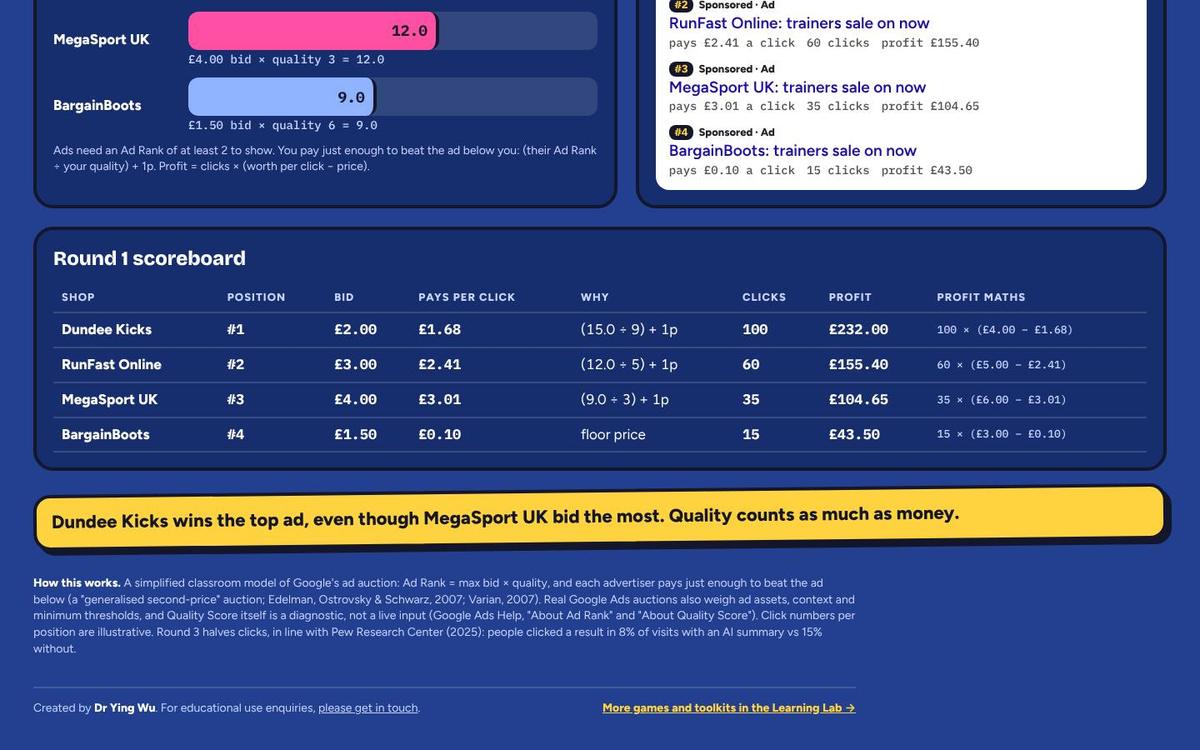
The scoreboard shows every calculation, so students can check the maths. 3 Round 2: fix your landing page?
2 to 4 min · timer 1:00- Click
- Press Next round (the pink button under the shop cards), then Start timer.
- For each team that pays for the fix, press its Fix landing page: quality +2 for £40 button. It turns green.
- Type all four new bids, read them back, press Bang the gavel.
- Say
- "You can pay £40 to improve your landing page: quality plus 2. Is it worth it? How many rounds until it pays back?"
- Watch for
- Bids carry over from the last round: overwrite all four. Each team can buy the fix only once.
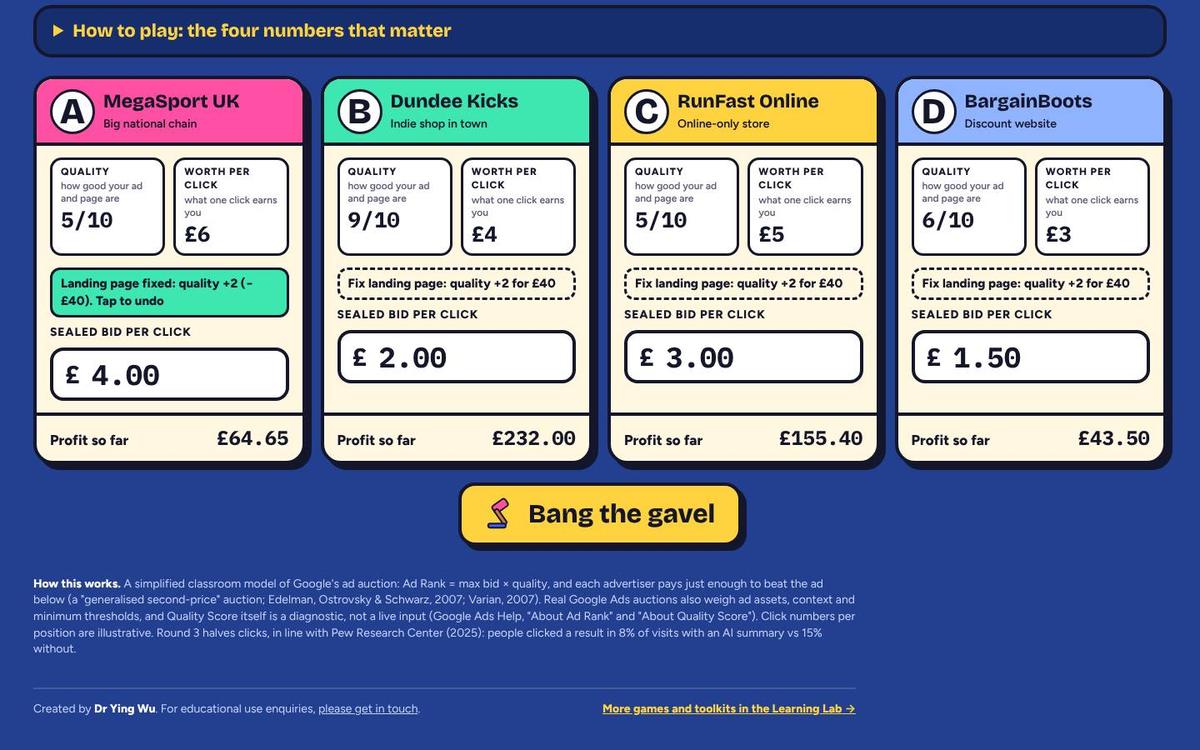
Shop A bought the fix: quality 3 to 5, profit down £40. 4 Round 3: an AI Overview appears
2 to 4 min · timer 1:00- Click
- Press Next round, then Start timer.
- Teams that have not fixed their page can still do it now.
- Type four bids, read them back, press Bang the gavel.
- Say
- "Google now shows an AI summary above the ads, and every position gets about half the clicks. Is the top spot still worth the price? Does anyone want to bid lower?"
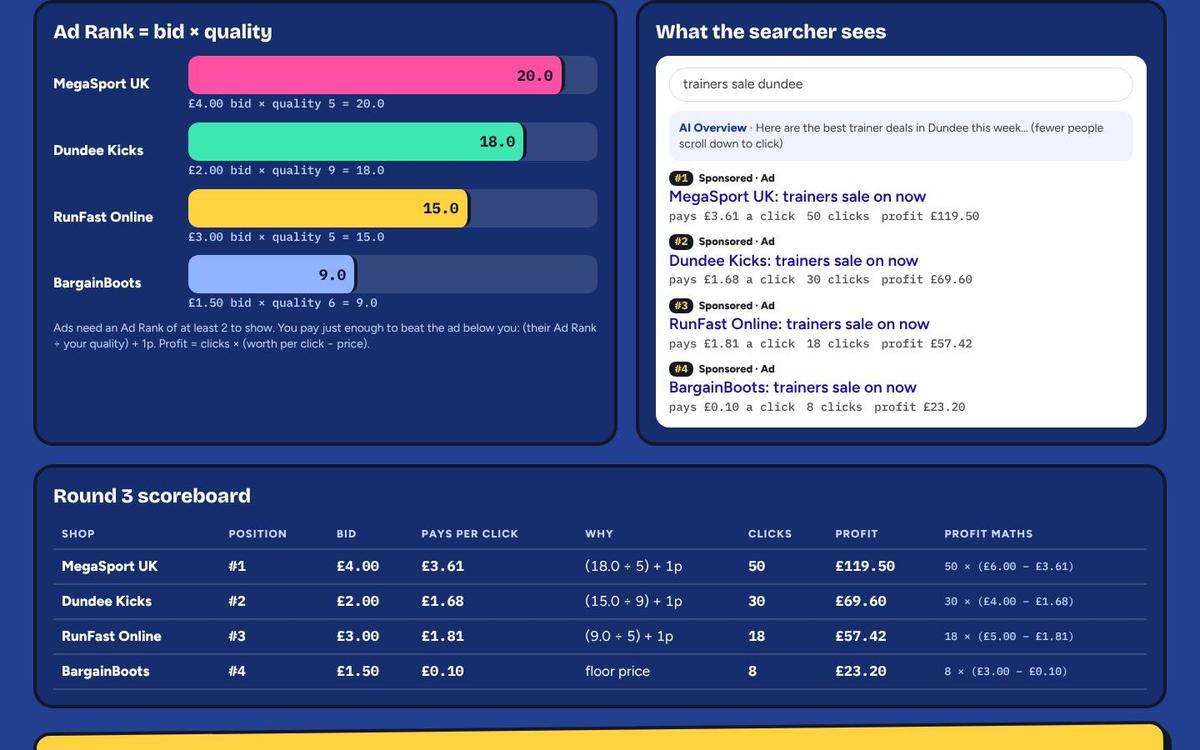
The AI Overview pushes ads down and halves the clicks. 5 Final results and debrief
1 to 2 min- Click
- Press Final results: a podium ranked by profit, a banner comparing "#1 position most often" with "most profit", a "Real world" note on what the #1 position is worth beyond profit (visibility, awareness, trust), and five debrief questions.
- Say
- Pick one: "Why did a small indie shop beat a national chain with a lower bid?" or "When the AI Overview halved the clicks, should a client still pay for the top spot?"
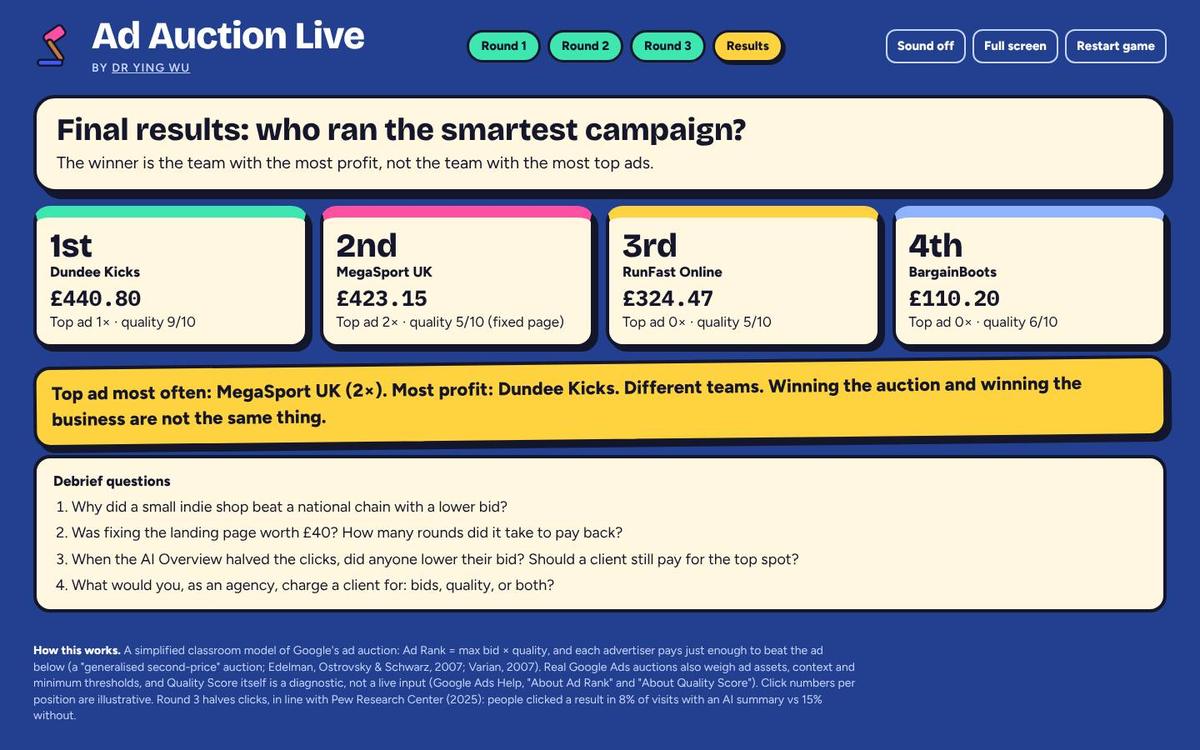
The winner is the team with the most profit.
If something goes wrong
| Problem | What to do |
|---|---|
| A wrong bid was gavelled | The profit is banked and cannot be undone. Say so and let that team adjust next round. Do not restart for one typo. |
| "Fix landing page" is grey | The team already bought it, or its quality is already 10. |
| An ad is "not shown" | Its Ad Rank was under 2 (for example a bid of £0.20 at quality 9). A useful teaching point about minimum thresholds. |
| A profit is negative | The team paid more per click than a click was worth. Ask them why. |
| The page reloaded | Everything is cleared. Reopen and ask teams for their running totals from their paper notes, or continue as a fresh game. |
| No Wi-Fi | If the page was already open, carry on. Otherwise use the worked answer table above on paper. |
| No sound | The top-right button should read "🔊 Sound is on". Turn it off and on again to hear a test knock, then check the computer's volume and output device. |
Cheat card: the button order
- Full screen, then Start timer (1:30)
- Type four bids: numbers only, with a full stop
- Bang the gavel, read the banner
- Next round, Start timer (1:00)
- Tap "Fix landing page" for teams that pay
- Type four new bids, Bang the gavel
- Next round, Start timer (1:00), four bids, Bang the gavel
- Final results and one debrief question
My Search Marketing students played Ad Auction Live in October 2026. Read what happened and what they said about it. Read the blog post →
Behind the model
- Edelman, B., Ostrovsky, M. and Schwarz, M. (2007) 'Internet advertising and the generalized second-price auction: selling billions of dollars worth of keywords', American Economic Review, 97(1), pp. 242-259.
- Google Ads Help (n.d.) About Ad Rank. support.google.com
- Google Ads Help (n.d.) About Quality Score. support.google.com
- Goodwin, D. (2025) 'Google AI Overviews drive 61% drop in organic CTR, 68% in paid', Search Engine Land, 4 November. searchengineland.com
- Pew Research Center (2025) Google users are less likely to click on links when an AI summary appears in the results, 22 July. pewresearch.org
- Seer Interactive (2026) AIO impact on Google CTR: 2026 update, 24 April. seerinteractive.com
- Varian, H.R. (2007) 'Position auctions', International Journal of Industrial Organization, 25(6), pp. 1163-1178.
- Varian, H.R. (2009) 'Online ad auctions', American Economic Review, 99(2), pp. 430-434.
A simplified classroom model: Ad Rank = bid × quality, the price rule and the Round 3 halving are teaching simplifications of the sources above. Click numbers per position are illustrative. The shops are fictional.