What students do
About 1.3 billion adults worldwide still lack a financial account (World Bank Global Findex 2025). Teams act as consultants to a self-service banking company: ATMs, kiosks and the networks behind them. Each team gets one real community with two key barriers, builds a solution from three cards on a tight budget, is scored like an innovation-challenge judging panel, survives a random reality check, and pitches in 30 seconds.
Good for
Strategy, innovation, entrepreneurship, marketing and social-impact modules; warm-ups before a case competition or pitch assessment.
You need
A laptop on the classroom screen running the game, paper or sticky notes for each team, and this guide. Students do not need devices.
Five golden rules
- Do not reload, close the tab, or click a link on the game page once you start.The game keeps everything in the open page only. A reload, or clicking a link in the footer, clears all teams and scores.
- There is no back button.Every big yellow or pink button moves forward. Check every team's entries before you press it.
- Timers never start themselves and never move the game on.Press Start timer. At 0:00 three bells chime and the clock turns pink; you decide when to continue.
- "Restart game" needs two taps within 3 seconds.One accidental tap does nothing.
- Once loaded, the page runs without Wi-Fi.Open it before the lesson, and do not reload.
The design, piece by piece
| Game feature | Why it is there | Linked tool |
|---|---|---|
| Communities with two key barriers | Design for one specific group and one real problem, not "everyone". | Jobs to be Done, barrier map |
| Three card slots: channel, trust builder, revenue model | Every solution needs a way to reach people, a reason to trust it, and someone who pays. | Business Model Canvas |
| 8 credits | Strategy is choice: teams cannot buy every good card. | Desirable, feasible, viable |
| Green ticks, red crosses | Some popular ideas make the real barrier worse, such as an app for people who avoid phones. | Value Proposition Canvas |
| Score out of 100: Innovation 25, Understanding 20, Viability 20, Impact 20, Pitch 15 | Mirrors a typical innovation-challenge judging panel. | Judging criteria |
| Reality check | The world changes. Robust ideas bend, fragile ones break. | PESTLE, assumption mapping |
| 30-second pitch and room vote | Practice saying the idea simply. | One-sentence pitch |
Each tool is explained with steps and examples in the Strategy Toolkit, which pairs well with the game.
The six communities
| Community | Key barrier 1 | Key barrier 2 |
|---|---|---|
| Rural pensioners in the Highlands | Physical access | Digital confidence |
| Gig workers aged 18 to 24 | Affordability | Trust |
| Women market traders in Lagos | ID and paperwork | Culture and language |
| Newcomers to the UK | ID and paperwork | Affordability |
| Smallholder farmers in rural India | Physical access | Money know-how |
| Cash-budgeting families in Dundee | Affordability | Money know-how |
With 7 or 8 teams, two teams share a community, which makes a useful comparison.
The card market
Points are Innovation / Viability / Impact. Green removes that barrier; red makes it worse. You can print this table as a team handout.
| Slot | Card | Cost | Inn / Via / Imp | Barrier effect |
|---|---|---|---|---|
| Channel | Smart ATM with cash-to-digital deposits | 3 | 1 / 3 / 2 | Physical access, Digital confidence |
| Video-teller kiosk in a community hub | 4 | 3 / 2 / 3 | Digital confidence, Trust, Culture and language | |
| Mobile-first banking app | 2 | 1 / 3 / 1 | Physical access; Digital confidence | |
| Cash agents in local shops | 3 | 2 / 2 / 3 | Physical access, Culture and language | |
| Pop-up banking van | 4 | 2 / 1 / 3 | Physical access, Trust | |
| Trust builder | Community partner (charity, faith group, union) | 2 | 1 / 2 / 3 | Trust, Culture and language |
| Voice and picture screens in local languages | 2 | 2 / 2 / 2 | Digital confidence, Money know-how, Culture and language | |
| Biometric sign-up (palm or face ID) | 3 | 3 / 2 / 2 | ID and paperwork; Trust | |
| Zero-fee basic account, no overdraft | 2 | 1 / 1 / 3 | Affordability, Trust | |
| Peer money champions and 2-minute lessons | 1 | 2 / 1 / 2 | Money know-how, Trust | |
| Revenue model | ATM-as-a-Service fee paid by partner banks | 2 | 1 / 3 / 1 | none |
| Retailer partnership: footfall and cashback fees | 1 | 2 / 2 / 1 | none | |
| Government or NGO inclusion contract | 2 | 1 / 2 / 2 | none | |
| Small fee on every transaction | 0 | 0 / 3 / 0 | Affordability | |
| Credit-builder micro-savings product | 2 | 3 / 2 / 2 | Money know-how |
Card points are teaching estimates designed to spark debate. Invite students to argue with them in their pitch.
How the score works
The game adds up the three cards' points and checks them against the team's key barriers. Before the pitch the maximum is 85; the pitch adds up to 15.
| Criterion | Max | How it is calculated |
|---|---|---|
| Innovation | 25 | Total innovation points ÷ 9 × 25. |
| Understanding | 20 | Share of key barriers removed. Each key barrier made worse takes off half a barrier. If one card removes a barrier and another makes it worse, it counts as made worse. |
| Viability | 20 | Total viability points ÷ 8 × 20. Halved if the team has not chosen all three cards. |
| Impact | 20 | Total impact points ÷ 8 × 20, scaled from 40% (no key barriers removed) to 100% (all removed). |
| Pitch | 15 | Room vote from 1 to 5, × 3. No vote scores 0. |
A strong, safe plan
Gig workers: Smart ATM + Zero-fee account + ATM-as-a-Service (7 credits).
8 + 20 + 18 + 15 = 61 / 85
Both barriers removed and the money works, but not very new.
Cheap and fragile
Rural pensioners: Mobile app + Biometric sign-up + Fee on every transaction (5 credits).
11 + 5 + 20 + 5 = 41 / 85
Plenty of revenue, but the app makes digital confidence worse.
The high scorer
Women traders in Lagos: Cash agents + Biometric sign-up + Micro-savings (8 credits).
22 + 20 + 15 + 18 = 75 / 85
…until reality hits
If the scam wave is drawn, trust becomes a key barrier for everyone. Biometric sign-up makes trust worse, so the Lagos plan drops by 14 to 61: a ready-made lesson in robustness.
The seven reality checks
One is drawn at random, once per game.
| Event | What changes | Who it hits |
|---|---|---|
| 🚨 A scam wave hits the headlines | Trust becomes a key barrier for every team | Biometric sign-up; plans with nothing that builds trust |
| 🏦 Your partner bank pulls out | ATM-as-a-Service fee: viability −2 | Plans relying on bank fees |
| ✂️ The grant money is cut | Government or NGO contract: viability −2 | Plans relying on grants |
| 📶 Mobile data prices jump | Affordability becomes key for every team; mobile app viability −1 and impact −1 | App plans; transaction fees |
| 🚪 Another wave of branch closures | Physical access becomes key for every team | Plans with no ATM, agent, van or app |
| 🤝 Your client gets a new owner (good news) | Smart ATM, Cash agents and ATM-as-a-Service: viability +1 | Helps plans built on the client's network |
| 🪪 Tougher ID checks | ID and paperwork becomes key for every team | Plans without biometric sign-up |
After the draw, each team may swap one card for 1 credit, or keep its plan. If the event adds a barrier a team already has, nothing changes for that team.
Before the lesson
- Open lab.yingwu.co.uk/bank-the-unbanked/ in Chrome or Edge on the classroom computer.
- Press Full screen. Esc leaves full screen.
- From the back of the room, zoom with Ctrl + + (Mac: Cmd + +) if needed. Zooming does not reset the game.
- Test the sound: the button at the top right shows the current setting (🔊 Sound is on). Click it twice: off, then on again, which plays a test knock. Check the computer's volume and that sound goes to the room speakers, not a headset or the projector.
- Do a two-minute dry run, then reload (fine before the real game starts).
- Put paper and pens on every table. Teams write decisions down and send one runner to you.
- Optional: print the card market table above, one per team.
Step by step
Timings are for 4 teams in about 15 minutes. See the timing table below for larger groups.
0 Introduce the game
1 min- Say
- "Each team gets a community with two barriers that keep them out of banking. You build a solution from three cards: a channel, a trust builder and a revenue model. You only have 8 credits. You will be scored like a judging panel. Then reality bites, you can change one card, and you pitch for 30 seconds."
- Students
- Sit in teams and choose a runner.
1 Set the teams and deal communities
1 min · timer 2:00 optional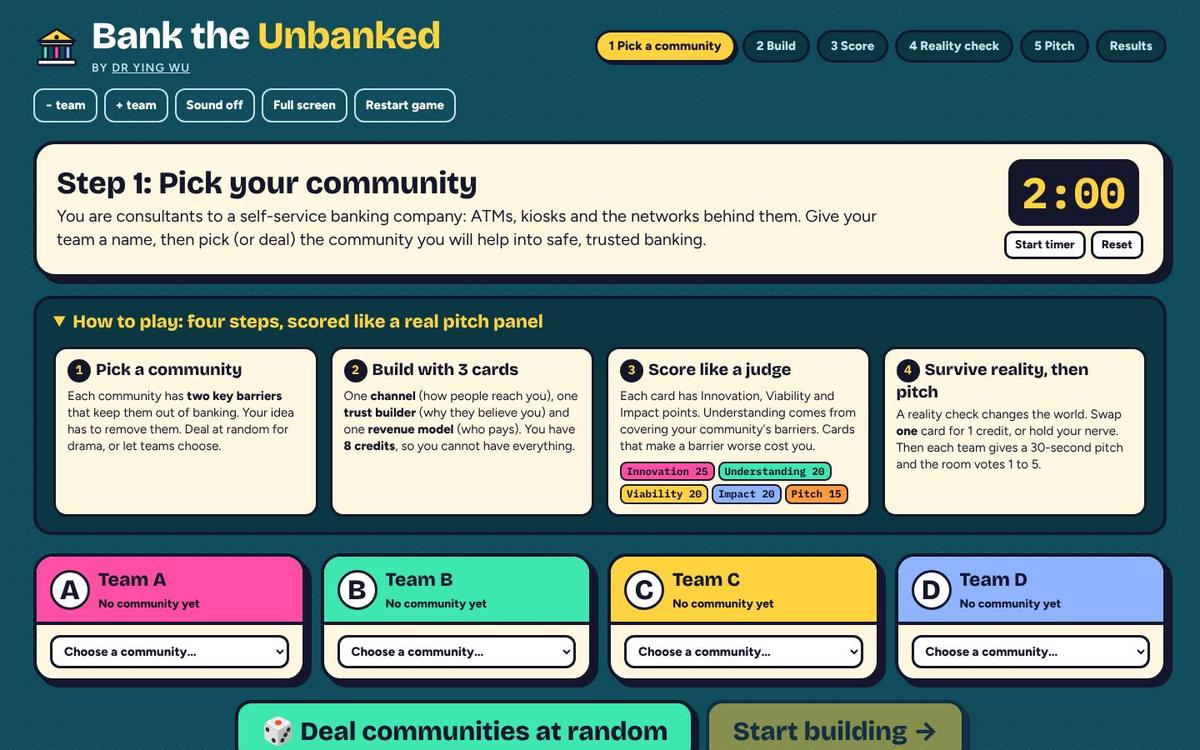
Step 1. The "− team" and "+ team" buttons appear only on this screen. - Click
- Press + team or − team to match your class (2 to 8). Do this first: the buttons disappear after this step.
- Optional: click "Team A" on a card header and type the team's name.
- Press 🎲 Deal communities at random (press again to re-deal), or choose from each team's menu.
- Read each community and its two key barriers aloud.
- Press Start building →. It stays grey until every team has a community.
- Watch for
- Adding a team after dealing leaves the new team without a community. Deal again or choose one.
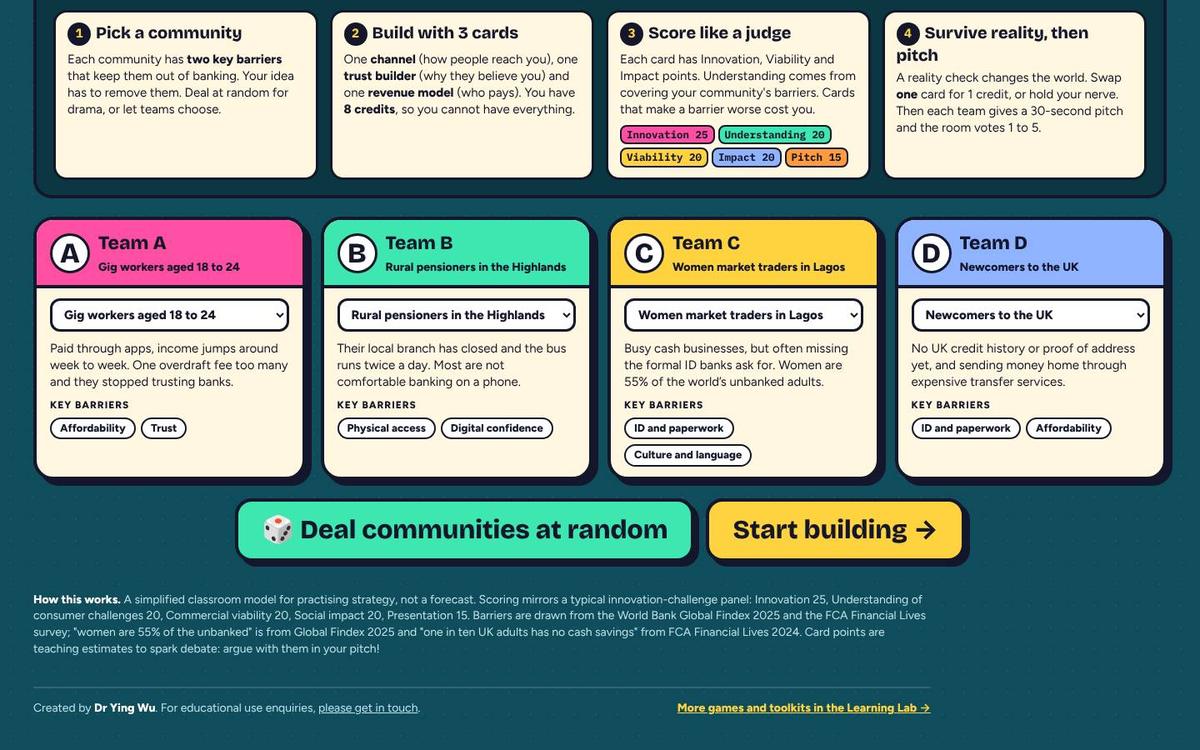
After dealing: each team's community and its two key barriers. 2 Build: three cards, 8 credits
4 to 5 min · timer 4:00- Click
- Press Start timer.
- Scroll down to show the card market while teams decide.
- As each runner reports, set the team's Channel, Trust builder and Revenue model menus. Each option starts with its cost.
- Check "Credits x/8" on each card. Barrier chips turn green with ✓ when removed and red with ✗ when made worse.
- Say
- "Green ticks remove barriers, red crosses make them worse. And who pays is a fifth of your marks."
- Watch for
- Options marked "(over budget)" are greyed out. Change another card to a cheaper one first.
- Make sure every team has all three cards before moving on. A missing card halves viability, and you cannot return to this step.
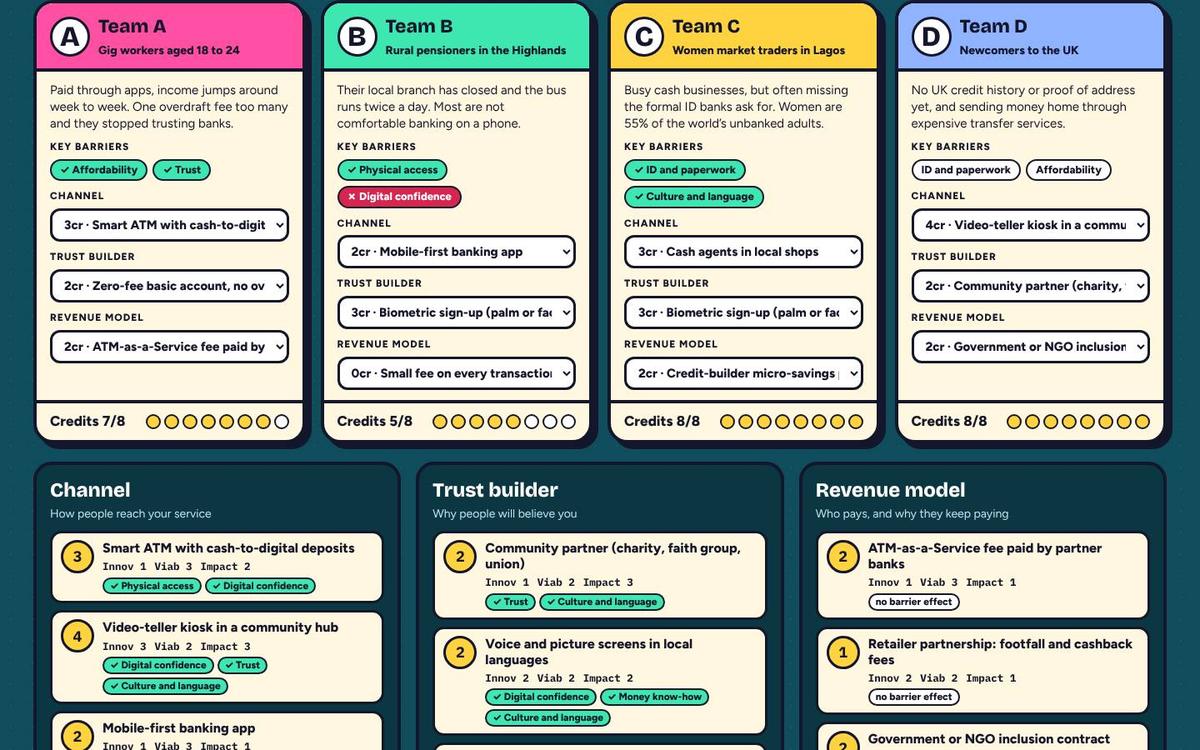
Picks entered. A red chip warns that a card makes a key barrier worse. 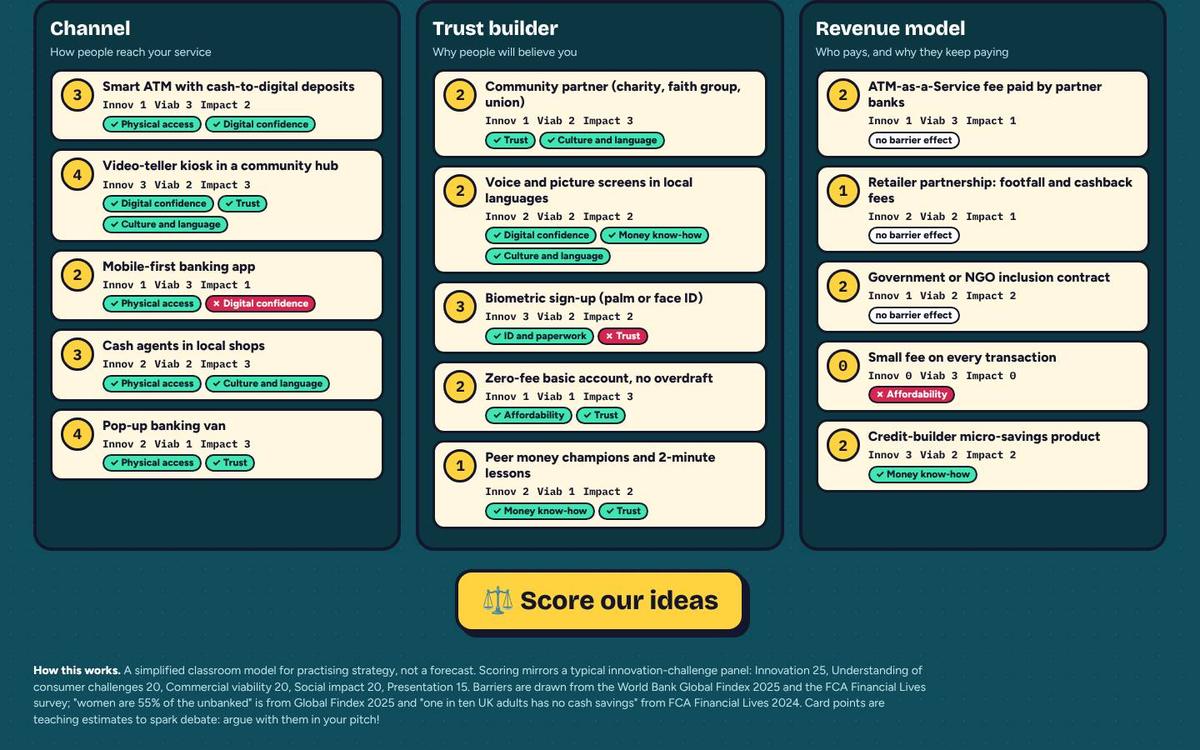
The card market sits below the team cards. 3 Score: the judges' first look
1 min- Click
- Press ⚖️ Score our ideas. If it reads "Score now (some plans are incomplete)", stop and fill the gaps first.
- Screen
- Ranked bars: pink Innovation, green Understanding, yellow Viability, blue Impact, out of 85, with "✓ solves", "✗ ignores" and "⚠ makes … worse" lines and a yellow lesson banner.
- Say
- Read the banner, then point at one "makes … worse" line: "A judge spots that in seconds."
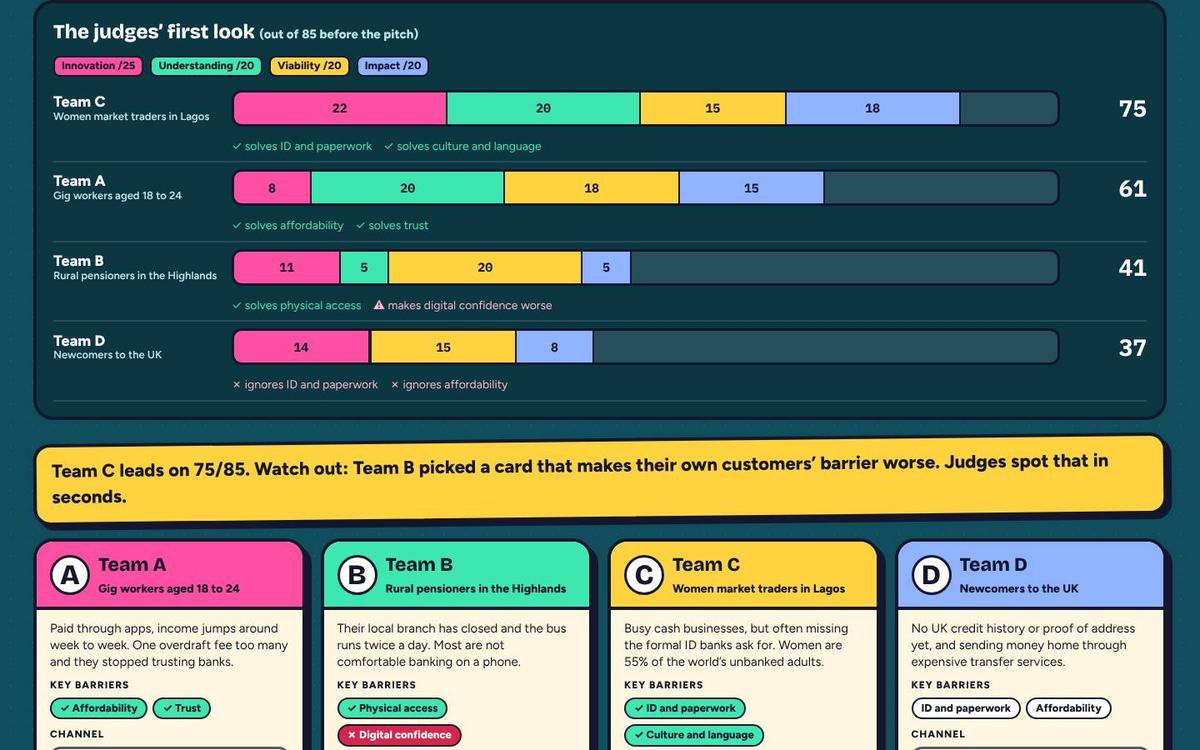
The first score, out of 85. 4 Reality check: draw, swap one card, re-score
3 min · timer 2:00- Click
- Press Bring on reality →, then 🎲 Draw a reality check. You can draw only once.
- Read the event and the black line that says exactly what changed. New barriers appear with a dashed pink outline; affected market cards are outlined in pink.
- Press Start timer.
- For each team that swaps, change one menu. It turns pink, costs 1 credit, and the other two menus lock. Undo restores the plan.
- Press ⚖️ Re-score after the twist. Arrows show each change.
- Say
- "The world just changed. Swap one card for 1 credit, or hold your nerve. Robust ideas bend; fragile ones break."
- Watch for
- A team at 8/8 can only swap to a card that costs at least 1 credit less.
- Changing a card after re-scoring brings the re-score button back. Press it again.
- "On to the pitches →" only appears after re-scoring.
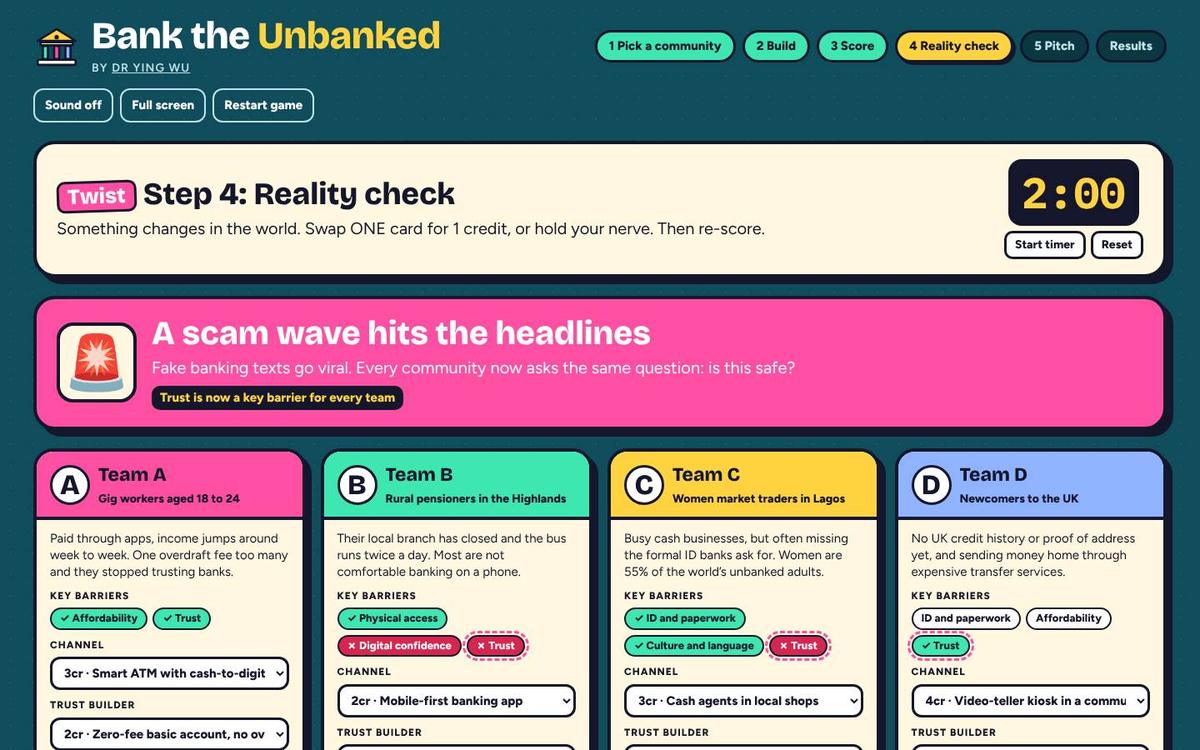
The drawn event and its effect. 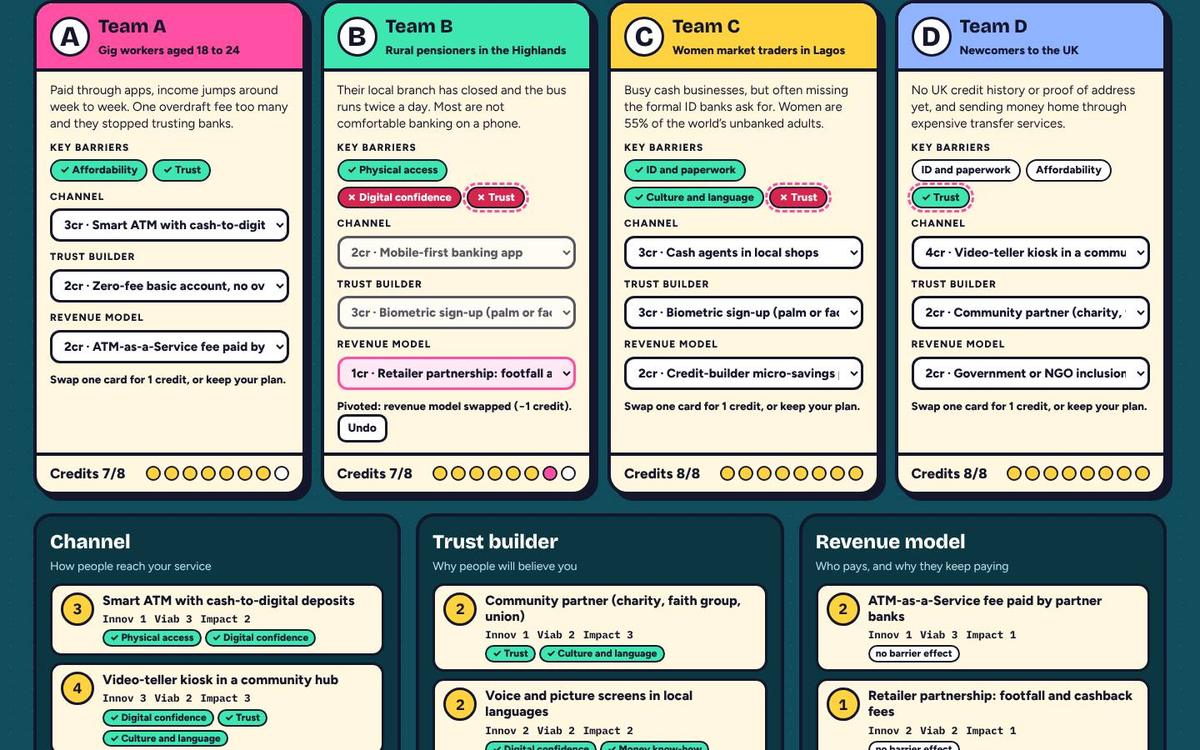
Team B has swapped its revenue model: pink menu, Undo button, pink fee coin. 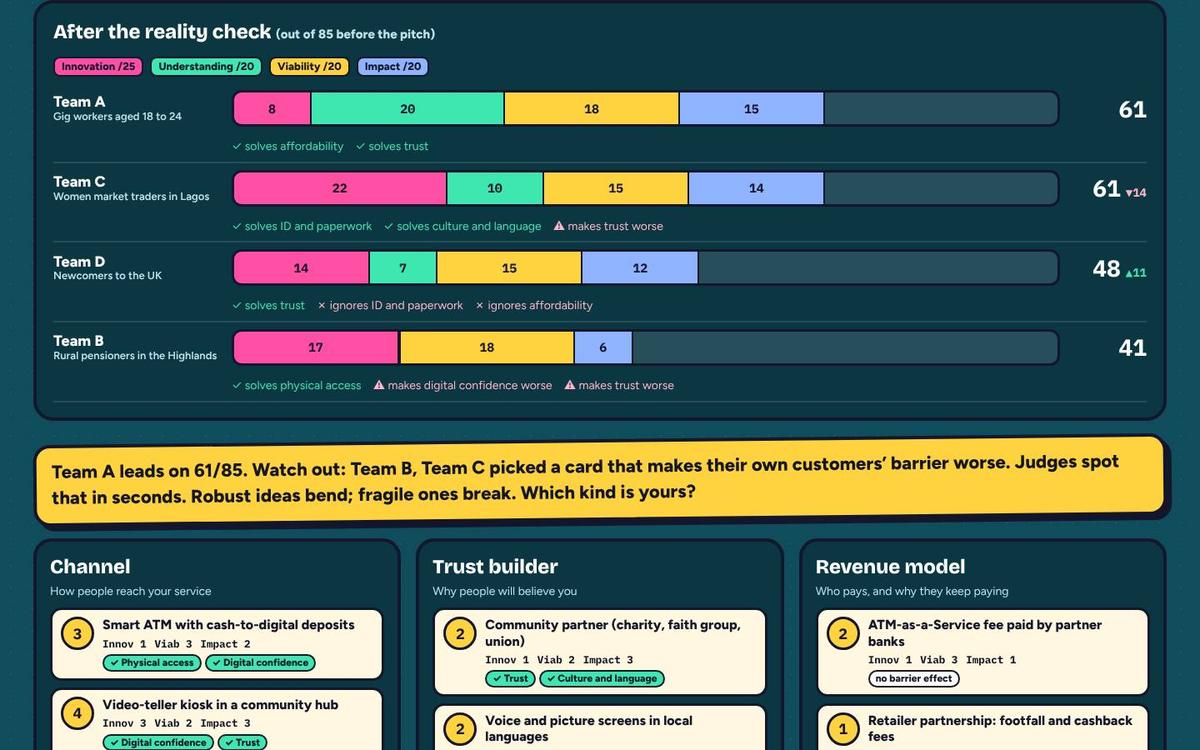
After re-scoring: one plan breaks, another gets stronger. 5 30-second pitches and the room vote
3 min for 4 teams- Click
- Press On to the pitches →.
- For each team: Start 30s pitch (press Stop if they finish early).
- Take the vote and tap that number from 1 to 5. Tap it again to clear.
- Say
- "Thirty seconds: who it is for, which barrier you remove, who pays." Then: "On three, show me 1 to 5 fingers. Not for your own team. One, two, three."
- Watch for
- The game takes one number, not an average: tap the most common. Every team needs a vote, or its pitch score is 0.
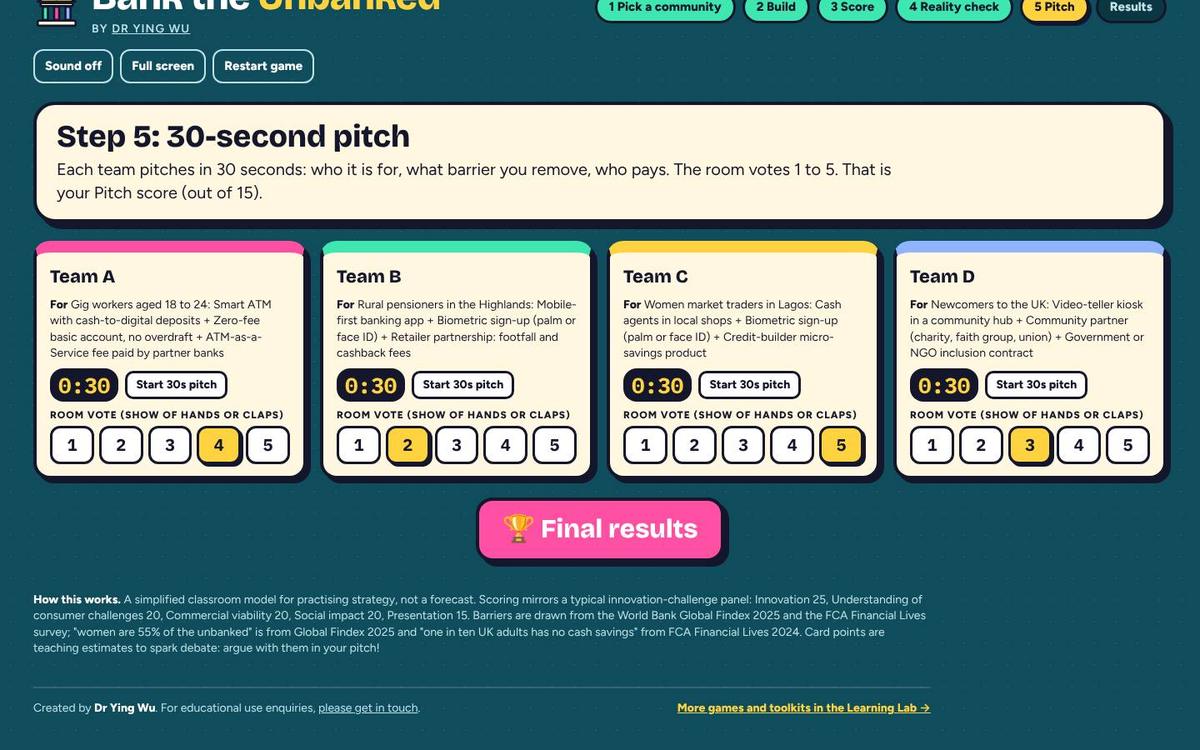
Pitch cards with votes entered. 6 Final results and debrief
2 min- Click
- Press 🏆 Final results for the podium out of 100, the score breakdown and five debrief questions.
- Say
- Pick one or two: "Which barrier does your idea really remove, and what one number would prove it?" "Who pays, and why would they still be paying in year three?"
- Then
- Leave the results on screen while teams photograph them. Restart only after the lesson.
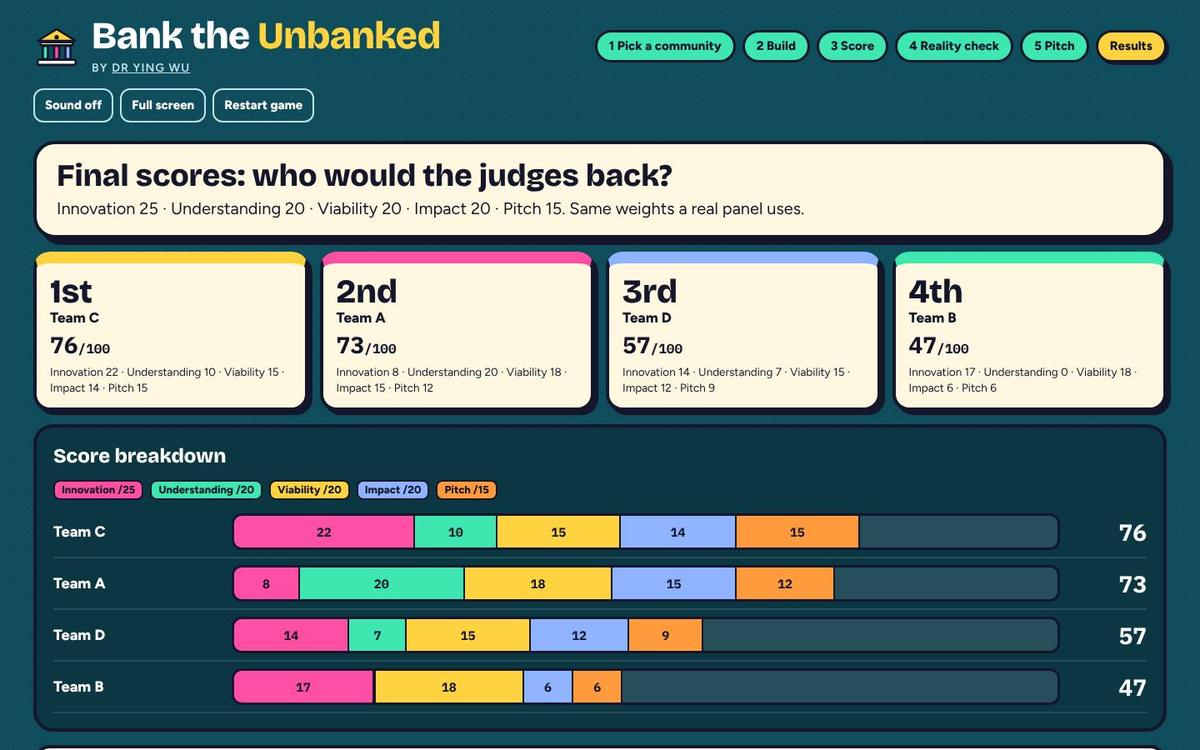
The final podium. 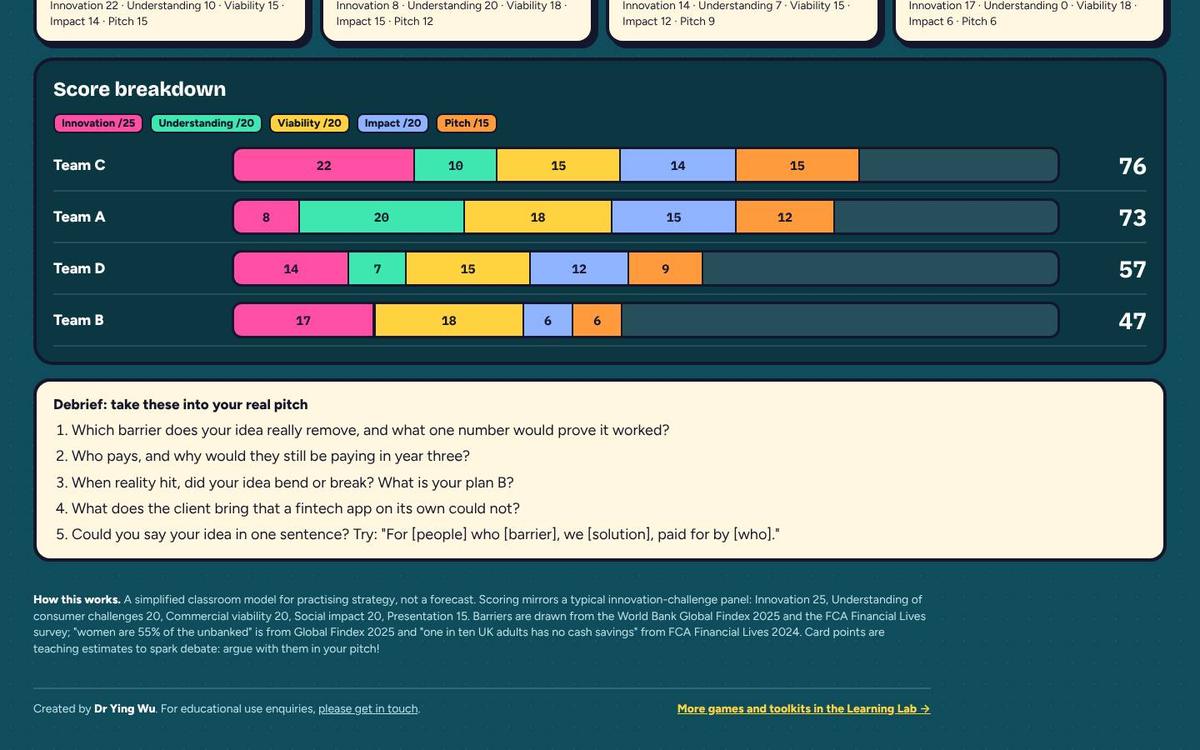
The five debrief questions.
Timing for larger classes
| Teams | Build timer | Pitches | Whole game | Tips |
|---|---|---|---|---|
| 2 to 4 | 4:00 | about 3 min | about 14 min | Run as above. |
| 5 to 6 | 3:30 | about 4.5 min | about 15 min | Skip renaming teams; vote quickly. |
| 7 to 8 | 3:00 | about 6 min | about 16 min | 20-second pitches: press Stop at 0:10. |
If something goes wrong
| Problem | What to do |
|---|---|
| "Start building" is grey | Every team needs a community. |
| A card says "(over budget)" | Change one of the team's other cards to a cheaper one first. |
| You pressed a big button too early | There is no way back. Carry on and use it: "An incomplete plan has its viability halved, just as a real panel would mark it." Restart only if the result makes no sense. |
| A team wants two swaps | The game allows one. Press Undo and let them choose a single swap. |
| You need another team mid-game | Team buttons only work in step 1. Merge the late arrivals into an existing team. |
| The page reloaded | Everything is cleared. Reopen, set up again and re-enter cards from the teams' paper notes. |
| No Wi-Fi | If the page was already open, carry on. Otherwise run it on paper with the card market table and the scoring rules above. |
| No sound | The top-right button should read "🔊 Sound is on". Turn it off and on again to hear a test knock. Then check the computer's volume and output device (room speakers, not a headset or HDMI). |
Cheat card: the button order
- Full screen
- + team / − team (now or never)
- 🎲 Deal communities at random
- Start building →
- Start timer (4:00), show the market, enter three cards per team, check credits
- ⚖️ Score our ideas
- Bring on reality → then 🎲 Draw a reality check (once)
- Start timer (2:00), one swap per team
- ⚖️ Re-score after the twist
- On to the pitches →, then for each team: Start 30s pitch and vote 1 to 5
- 🏆 Final results and debrief
Data behind the game
- Financial Conduct Authority (2025) Financial Lives 2024 survey. London: FCA. fca.org.uk
- World Bank (2025) The Global Findex Database 2025: connectivity and financial inclusion in the digital economy. Washington, DC: World Bank. worldbank.org
- Strategy and innovation tools are referenced in full in the Strategy Toolkit.
A simplified classroom model for practising strategy, not a forecast. NCR Atleos and Brink's are named in one reality check for educational discussion only; the game is independent and not endorsed by either company.