What students learn
1. Pick the platform
Search ads capture demand that already exists; social, video and marketplace ads reach people in other moments. Six scenarios match goals to Google Ads, Microsoft Advertising, Meta, LinkedIn, Amazon and YouTube.
2. Keywords and negatives
Since 2021 Google matches broad, phrase and exact keywords on meaning rather than exact wording. Students decide which match types a search could trigger, then clean up a search terms report with negative keywords.
3. Quality beats money
In a five-advertiser auction, Ad Rank is bid × Quality Score (simplified). Students spend three tokens on Quality Score components and see that a better ad ranks higher and pays less per click.
4. Read the report
Students calculate CTR, average CPC, conversion rate, CPA and ROAS from a month of results, then use break-even ROAS and impression share lost to budget or rank to decide where money should go.
Good for search marketing, digital marketing and marketing analytics classes at undergraduate, postgraduate or MBA level. The shop, its rivals and all figures are fictional; platform features are described as at October 2026.
Three PPC games, three jobs
Bid & Rank (this one)
The whole PPC lecture in one sitting: platforms, keywords, the auction and metrics. Self-paced, 20 to 40 minutes. Best straight after the lecture or as homework.
Ad Auction Live
15 to 25 minutes, four teams on one screen, nothing but the auction. Best as a live opener before you explain Ad Rank.
Match Point
20 to 35 minutes on keywords only: match types, the search terms report, negatives, ad and landing page. Best for a seminar that goes deeper on keyword strategy.
Running all three
Ad Auction Live to open the lecture, Bid & Rank to close it, Match Point in the follow-up seminar. Each game stands alone, so any one works on its own.
Short of time in the lecture itself? Hungry for Clicks is a 15–25 minute team game on a whole campaign: keywords, CPC vs CPM vs CPV, smart bidding and a chaos card.
Five golden rules
- A reload starts again.Progress lives only in the open page. Nothing is saved part-way through, so ask students to keep the tab open.
- Answers lock when clicked.In every round, the explanation appears straight after an answer and the points are banked. That is deliberate: the explanation is where the learning happens.
- Only the locked auction counts.Round 3 allows up to three auction runs. Students choose which result to lock in, so they can experiment before committing.
- Rounding is forgiven.Round 4 accepts small rounding differences, and ROAS can be typed as a ratio (2.5) or a percentage (250).
- Nothing leaves the device.The optional team name stays on screen. There are no accounts, and no answers are sent anywhere.
The four rounds
| Round | Task | Concepts | Points |
|---|---|---|---|
| 1 | Six scenarios: pick the best platform for each goal | Demand capture vs demand generation; platform targeting | 30 (5 each) |
| 2a | Four searches: which match types of trail running shoes could show an ad? | Broad, "phrase" and [exact] match on meaning | 12 (1 per box) |
| 2b | Eight search terms: keep or add as a negative | Search terms report, search intent, negative keywords | 16 (2 each) |
| 3 | Set a bid, spend three Quality Score tokens, run the auction up to three times, lock one result | Ad Rank, Quality Score components, actual CPC, position | Up to 18 |
| 4 | Five metrics for one campaign, then two budget decisions | CTR, CPC, conversion rate, CPA, ROAS, break-even ROAS, impression share | 24 (15 + 5 + 4) |
Bands on the debrief screen: Account Lead (85+), Senior PPC Executive (70+), PPC Executive (50+), Trainee (below 50). Badges: Paid search pro for finishing, Account lead for 85 or more.
How the Round 3 auction works
Ad Rank
Ad Rank = max CPC bid × Quality Score. The highest Ad Rank takes position 1. Positions 1 to 3 show at the top of the page, 4 and 5 at the bottom.
What you pay
Actual CPC = (Ad Rank of the advertiser below you ÷ your Quality Score) + £0.01, never more than your bid. The last advertiser pays a £0.10 reserve.
Quality Score
A base of 1, plus points for each component: below average 0, average 2, above average 3. Students start at expected CTR average, ad relevance and landing page below average: a Quality Score of 3.
Tokens
Each token lifts one component by one level. Any spread that brings every component up to at least average gives a Quality Score of 8; leaving one component below average caps it at 7. Fix the weakest part first.
| Advertiser | Max CPC | Quality Score | Ad Rank |
|---|---|---|---|
| Shop B | £1.50 | 7 | 10.50 |
| Shop C | £2.40 | 4 | 9.60 |
| Shop D | £3.00 | 3 | 9.00 |
| Shop E | £1.10 | 8 | 8.80 |
| Shop A (students), starting point | Their choice | 3 | Bid × 3 |
The best possible result is 18 points, reached two ways (checked by testing every bid and token combination): position 1 at £1.32 a click (Quality Score 8, bid £1.35 or more) or position 2 at £1.21 (Quality Score 8, a bid of £1.25 or £1.30). The common mistake is to bid the maximum £3.00 without improving quality: Quality Score 3, Ad Rank 9.00, position 4 at £2.94 a click, 5 points.
This is a simplified teaching model. Google’s real Ad Rank also uses the auction-time quality of the ad, the search context, ad assets and thresholds, and Quality Score is a diagnostic shown in the account rather than a direct input. The simplification keeps the main lesson intact: better ads rank higher and cost less.
Every answer
Collapsed so students looking over your shoulder don’t see them. Open before the debrief.
Round 1: platforms
| # | Goal | Best fit | Why |
|---|---|---|---|
| 1 | Catch runners ready to buy today | Google Ads | Search captures existing, high-intent demand; Google handles most UK searches. |
| 2 | Reach searchers beyond Google, often cheaper | Microsoft Advertising | Bing and partner sites; desktop-heavy audience; imports Google Ads campaigns. |
| 3 | Build interest in a new women’s trail club | Meta Ads | Demand generation: nobody searches for a club that does not exist yet. |
| 4 | Sell lunchtime workshops to employers | LinkedIn Ads | Job title, function, seniority and company size targeting for a B2B sale. |
| 5 | Win sales of own-brand socks on a marketplace | Amazon Ads | Sponsored Products appear inside Amazon’s own search results. |
| 6 | Show what a gait analysis involves, on video | YouTube | Video campaigns are bought in Google Ads, targeted by topic and audience. |
Round 2a: match types for trail running shoes
| Search | Broad | "Phrase" | [Exact] | Why |
|---|---|---|---|---|
| shoes for trail running | ✓ | ✓ | ✓ | Same meaning; exact match covers reordering and small function words. |
| waterproof trail running shoes for women | ✓ | ✓ | ✗ | Includes the keyword’s meaning plus detail; narrower than the keyword, so not exact. |
| running shoes | ✓ | ✗ | ✗ | Broader than the keyword (drops “trail”), so only broad match. |
| hiking boots | ✓ | ✗ | ✗ | Related search: broad match can reach it, which is why negatives and Smart Bidding matter. |
Round 2b: search terms report
| Search term | Decision | Why |
|---|---|---|
| trail running shoes sale | Keep | Commercial intent; 2 conversions. |
| free trail running shoes | Negative | Freebie seekers: add “free”. |
| running shop jobs dundee | Negative | Job seekers: add “jobs”. |
| how to clean trail running shoes | Negative | Informational: a blog post (SEO) serves it better. |
| gait analysis dundee | Keep | The shop’s own service; best conversion rate. |
| trail running shoes second hand | Negative | The shop sells new stock only. |
| womens trail shoes wide fit | Keep | Specific product need; converted. |
| parkrun dundee results | Negative | Running-related, but people want race times. |
Round 4: Generic · Trail shoes metrics
| Metric | Working | Answer |
|---|---|---|
| CTR | 480 ÷ 12,000 | 4.0% |
| Average CPC | £576 ÷ 480 | £1.20 |
| Conversion rate | 12 ÷ 480 | 2.5% |
| CPA | £576 ÷ 12 | £48.00 |
| ROAS | £1,440 ÷ £576 | 2.5× (250%) |
Round 4: budget decisions
| Question | Answer | Why |
|---|---|---|
| The client adds £20 a day. Which campaign? | Gait analysis bookings (5 pts) | Loses 45% of impression share to budget, so more money buys more appearances; ROAS 2.86 against a break-even of 1.25 (80% margin). Brand already shows 96% of the time; Generic sits at break-even. |
| Generic loses 49% to rank. Best first fix? | Improve Quality Score and review bids (4 pts) | Lost to rank means the ads ranked too low, so budget will not help. Better relevance, landing pages and expected CTR raise Ad Rank and cut CPC. |
The negatives in Round 2b block £78 a week of spend that earned nothing, about £4,000 a year. That figure lands well in the debrief.
Before the lesson
- Share lab.yingwu.co.uk/bid-and-rank/ as a link or QR code on your last lecture slide.
- Play it once yourself. It takes 15 to 25 minutes when you know the answers.
- Decide whether students play alone or in pairs. Pairs talk through the auction, which is where most of the learning happens.
- Pick where results go: the class chat, a discussion board or a padlet. The debrief screen’s “Copy result” button writes a one-line score.
- Open the answer key above, ready for the debrief.
How long will it take?
Every time in this guide is a range. The low end is a tight run; the top end is what most classes take once students discuss, decide and react to the results.
In class: 25 to 40 minutesSolo or in pairs: 20 to 40 minutes
What moves you up or down the range
- How strictly you keep time. Calling time on each round keeps you near the low end; letting everyone finish every round at their own pace moves you to the top.
- Solo or pairs. Pairs talk through the auction, which is where most of the learning happens, but they take longer than students playing alone.
- Reading every explanation. Students who read every explanation, even when they are right, take longer and learn more.
- Getting started. Sharing the link or QR code, phones joining or loading, and reading the client brief all take a few minutes.
- Interaction in between. Questions, students comparing scores, replaying the auction to lock a better result, or a tech hiccup.
- The debrief. One question, or a full discussion of what the game showed.
- Your group. Familiarity with the topic, reading in a second language, and the room layout.
Short on time? Call time on each round, ask students to play in pairs, and take one debrief question. Want the richest discussion? Plan for the top of the range.
Step by step
25 to 40 minutes, with students on their own laptops or phones.
0 Set it up
2 to 4 min- Say
- “You have just taken over the Google Ads account for a running shop in Dundee. Four rounds, 100 points. Read every explanation, even when you are right.”
- Students
- Open the game, type a player or team name if they like, and read the client brief: 40% margin on shoes, £50 a day budget.
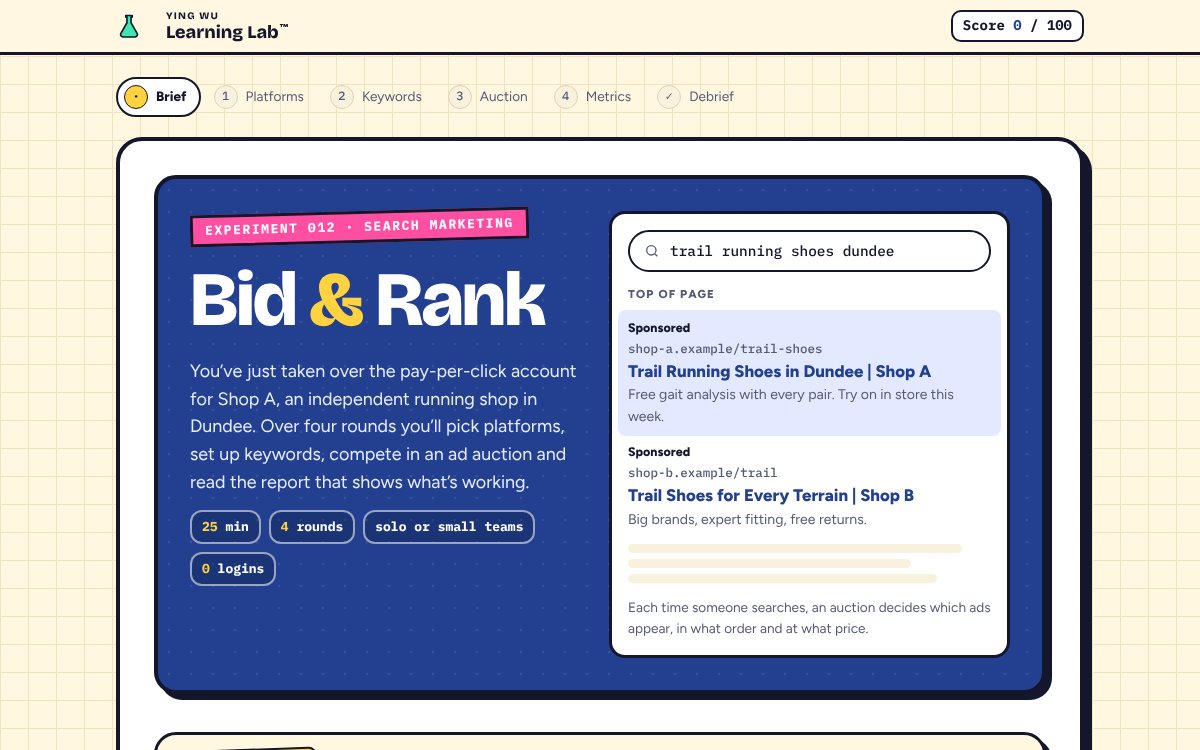
The start screen: the client brief and the four rounds. 1 Platforms and keywords
8 to 12 min- Students
- Round 1: pick a platform for each of six goals.
- Round 2a: for each search, tick every match type that could show the ad.
- Round 2b: mark each search term Keep or Negative, then submit.
- Watch for
- Students ticking only exact match for close variants such as “shoes for trail running”. The explanation covers it.
- Students keeping “how to clean trail running shoes” because it contains the keyword. Ask: will this person buy today?
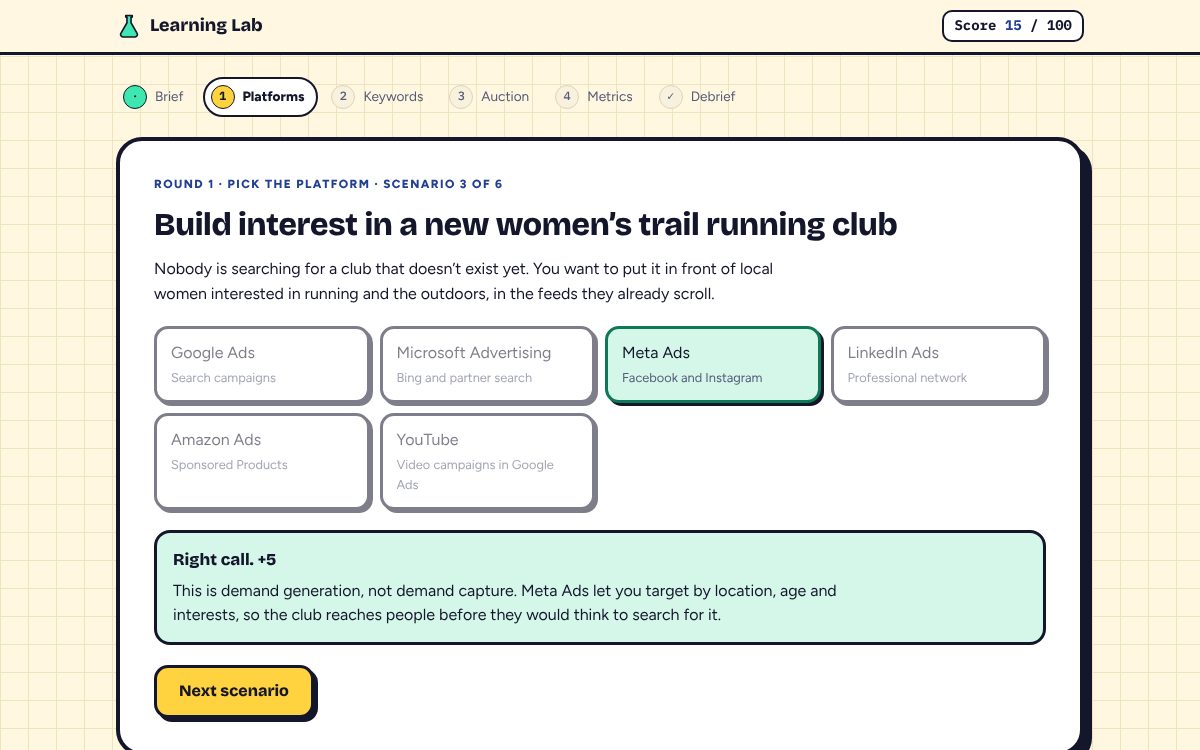
Round 1: each answer comes with the reason. 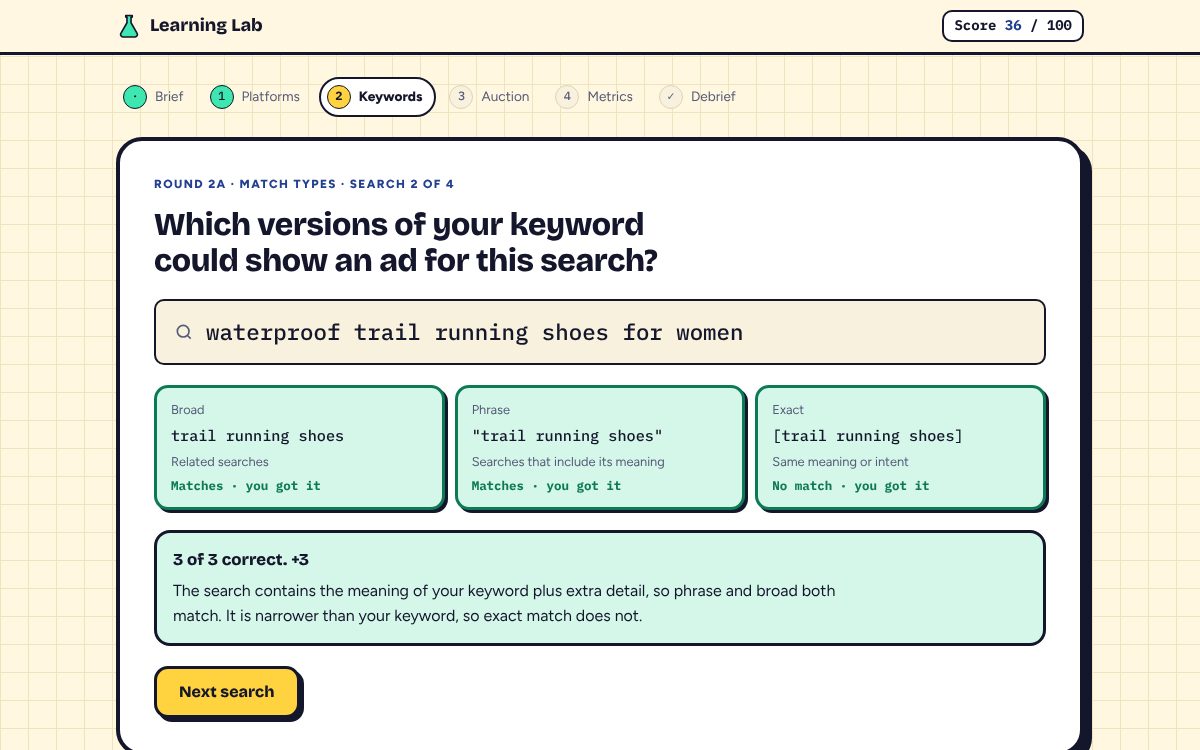
Round 2a: which match types could trigger the ad? 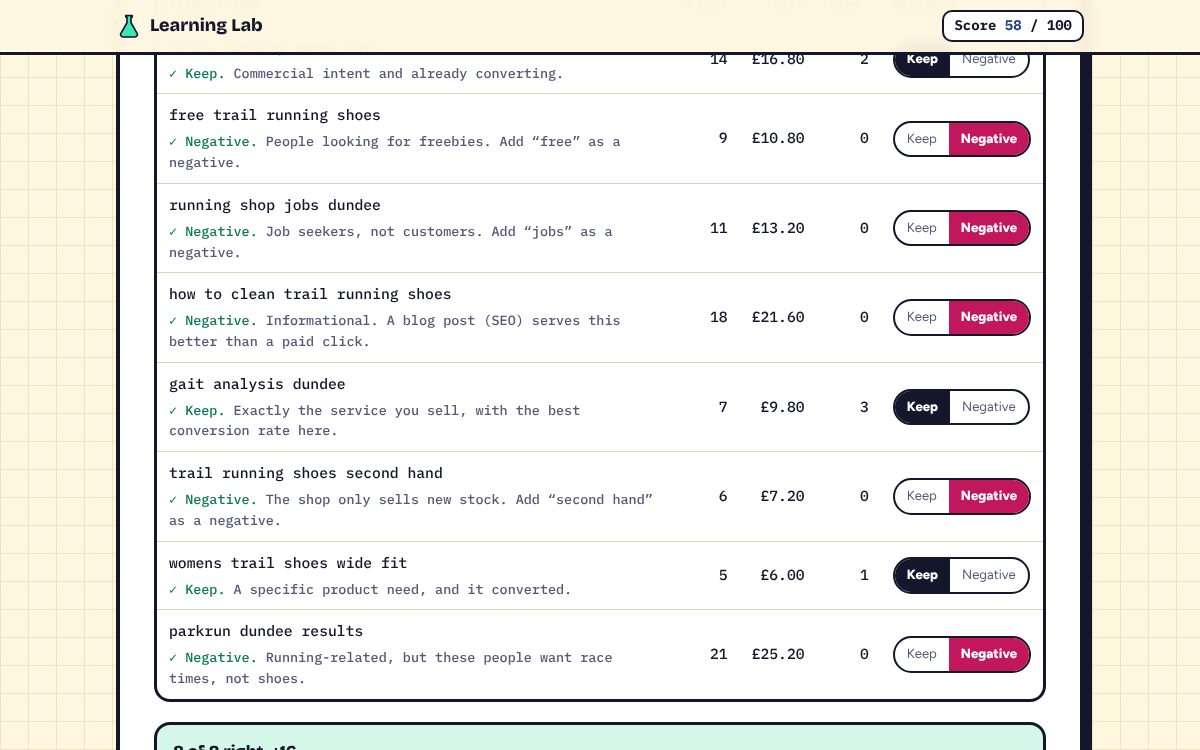
Round 2b: the negatives block £78 a week of wasted spend. 2 The auction
6 to 9 min- Students
- Try a bid, run the auction, read the table, spend tokens on Quality Score, run again, then lock the best result.
- Say
- “Shop D bids the most. Why are they fourth?”
- Watch for
- Students who raise the bid to £3.00 before touching Quality Score. Let them see position 4 at £2.94, then ask what they would change.
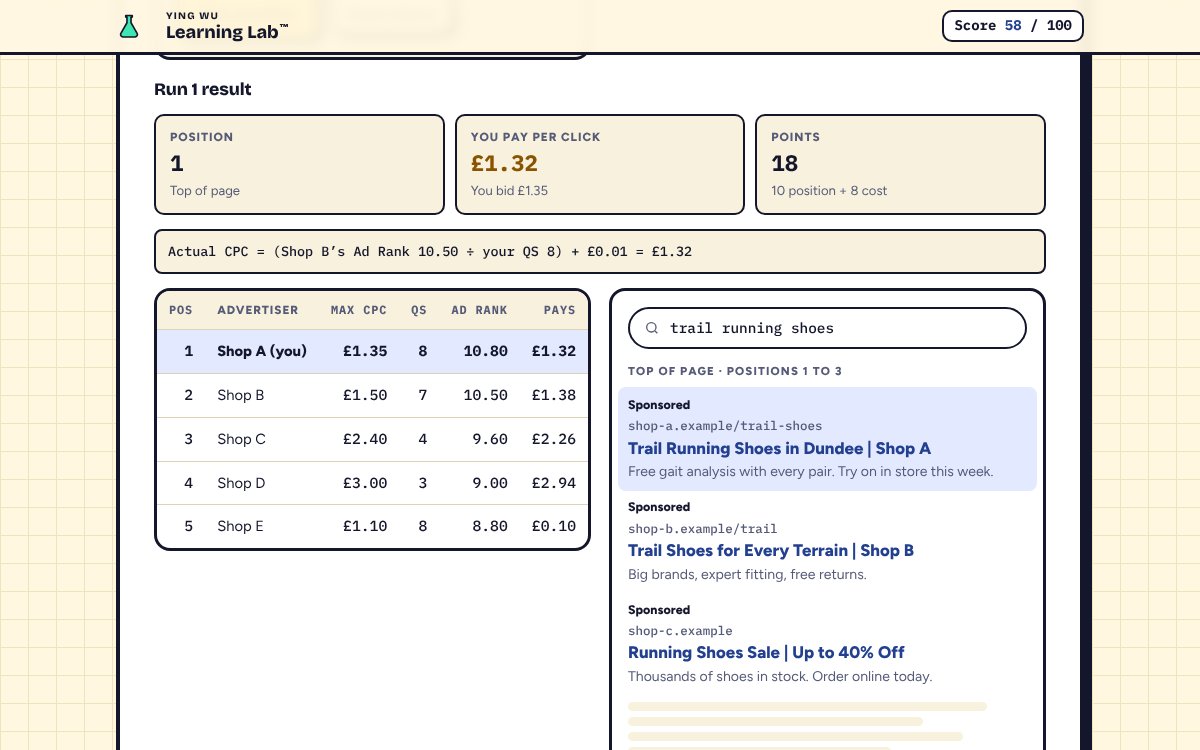
Round 3: the price depends on the advertiser below and on your Quality Score. 3 The report
5 to 10 min- Students
- Calculate the five metrics for the Generic campaign, then answer the two budget questions.
- Watch for
- Confusion between conversion rate (per click) and CTR (per impression). Point at the column headings.
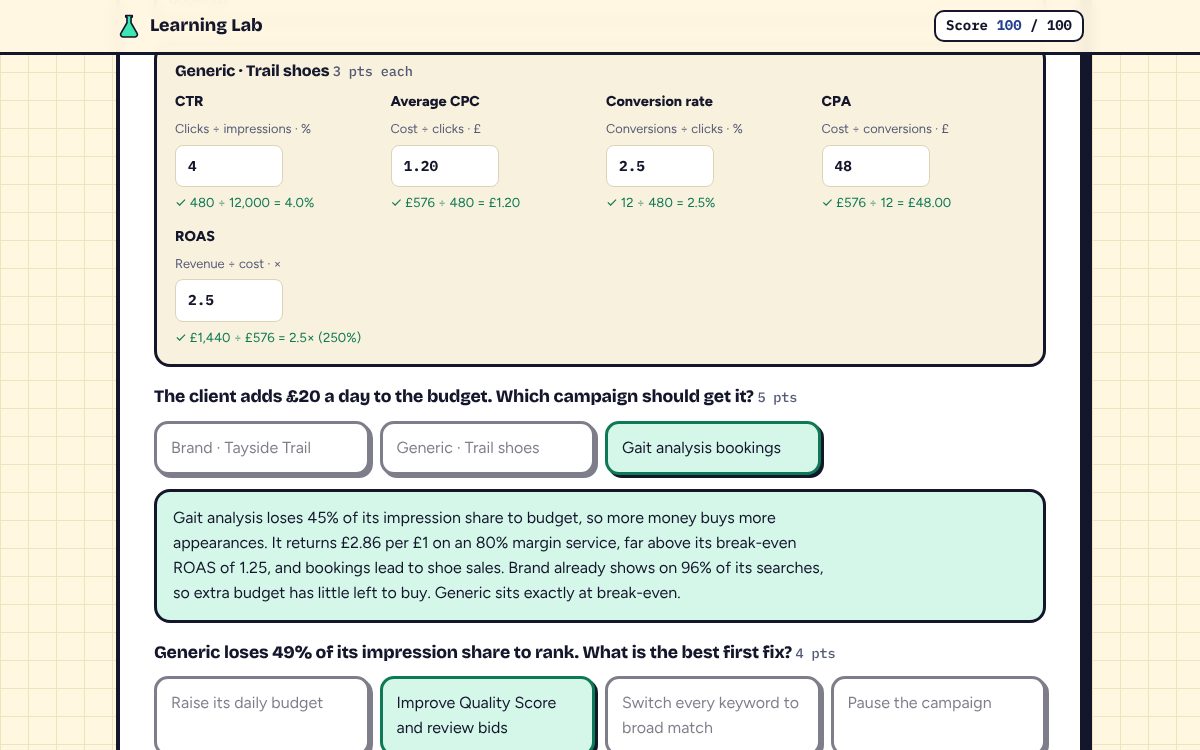
Round 4: every answer shows its working. 4 Debrief
5 to 10 min- Students
- See their band and per-round score, copy the result to the class chat.
- Ask
- “Brand ROAS was 29×. Should the shop bid on its own name at all? What if a rival did?”
- “Google now matches exact keywords on meaning. Who gains more from that, the advertiser or the platform?”
- “Would you pay 11p more per click for position 1 over position 2? What data would you want first?”
- “Which of today’s decisions would you hand to automated bidding, and which would you keep?”
- Takeaway
- Relevance and quality decide both where an ad shows and what each click costs.
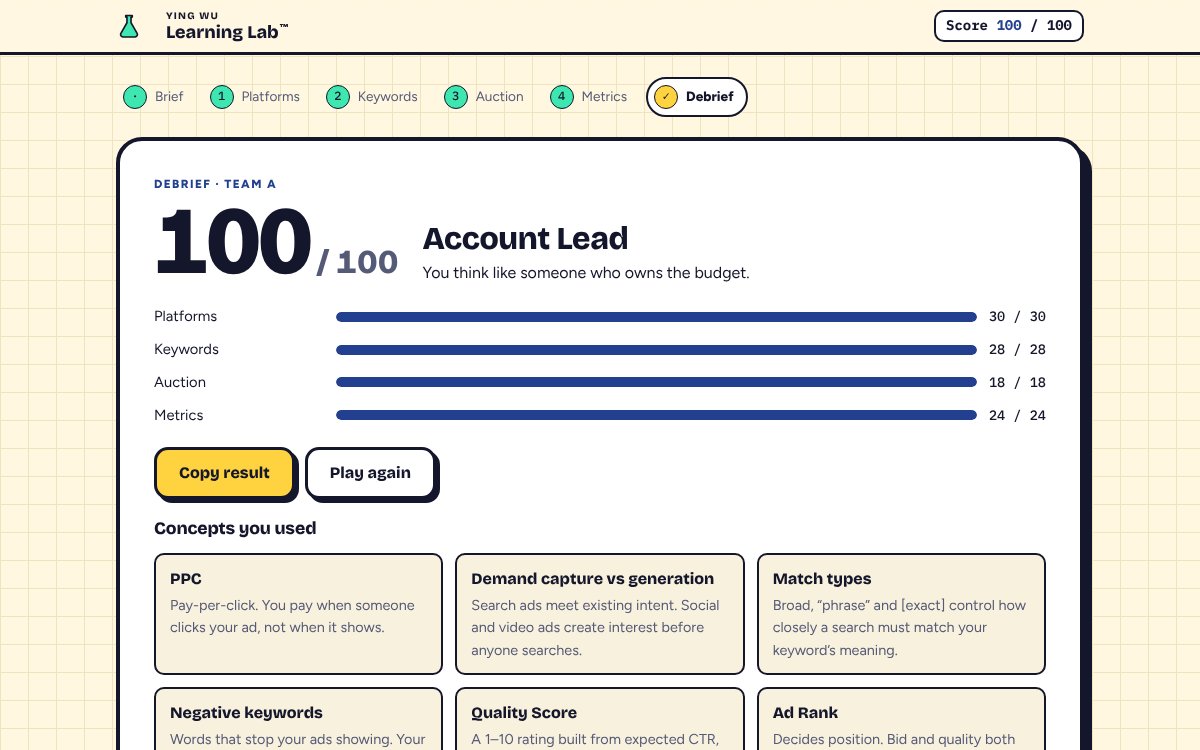
The debrief: score, band, per-round bars and a copyable result.
If something goes wrong
| Problem | What to do |
|---|---|
| A student reloaded the page | The game starts again from the beginning. Each round is short, so replaying is quick, and the second run is usually better. |
| "Copy result" does not copy | Some browsers block the clipboard. The text appears on screen instead: select it and copy by hand. |
| No devices | Put the game on the projector and play it as a whole class: read each item aloud, take a vote by show of hands, then click the room’s answer. |
| No Wi-Fi | Once the page has loaded it runs without a connection. Otherwise, use the answer key on this page as a paper activity. |
| Students finish in ten minutes | Send them to Match Point for keywords in more depth, or ask them to find the two ways to score 18 in Round 3. |
| A student disputes a match type answer | Good. Google’s matching changes often and the boundaries are fuzzy. Ask them to argue from intent, then check Google Ads Help together. |
Cheat card
- Share the link or QR code
- “Read every explanation, even when you are right.”
- Rounds 1 and 2: 8 to 12 minutes
- Auction: “Why is the biggest bidder fourth?”
- Report: CTR per impression, conversion rate per click
- Debrief: brand bidding, automation, is position 1 worth it?
Behind the game
- Google Ads Help (2026) About keyword matching options; About Quality Score; About Ad Rank; Actual cost-per-click (CPC); About impression share. support.google.com/google-ads
- Microsoft Advertising Help (2026) Import campaigns from Google Ads. help.ads.microsoft.com
- LinkedIn Marketing Solutions (2026) Ad targeting; Meta Business Help Centre (2026) About ad targeting; Amazon Ads (2026) Sponsored Products.
- Chaffey, D. and Ellis-Chadwick, F. (2022) Digital marketing: strategy, implementation and practice. 8th edn. Harlow: Pearson.
Shop A, its rivals and every figure are fictional. Platform features are described as at October 2026 and change often.