What students learn
1. Eight lenses
Every application is checked against the same eight lenses: informed consent, vulnerable participants, power and coercion, data protection, anonymity, risk to participants, researcher safety, and deception and debrief.
2. Proportion
Ticking every box costs points. One application is low risk and should simply be approved. Good committees enable research rather than block it.
3. The right route
Some studies need more than a university committee. Research with adults who may lack capacity in Scotland goes to a specially designated NHS committee under the Adults with Incapacity (Scotland) Act 2000.
4. Write a better application
Every issue comes with the change a committee would ask for, so students leave with a checklist for their own ethics form.
The applications come from social work, computing, psychology, politics, education and architecture, so every student meets a project close to their own and several far from it. All applications are fictional. Legal references reflect UK and Scottish practice as at October 2026, as a teaching summary rather than legal advice.
Pick a format
Before an ethics application
Ask students to play it in the week before they draft their own ethics form, then bring the issue they are least sure about to supervision.
Workshop in small groups
Groups of three act as a committee and must agree their flags before submitting. The disagreements are the best material. This is the plan below.
Doctoral training
For PGR induction or research methods training, run it alongside The Viva Room: both rehearse a panel judging your research.
One screen
No devices? Project it, read each application aloud and take a vote on each lens by show of hands.
Scoring rules
- +2 for each real issue flagged.Each application has between none and three significant issues.
- −1 for each flag on a non-issue.This stops students ticking everything. An application’s flag score never drops below zero.
- Judgement calls cost nothing.Some lenses are arguable for some applications (for example consent for 50,000 public posts). Flagging them earns and loses nothing, and the letter explains why.
- +4 for the committee’s decision.Approve, approve with amendments, or reject for major resubmission.
- No back button.Once a review is submitted, the decision letter appears. Bands: Committee Chair (85%+), Experienced Member (65%+), New Member (45%+), Observer.
The six applications
Maximum score 52: 14 real issues × 2, plus 6 decisions × 4.
Every application, with the answer
Collapsed so students looking over your shoulder don’t see them. Open before the debrief.
Summary: issues and decisions
| Ref | Discipline | Study | Real issues | Decision |
|---|---|---|---|---|
| REC-031 | Social Work, MSc | Living with gambling debt | Researcher safety; risk to participants; anonymity | Approve with amendments |
| REC-037 | Computing, PhD | Dementia wandering sensors | Informed consent; vulnerable participants; data protection | Reject: major resubmission |
| REC-040 | Psychology, staff | Failure feedback and persistence | Deception and debrief; power and coercion; risk to participants | Approve with amendments |
| REC-044 | Politics, PhD | Immigration talk online | Data protection; anonymity | Approve with amendments |
| REC-052 | Education, UG | Maths apps at home (age 9 to 10) | Informed consent; vulnerable participants; anonymity | Approve with amendments |
| REC-058 | Architecture, UG | Staff views on cycling facilities | None | Approve |
Each issue and the change the committee requires
| Ref | Issue | Why | Required change |
|---|---|---|---|
| REC-031 | Researcher safety | Lone evening home visits; nobody holds the schedule. | Lone-working protocol: named contact, check-in and check-out calls, option of a neutral venue. |
| REC-031 | Risk to participants | Gambling debt can cause shame and distress; no plan if someone is upset. | Distress protocol and signposting to debt advice and gambling support. |
| REC-031 | Anonymity | Full names in audio file names. | Participant codes, with the key held separately and securely. |
| REC-037 | Informed consent | A relative’s email is not valid consent; capacity is not assessed. | Capacity assessment, a lawful route for decisions on behalf of adults who lack capacity, assent for every participant. |
| REC-037 | Vulnerable participants | Adults who may lack capacity: in Scotland the Adults with Incapacity (Scotland) Act 2000 applies. | Review by the designated NHS research ethics committee, not the university committee alone. |
| REC-037 | Data protection | Special category health data streamed abroad to a free commercial service; sensors in bathrooms. | DPIA, approved UK storage, a processing agreement, no bathroom or bedroom sensors without clear justification. |
| REC-040 | Deception and debrief | False feedback with no debrief. | Full debrief explaining the deception, with the option to withdraw data. |
| REC-040 | Power and coercion | Own students, marks tied to taking part, no alternative. | Recruitment by a colleague, an equivalent alternative task, lecturer unaware of who took part. |
| REC-040 | Risk to participants | “Bottom 10%” feedback can knock first-years’ confidence. | Same-day debrief where possible, a wellbeing check and signposting to support. |
| REC-044 | Data protection | Public posts are still personal data; political opinions are special category; scraping breaks the terms; unencrypted laptop. | Permitted research access, DPIA, encrypted university storage. |
| REC-044 | Anonymity | Verbatim quotes are searchable; usernames identify people. | Remove usernames; paraphrase or combine quotes; keep only what is needed. |
| REC-052 | Informed consent | Headteacher access is not consent; pupils told it is part of the lesson. | Parent consent, child-friendly information, a clear way for pupils to say no. |
| REC-052 | Vulnerable participants | Children; no PVG Scheme membership; student alone in class. | PVG Scheme membership before visits; a teacher present. |
| REC-052 | Anonymity | Names on questionnaires. | Pupil codes, with the matching list kept separately. |
Judgement calls (no points either way)
| Ref | Lens | Why it is arguable |
|---|---|---|
| REC-037 | Risk to participants | Intrusion into private spaces is a real harm, counted under data protection here. |
| REC-044 | Informed consent | Asking 50,000 posters is not practical; often accepted for lawfully handled, de-identified public data. |
| REC-044 | Risk to participants | People posting about immigration could face abuse if identified; the fix sits under anonymity. |
| REC-058 | Anonymity | Someone could identify themselves in the free-text box: a minor point. |
The best debrief starters: REC-037 (why a relative cannot consent, and why the legal route matters), REC-044 (when public data still needs protecting) and REC-058 (why approving a clean application quickly is part of the job).
Before the workshop
- Share lab.yingwu.co.uk/ethics-board/ as a link or QR code.
- Play one application yourself, so you know the flow. A full run takes 25 to 40 minutes.
- Have your own university’s ethics form and guidance open: the strongest debrief links each issue to the section of the real form where it belongs.
- Form groups of three if running it as a committee. Each group needs one device.
- Open the answer key above, ready for the debrief.
How long will it take?
Every time in this guide is a range. The low end is a tight run; the top end is what most groups take once they discuss, decide and read the committee’s letters.
Solo: 25 to 45 minutesIn a workshop: 45 to 60 minutes
What moves you up or down the range
- How strictly you keep time. Calling time on the review keeps you near the low end; letting every group finish all six applications moves you to the top.
- Solo or a committee. Groups of three must agree their flags before submitting. Those disagreements are the best material, and they take time.
- How long players think before flagging. Quick flags, or weighing every application against all eight lenses.
- Reading every committee letter. Players who read each letter in full take longer and learn more.
- Getting started. Sharing the link, forming groups and reading the agenda all take a few minutes.
- The debrief. Two applications, or linking every issue to your own university’s ethics form.
- Your group. Research experience, reading long application forms in a second language, and the room layout.
Each step below has its own range. Few sessions reach the top of every step, so the step ranges add up to more than the session range: if one step runs long, shorten a later one to stay within your slot.
Short on time? Call time on the review, keep groups to three, and debrief REC-037 and REC-044 only. Want the richest discussion? Plan for the top of the range.
Step by step
45 to 60 minutes in small groups, one device per group.
0 Set it up
3 to 6 min- Say
- “Today you are the ethics committee. Six applications from across the university. Flag what worries you, but every flag on a non-issue costs a point. Then decide.”
- Students
- Open the game, type a group name if they like, and read the agenda.
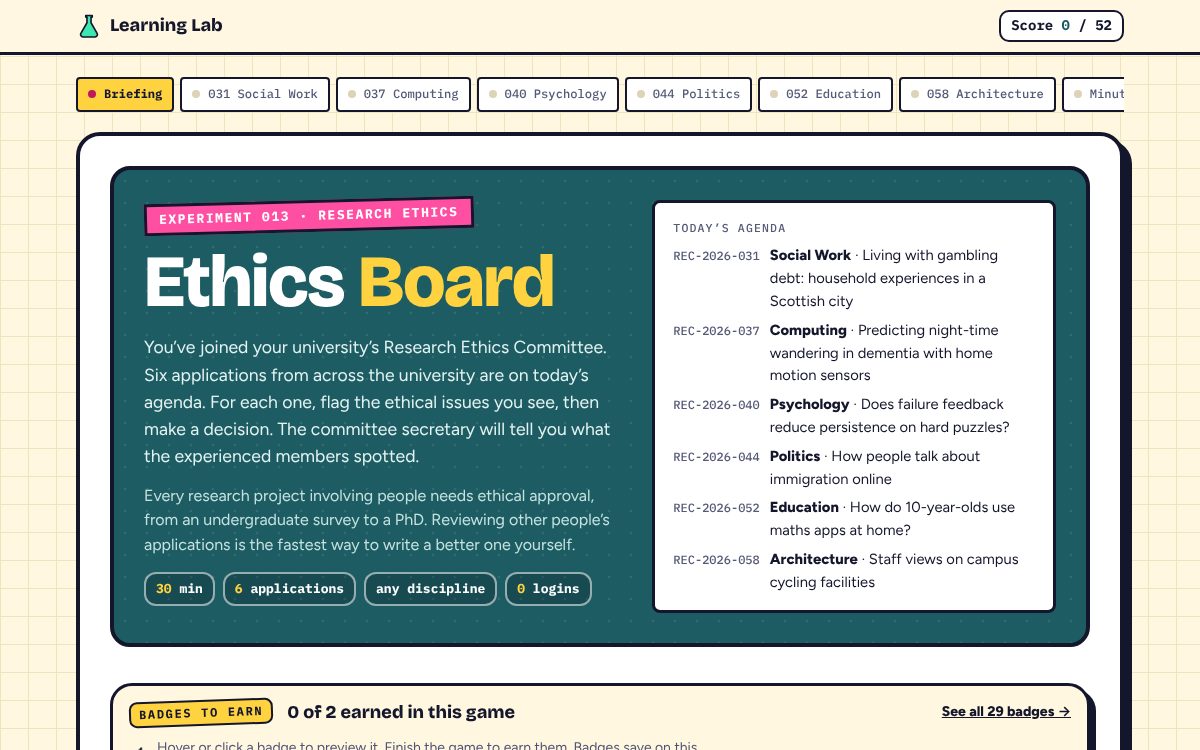
The agenda: six applications from six disciplines. 1 Review the applications
25 to 38 min- Students
- For each application: read the form, agree the flags, choose a decision, submit, read the committee’s letter.
- Watch for
- Groups that flag everything on the first application. The letter shows the penalty; they adjust quickly.
- Groups that reject the cycling survey. Ask what the actual risk is.
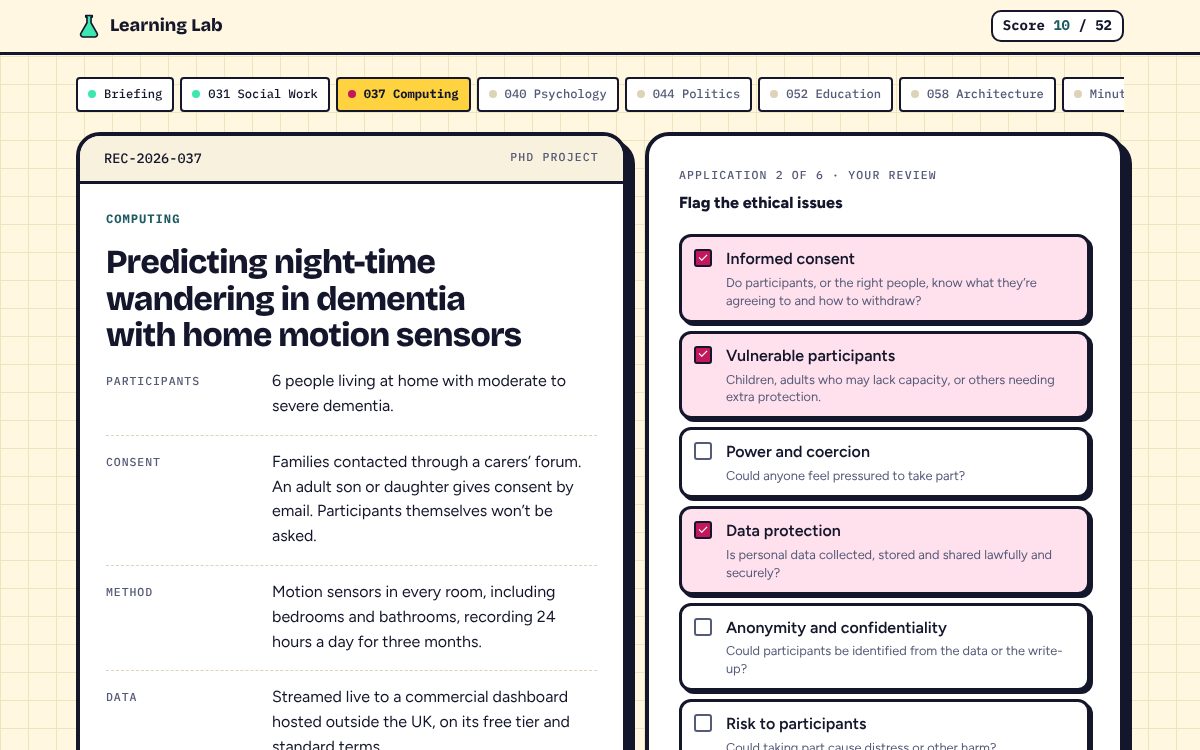
Each application: the form, eight lenses and three possible decisions. 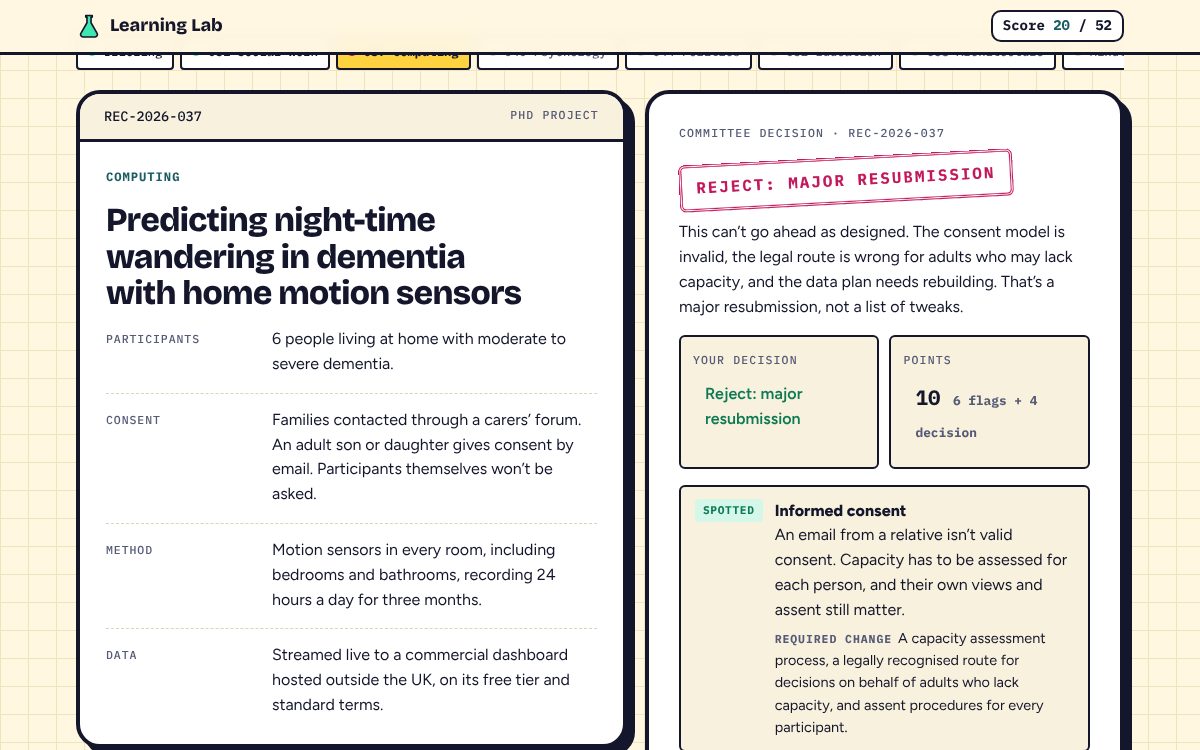
The letter: the decision, the points and the change the committee requires. 2 Minutes and debrief
15 to 23 min- Students
- The minutes show their band and which lenses they spot or miss.
- Ask
- “Which application would you most like to have run, and what would you change first?”
- “Is scraping public posts without consent ever acceptable? Where is the line?”
- “When is deception justified in research, and who decides?”
- “What is the riskiest part of your own project, and how would a committee want you to handle it?”
- Takeaway
- Ethics review protects participants and researchers, and a well-prepared application gets a faster yes.
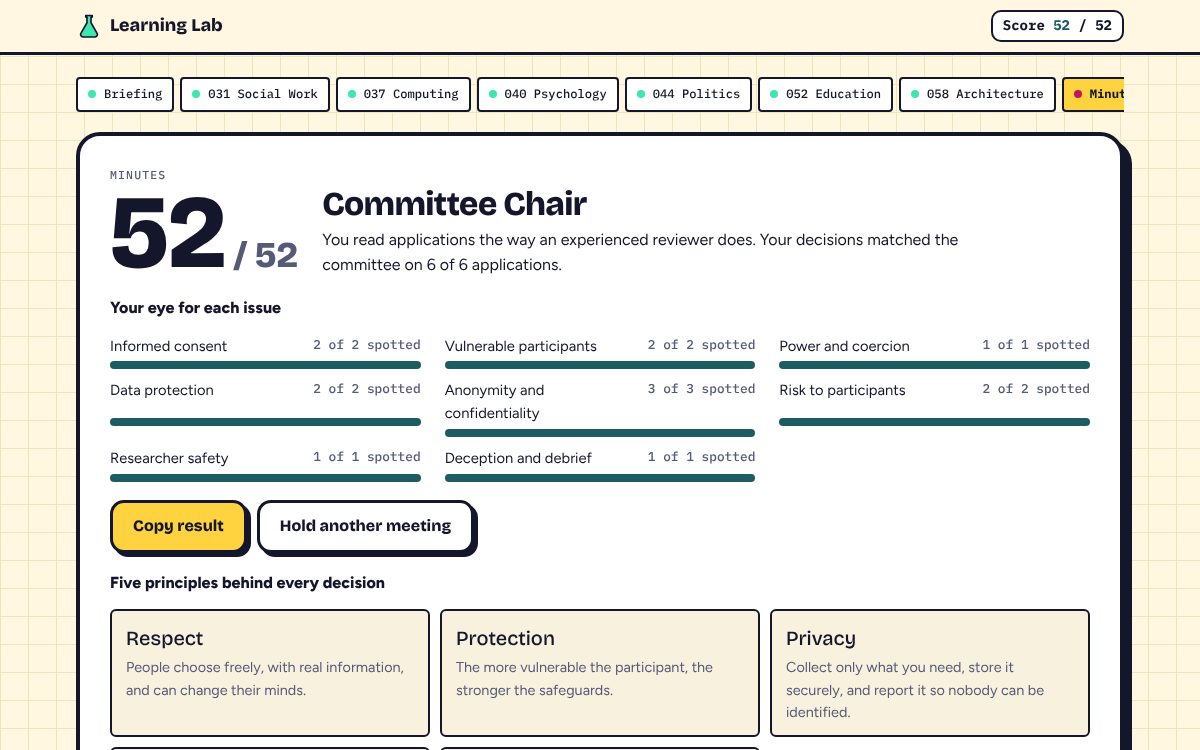
The minutes: a profile of which lenses each group spots.
If something goes wrong
| Problem | What to do |
|---|---|
| A student reloaded the page | The game starts again from the beginning. Each round is short, so replaying is quick, and the second run is usually better. |
| "Copy result" does not copy | Some browsers block the clipboard. The text appears on screen instead: select it and copy by hand. |
| No devices | Put the game on the projector and play it as a whole class: read each item aloud, take a vote by show of hands, then click the room’s answer. |
| No Wi-Fi | Once the page has loaded it runs without a connection. Otherwise, use the answer key on this page as a paper activity. |
| “That isn’t how our committee does it” | Good: procedures vary. Ask the group to say what their own university would require, then compare with the game. |
| Students outside the UK | The principles carry over. Swap the named laws for local ones in the debrief (for example GDPR in the EU, or the Common Rule in the US). |
Cheat card
- Share the link or QR code
- “Flag what worries you; every wrong flag costs a point.”
- 25 to 38 minutes, groups agree before submitting
- Watch for: rejecting the cycling survey
- Debrief REC-037 and REC-044
- “What is the riskiest part of your own project?”
Behind the game
- UK Research Integrity Office (2023) Code of practice for research. ukrio.org
- Economic and Social Research Council (UKRI) Framework for research ethics. ukri.org
- British Psychological Society (2021) BPS code of human research ethics. Leicester: BPS.
- Adults with Incapacity (Scotland) Act 2000, section 51. legislation.gov.uk
- Data Protection Act 2018 and UK GDPR; Information Commissioner’s Office guidance on research.
- Disclosure Scotland: Protecting Vulnerable Groups (PVG) Scheme. mygov.scot
All applications are fictional. Always follow your own university’s ethics procedures.