What players learn
1. Read the three statements
Know which statement answers which question: the income statement covers a period, the balance sheet is a snapshot on one day, and the cash flow statement tracks the cash.
2. Profit is not cash
Explain why a profitable company can run short of cash: equipment, loan repayments, dividends, stock and unpaid invoices all use cash without touching profit.
3. Compare with ratios
Use gross margin, current and quick ratios, receivable and payable days, gearing, interest cover and cash runway to judge a business as an investor, a lender, a supplier and a job-hunter.
4. Close the books and write it up
Classify transactions as revenue, expense, asset, liability or equity, watch the balance sheet balance after every entry, then choose clear, honest commentary over hype or vagueness.
The figures are invented and simplified, and Company D's accounts leave tax out. Real UK accounts follow UK accounting standards or IFRS and come with notes and a directors' report: see Adapt it for taking players on to real filed accounts.
Pick a format
Finance for non-finance managers
Run all three episodes in one 50–65 minute session, with a short debrief after each. This is the plan below. It suits MBA induction, management development and executive education.
One episode, one lecture
Each episode stands alone and can be opened directly: episode 1 before a lecture on the financial statements, episode 2 after one on ratio analysis, episode 3 after one on double entry or the accounting equation.
Enterprise and start-up workshops
Play episode 3, then ask founders to write the same four commentary sentences for their own business or business idea: headline, cash, risks and what they took out.
Careers and employability
Episode 2's last round asks players to judge an employer's security. Pair it with a task: find a real employer on Companies House and check its cash, debts due within a year and the notes.
Five golden rules
- Answers lock when clicked.The explanation appears straight away, with the working for every ratio. Ask players to read it even when they are right.
- The books always balance.In episode 3, a wrong answer is still posted the right way, so Company D's balance sheet balances after every entry and the end-of-year report is always correct.
- Everything is fictional.Companies A, B, C and D and all their figures are invented for learning. Figures are in £ thousands, and brackets mean a minus.
- Episodes are independent.Links ending #ep1, #ep2 or #ep3 open an episode directly. A reload starts the episode again; best scores are remembered on that device.
- Nothing leaves the device.There are no accounts and no answers are sent anywhere. The star rating at the end is optional and anonymous.
The three episodes
| Episode | What players do | Rounds | Points |
|---|---|---|---|
| 1 | Read it: The Three Statements. Find their way round Company A's income statement, balance sheet and cash flow statement (three tabs), then interpret them. | Which statement? · Find the number · So what? | 12 |
| 2 | Compare it: Ratio Radar. Compare Companies A (coffee roaster), B (fitness app) and C (furniture maker) side by side, with an eight-ratio toolkit, then decide as a supplier, a bank, a job-hunter and an investor. | Crunch it · Spot it · Decide it | 12 |
| 3 | Write it: Close the Books. Post twelve transactions for Company D, a bike repair start-up, into a live income statement and balance sheet, then pick the four sentences of its year-end commentary. | Post it · Tell it | 16 |
Episodes 1 and 2 have three options per question, and their correct answers are spread evenly across A, B and C (four of each); episode 3's postings have five options (revenue, expense, asset, liability, equity). Ranks: episode 1 Report Reader (11 to 12), Line Spotter (8 to 10), First Read (0 to 7); episode 2 Ratio Radar Pro (11 to 12), Analyst (8 to 10), Rookie Analyst (0 to 7); episode 3 Finance Director (15 to 16), Bookkeeper (11 to 14), Founder in Training (0 to 10). Each result screen gives four reminders, and episode 3 ends with Company D's Year 1 report, which players can copy as text.
Every answer
Collapsed so students looking over your shoulder don’t see them. Open before the debrief.
Episode 1, round 1: Which statement?
| # | Question | Answer | Why |
|---|---|---|---|
| 1 | Where would you find how much Company A sold to customers this year? | A. Income statement | Revenue (turnover) is the top line of the income statement, which covers the whole year: £1,200k for Company A. |
| 2 | Where would you find how much customers still owed Company A on the last day of the year? | B. Balance sheet | Money owed by customers is an asset called trade receivables. The balance sheet is a snapshot on one date: £100k here. |
| 3 | Where would you see the cash Company A spent on a new roaster this year? | C. Cash flow statement | The cash flow statement shows the £60k leaving under investing activities. The roaster then sits on the balance sheet as equipment, and only a slice of its cost (depreciation) reaches the income statement each year. |
| 4 | Where would you find how much Company A owes the bank? | B. Balance sheet | Borrowing is a liability, so it's on the balance sheet: a £120k bank loan. Only the interest on it (£10k) appears in the income statement. |
Episode 1, round 2: Find the number
| # | Question | Answer | Why |
|---|---|---|---|
| 5 | What was Company A's gross profit? | A. £480k | Revenue £1,200k minus cost of sales £720k = £480k. Gross profit is what's left after the direct cost of the coffee sold. £120k is operating profit and £85k is the final profit. |
| 6 | What profit did Company A make for the year, after interest and tax? | C. £85k | The bottom line is £85k. Operating profit (£120k) comes before interest; profit before tax (£110k) comes before the £25k tax charge. |
| 7 | How much cash did Company A hold at the end of the year? | B. £110k | £110k, shown on the balance sheet and as the last line of the cash flow statement. £85k is profit and £300k is all current assets, including stock and money owed by customers. |
| 8 | Total assets are £600k. What do liabilities plus equity add up to? | C. £600k | Liabilities £225k + equity £375k = £600k. Everything a company owns was paid for either by borrowing or by its owners, so the two sides always balance. |
Episode 1, round 3: So what?
| # | Question | Answer | Why |
|---|---|---|---|
| 9 | Company A made a profit of £85k, yet its cash fell by £10k. Best explanation? | B. It spent cash on things that aren't costs this year | Trading brought in £100k of cash. Investing used £60k and financing used £50k, so cash fell by £10k. None of those payments is an expense, which is why profit and cash part ways. |
| 10 | The cash flow statement adds back £30k of depreciation. Why? | C. It's a cost that uses no cash this year | Depreciation spreads the cost of equipment over the years it's used. It reduces profit, but no cash leaves the business, so the cash flow statement puts it back. |
| 11 | Gross margin is gross profit ÷ revenue. What is Company A's? | A. 40% | £480k ÷ £1,200k = 40%: for every £1 of coffee sold, 40p is left to pay staff, rent and everything else. 10% is the operating margin and 7% the net margin. |
| 12 | Current assets are £300k and liabilities due within a year are £105k. What does that tell a supplier? | A. It can cover its short-term bills almost 3 times over | £300k ÷ £105k ≈ 2.9. Above 1 means more short-term assets than short-term debts. A careful supplier also checks how much of that is cash (£110k) rather than stock. |
Episode 2, round 1: Crunch it
| # | Question | Answer | Why |
|---|---|---|---|
| 1 | What is Company B's gross margin? | A. 70% | £630k ÷ £900k = 70%. An app costs little to serve one more customer. Company C's 30% reflects wood, fabric and workshop time in every sofa. |
| 2 | What is Company C's quick ratio (leaving out stock)? | B. About 0.6 | (£1,050k − £500k) ÷ £935k ≈ 0.59. Without selling stock, C has about 59p for every £1 due within a year. 1.1 is its current ratio; 2.0 is Company A's quick ratio. |
| 3 | On average, how long do Company C's customers take to pay? | B. About 100 days | £550k ÷ £2,000k × 365 ≈ 100 days. Company A's customers pay in about 30. C's growth is being funded by letting customers pay late. |
| 4 | Company B used £300k of cash this year (£260k on operations, £40k on equipment). At that pace, how long will its £600k last? | B. About 24 months | £300k a year is £25k a month; £600k ÷ £25k = 24 months. That's B's cash runway, and it shortens if spending rises as the app grows. |
Episode 2, round 2: Spot it
| # | Question | Answer | Why |
|---|---|---|---|
| 5 | Which company made the biggest profit? | C. Company C | Company C, with £105k. But its operations used £150k of cash. Hold that thought. |
| 6 | Which company's day-to-day operations actually brought in cash? | A. Company A | Only Company A (+£100k). B's losses burned cash; C's cash disappeared into £500k of stock and £550k of unpaid customer invoices. |
| 7 | Which company relies most on borrowing? | C. Company C | Company C borrows £850k against £515k of equity, gearing of about 165%, and profit covers its interest only 3.3 times. A's gearing is 32% with interest covered 12 times; B has no borrowing. |
| 8 | Company B lost £400k. Why might investors still back it? | B. Revenue doubled with a 70% gross margin | Investors are paying for growth: each extra £1 of sales brings 70p of gross profit. The risk is time. B must cut losses or raise more money within about two years. |
Episode 2, round 3: Decide it
| # | Question | Answer | Why |
|---|---|---|---|
| 9 | You: a coffee-bean supplier: Who is the riskiest customer? | C. Company C | Company C has no cash, a quick ratio of 0.6, and already takes about 91 days to pay its own suppliers (£350k ÷ £1,400k × 365). You'd likely wait well beyond 60 days. |
| 10 | You: a bank: Who would you lend to most comfortably? | A. Company A | Company A: profit covers interest 12 times, borrowing is modest, and trading brings in cash. B has no profit to pay interest from; C is already heavily borrowed. |
| 11 | You: a job-hunter: What should you check first? | C. Cash, cash flow and debts due soon | Businesses fail when cash runs out, not when profit dips. A is cash-positive; B has about two years of runway; C has an overdraft and a £300k loan due within a year. |
| 12 | You: a potential investor: What does that note signal? | A. A going concern question | Accounts assume a business will keep going for at least the next year. A note like this flags that this depends on a deal not yet done. The notes are where risks surface, so read them. |
Episode 3, round 1: Post it
| # | Question | Answer | Why |
|---|---|---|---|
| 1 | You put your own savings into the company in return for shares. (£20k) | E. Equity | Money from the owners is equity. The company didn't earn it, so it isn't revenue. |
| 2 | The bank lends the company money, repayable over five years. (£15k) | D. Liability | It must be paid back, so it's a liability. More cash, but no profit. |
| 3 | You buy repair stands, tools and a coffee machine. (£12k) | C. Asset | They'll be used for years, so they're assets (equipment), not a cost of this year alone. Their cost reaches profit gradually through depreciation. |
| 4 | Repairs and coffee sold at the till during the year, all paid. (£60k) | A. Revenue | Earned from customers: revenue. |
| 5 | You service a delivery firm's bikes and send an invoice. They haven't paid by year end. (£5k) | A. Revenue | Revenue counts when the work is done, not when the cash arrives (the accruals principle). The unpaid £5k becomes a trade receivable, an asset. |
| 6 | Bike parts and coffee beans used up during the year, all paid. (£18k) | B. Expense | Used up to earn this year's revenue: an expense, shown as cost of sales. |
| 7 | Wages for your part-time mechanic. (£14k) | B. Expense | A running cost of this year: an expense. |
| 8 | Rent and utilities for the year. You've paid £12k; a £1k energy bill is still unpaid. (£13k) | B. Expense | The whole £13k is this year's cost, paid or not. The unpaid £1k becomes a trade payable, a liability. |
| 9 | Parts bought during the year are still on the shelf, unused. (£3k) | C. Asset | Not used yet, so they're stock (inventory), an asset. They become cost of sales next year when you fit them. |
| 10 | You repay part of the bank loan. (The £1k interest on top is posted for you.) (£3k) | D. Liability | Repaying a loan reduces a liability; it isn't an expense. Only the £1k interest is a cost of borrowing, and that's been posted as an expense. |
| 11 | Your £12k of equipment should last about four years. This year's share of its cost: (£3k) | B. Expense | Depreciation is an expense that spreads the cost over the equipment's life. No cash moves now; the asset's value on the balance sheet goes down. |
| 12 | As the owner, you pay yourself a dividend. (£6k) | E. Equity | A dividend is a share of profit paid to owners, so it reduces equity. It isn't an expense. (A salary would be.) |
Episode 3, round 2: Tell it
| # | Question | Answer | Why |
|---|---|---|---|
| 13 | Your report · headline: Pick the sentence for your headline. | B. Company D made a profit of £16k on revenue of £65k in its first year, a net margin of about 25%. | Specific and checkable. The first is hype with no numbers; the third tells the reader nothing. |
| 14 | Your report · cash: Pick the sentence for the cash section. | C. Cash was £26k. Trading brought in £12k, less than the £16k profit because £5k of invoices were unpaid and £3k was in stock. The rest came from shares and the bank loan. | It explains the gap between profit and cash and where the money came from. The first confuses profit with cash; the second is reassurance without evidence. |
| 15 | Your report · risks: Pick the sentence for the risks section. | A. The company owes £12k on its bank loan, and £5k is due from one customer: if that invoice isn't paid, profit would fall by £5k and the cash would never arrive. | Naming specific risks builds trust with banks and investors. Saying there are none, or hiding behind a vague line, does the opposite. |
| 16 | Your report · dividend: Pick the sentence for the dividend section. | C. Of the £16k profit, £6k was paid as a dividend and £10k was kept in the business to fund growth. | Clear and correct: dividends come out of profit, and what's kept (retained earnings) funds the business. A dividend is never an expense. |
The fictional figures, checked
| Company | Key figures (£k) | Ratios used in the game |
|---|---|---|
| A · coffee roaster | Revenue 1,200; gross profit 480; operating profit 120; profit 85; cash 110; operating cash flow 100; assets 600 = liabilities 225 + equity 375 | Gross margin 40%; current ratio 2.9; quick ratio 2.0; receivable days 30; gearing 32%; interest cover 12× |
| B · fitness app | Revenue 900 (up 100%); gross profit 630; loss 400; cash 600; cash used 300 a year | Gross margin 70%; current ratio 2.2; no borrowing; runway 24 months |
| C · furniture maker | Revenue 2,000 (up 25%); gross profit 600; profit 105; cash 0; operating cash flow (150); borrowing 850 | Gross margin 30%; current ratio 1.1; quick ratio 0.6; receivable days 100; payable days 91; gearing 165%; interest cover 3.3× |
| D · your start-up | Revenue 65; gross profit 47; operating profit 17; profit 16; dividend 6; cash 26; assets 43 = liabilities 13 + equity 30 | Net margin about 25%; cash from trading 12 |
How long will it take?
Every time in this guide is a range. The low end is a tight run; the top end is what most classes take once players discuss, decide and talk through the answers.
In class, all three episodes: 50 to 65 minutesSolo: 8 to 20 minutes an episode
What moves you up or down the range
- How strictly you keep time. Calling time on each episode keeps you near the low end; letting everyone finish at their own pace moves you to the top.
- Alone or in pairs. Pairs talk through each answer, which helps non-finance learners, but they take longer than players working alone.
- Reading every explanation. Players who read every explanation and check the figures take longer and learn more.
- Getting started. Sharing the link, phones joining or loading, and a first look at a set of accounts all take a few minutes.
- The debriefs in between. A quick question after each episode, or a full debate on episode 2.
- Your group. Confidence with numbers, reading financial language in a second language, and the room layout.
Each step below has its own range. Few sessions reach the top of every step, so the step ranges add up to more than the session range: if one step runs long, shorten a later one to stay within your slot.
Short on time? Run one episode only, call time at the low end, and take one debrief question. Want the richest discussion? Plan for the top of the range.
Step by step
50 to 65 minutes for all three episodes, with players on their own phones or laptops, alone or in pairs.
0 Set it up
3 to 6 min- Say
- “Annual reports look scary until you know where to look. Three short episodes: read one company's accounts, size up three companies, then close the books on your own start-up. Read every explanation, even when you are right.”
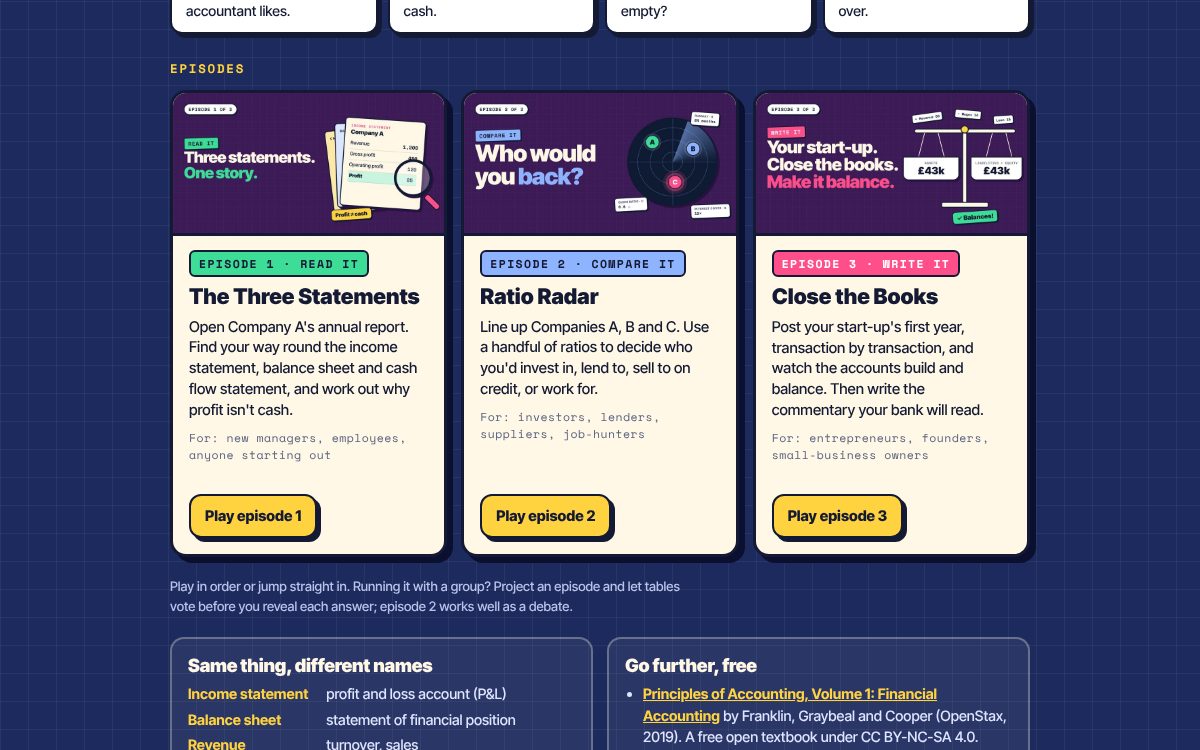
The hub: the cast of four fictional companies and three episodes. 1 Episode 1: Read it
10 to 15 min + 3 to 6 min debrief- Players
- Round 1: say which statement answers each question.
- Round 2: find gross profit, profit, cash and the balance sheet total.
- Round 3: explain why profit was £85k but cash fell by £10k.
- Watch for
- Players looking for the new roaster on the income statement: its cash leaves on the cash flow statement.
- Players picking operating profit (£120k) as “the profit”.
- Ask
- “Company A made £85k profit. Where did the cash go?”
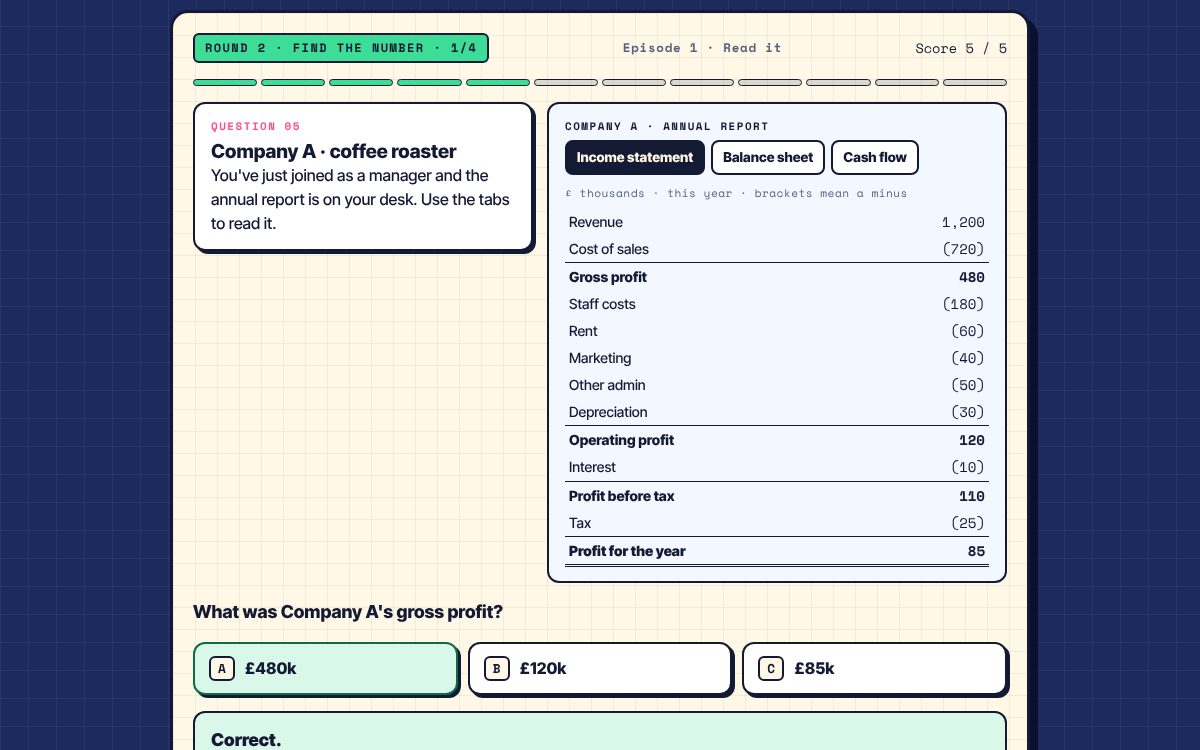
Episode 1: the annual report sits beside every question, in three tabs. 2 Episode 2: Compare it
12 to 18 min + 5 to 10 min debate- Players
- Round 1: work out four ratios from the side-by-side table, using the ratio toolkit tab.
- Round 2: spot the biggest profit, the only cash-generating business and the most heavily borrowed one.
- Round 3: decide as a supplier, a bank, a job-hunter and an investor.
- Watch for
- Players backing Company C because it has the biggest profit. That is the trap the episode is built around.
- No devices? Project it and let tables vote A, B or C, then argue it out.
- Ask
- “Company C made the most profit. Would you sell to it on 60 days' credit? Would you work there?”
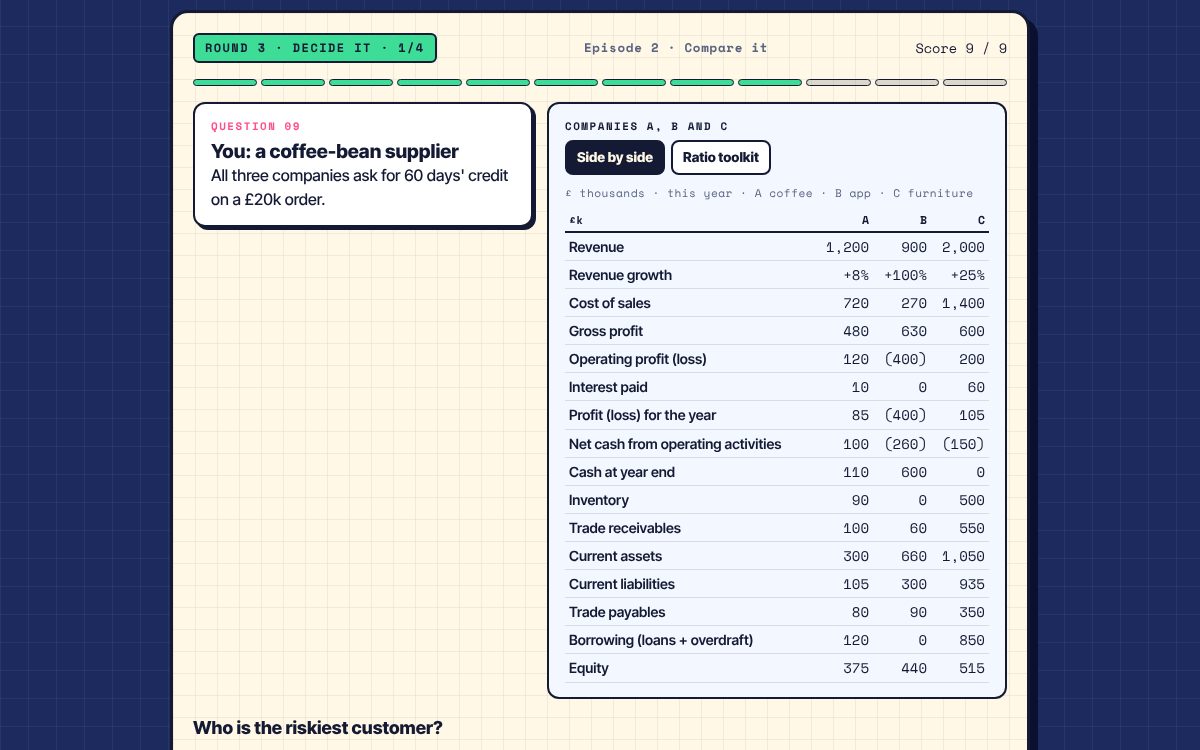
Episode 2: the side-by-side table, with a ratio toolkit one tab away. 3 Episode 3: Write it
12 to 18 min- Players
- Round 1: post twelve transactions and watch the books build and balance.
- Round 2: choose the clearest, most honest sentence for the headline, cash, risks and dividend.
- Watch for
- The loan repayment (transaction 10) posted as an expense: it reduces a liability.
- The dividend (transaction 12) posted as an expense: it is a share of profit.
- The unpaid invoice (transaction 5) left out of revenue.
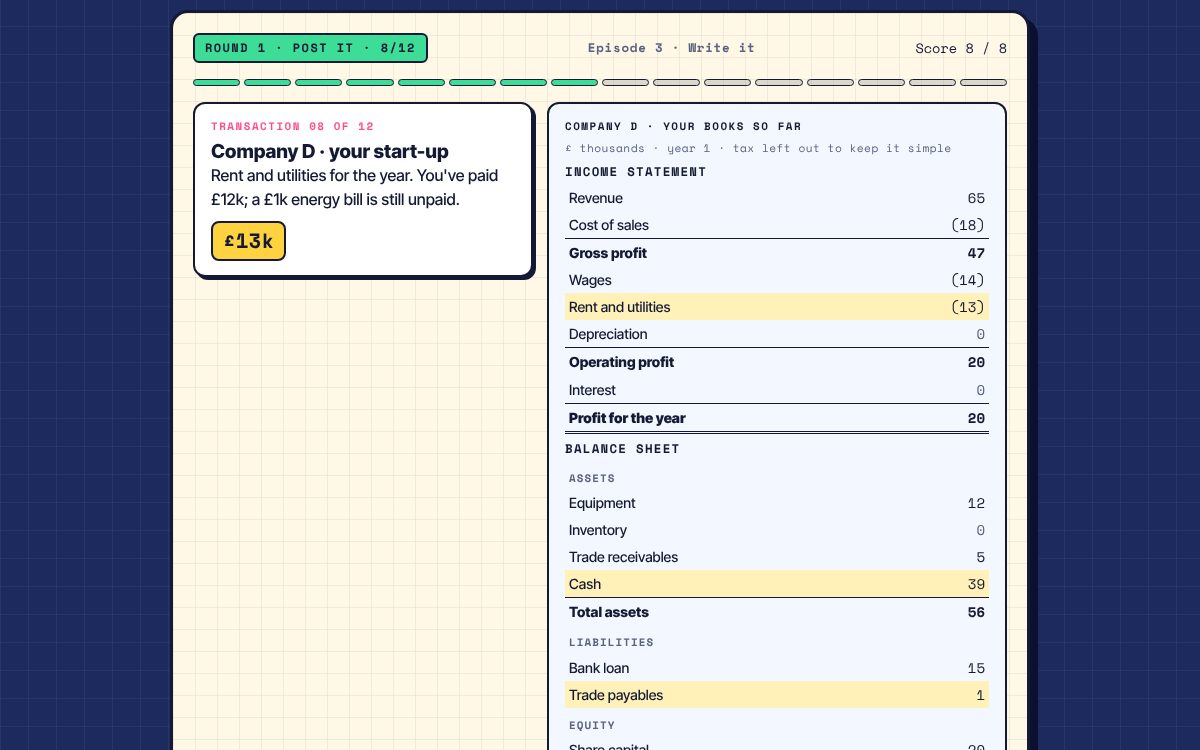
Episode 3: each posting updates the income statement and balance sheet, and the check line shows they still balance. 4 Debrief and write
5 to 10 min- Ask
- “Company D made £16k profit but has £26k in the bank. Explain the difference in one sentence.”
- “Which of the hype or vague sentences have you seen in a real report?”
- “Write your own four sentences for a real or imagined business: headline, cash, risks, what the owners took out.”
- Takeaway
- Read all three statements, check cash before profit, and write it straight.
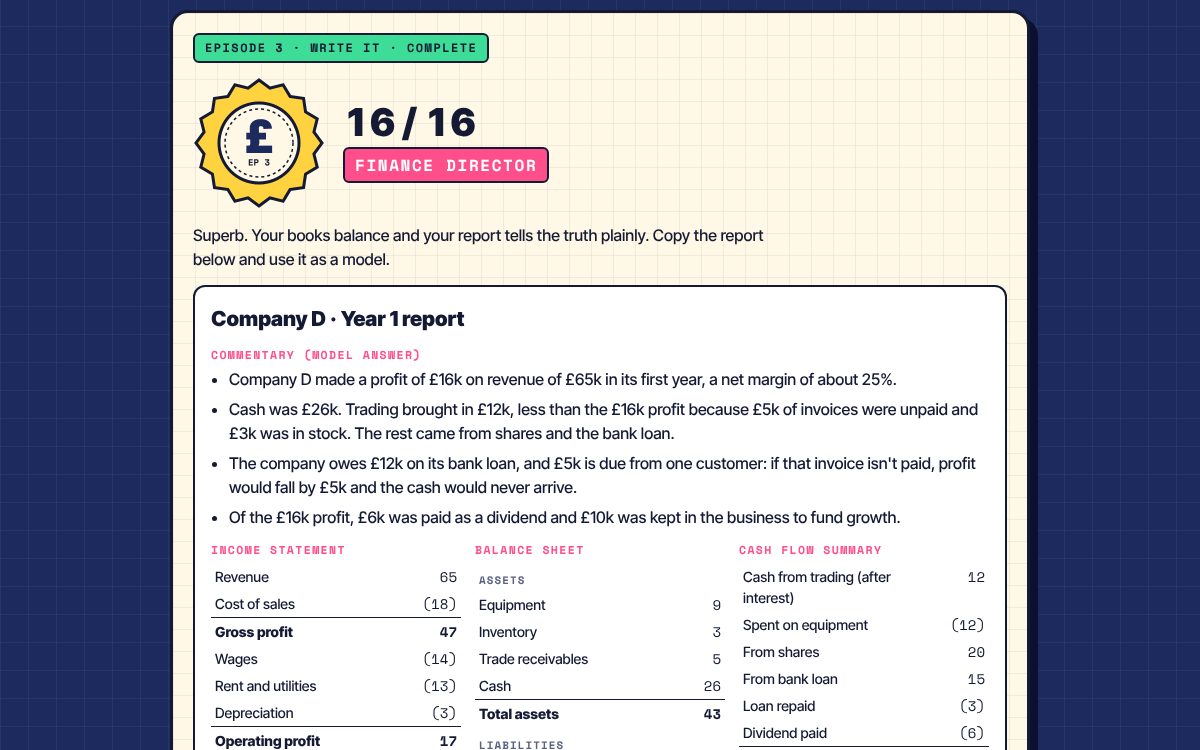
The end of episode 3: a model Year 1 report that players can copy.
Taking it further
- Real accounts. After episode 1, ask players to find a real UK company on Companies House (free) and locate the same lines. Small companies may file only a balance sheet, which is itself a good discussion point: GOV.UK explains what UK company accounts must include.
- International terms. The game uses UK terms with the international ones alongside (profit and loss account, statement of financial position, turnover, stock, debtors and creditors). The hub has a “same thing, different names” glossary.
- Tax. Company D's accounts leave tax out to keep the postings simple. For an accounting class, ask players to estimate a tax charge and redo the retained profit.
- Deeper reading. The free OpenStax textbook Principles of Accounting, Volume 1 and the OpenLearn course Introduction to bookkeeping and accounting follow on well from episodes 1 and 3.
- Not advice. The game is a learning aid, not financial, investment or accounting advice.
If something goes wrong
| Problem | What to do |
|---|---|
| A player reloaded the page | The episode starts again. Each takes 8 to 20 minutes, and the questions stay the same, so a second run tests what they learned. |
| Short of time | Run one episode only, using the #ep1, #ep2 or #ep3 link. Episode 2 alone makes a strong 20–35 minute debate. |
| No devices | Put an episode on the projector, read each question aloud, take a vote, then click the room's answer. |
| No Wi-Fi | Once the page has loaded it runs without a connection. Otherwise, use the answer key and the figures table on this page as a paper activity. |
| Finance students find it easy | Ask them to explain each answer to a non-finance partner, or to rewrite Company C's commentary for its bank. |
Cheat card
- Share the link or QR code
- “Read every explanation.”
- Episode 1: profit £85k, cash down £10k. Why?
- Episode 2: C has the biggest profit and no cash
- Episode 3: loans and dividends aren't expenses
- “Read all three, check cash first, write it straight.”
Behind the game
All questions, companies and figures were written from scratch for the Learning Lab and are not based on any other course. These free sources go further:
- Franklin, M., Graybeal, P. and Cooper, D. (2019) Principles of Accounting, Volume 1: Financial Accounting. OpenStax. Open textbook, CC BY-NC-SA 4.0. openstax.org
- The Open University. Introduction to bookkeeping and accounting. Free OpenLearn course. open.edu/openlearn
- GOV.UK. Prepare annual accounts for a private limited company. gov.uk
- Companies House. Find and update company information. company-information.service.gov.uk