What students learn
1. The 4Cs, not the 4Ps
Customer solutions, customer cost, convenience and communication look at the mix from the customer's side, across purchase, use and post-use (Belz and Peattie, 2012).
2. Total customer cost
A fair price can still feel steep, and time and travel are costs too. Students learn to look past the price tag.
3. Evidence beats description
Every rating needs the strongest evidence: measured, dated and ideally from customers, not the organisation describing itself.
4. Green claims need proof
A vague ‘100% eco’ claim is a communication weakness and a Green Claims Code risk, even when the real impact is good.
Pick a format
Seminar warm-up
Students play solo for 10 minutes, then you debrief the rows that split the room. The plan below.
Assessment preparation
Set it before students write the analysis section of a report: the end screen shows a model criterion, rating, evidence, so what table.
Homework or revision
Share the link. It works on a phone and keeps progress if the page is reloaded.
Whole class on one screen
No devices? Put it on the projector, read each item aloud, take a show of hands and click the room's answer.
The Kit Cupboard
The Kit Cupboard is a community tool library in Northbridge, a made-up city. Members borrow drills, ladders, sewing machines and garden tools instead of buying them. It's run by two part-time staff and 25 volunteers, and it wants a campaign to grow membership. Before planning one, you're doing the situation analysis.
| Step | What students do | Points |
|---|---|---|
| 1 | Rate the criterion: strong, moderate, weak or not at all. | 2 if exact, 1 if one step away |
| 2 | Pick the piece of evidence that best supports the rating. | 2 for the best, 1 for a supporting piece |
| 3 | Choose the so what: what the campaign should do about it. | 2 |
The evidence board (8 pieces, all invented)
| Card | Source | What it says |
|---|---|---|
| E1 | Website home page | “Borrow a drill, ladder or sewing machine for a week instead of buying one. 900 tools, all checked and repaired by our volunteers.” |
| E2 | Membership page | “Membership £30 a year, or pay what you can from £5. Borrowing is free. Late returns £1 a day.” |
| E3 | Opening hours | “Open Saturdays 10:00 to 13:00. Collect and return in person at the Old Fire Station. Sorry, no parking.” |
| E4 | Instagram bio | “♻️ 100% eco! Saving the planet one drill at a time 🌍” (no link, no figures) |
| E5 | Impact report 2025, page 7 | 3,200 loans last year. In the member survey (410 replies), 64% said they didn't buy a tool they would otherwise have bought. |
| E6 | Google review, 3 stars | “Love the idea, but I work Saturdays, so I've only managed to borrow twice. Booking online would change everything.” |
| E7 | Google review, 5 stars | “The £30 felt steep until I worked out that a new hedge trimmer was £90.” |
| E8 | Website FAQ | “Can I reserve a tool online? Not yet. Just turn up and see what's on the shelf.” |
Answer key
Collapsed, so students skimming this page don't meet the answers by accident. Each criterion is worth 6 points; 21 or more earns the second badge.
Show the answer key
| Criterion | Rating | Best evidence | So what |
|---|---|---|---|
| Customer solutions | strong Borrowing replaces buying, every tool is repaired and reused, and there's measured proof that it changes behaviour: 64% didn't buy a tool they would otherwise have bought. | E5 (Impact report 2025, page 7) Also accepted (1 point): E1 | ✓ Keep it and prove it: lead the campaign with the 64% ‘didn't buy’ figure from the impact report. ✗ Add more tools to the catalogue before running any campaign. Nothing in the evidence says the range is the problem. Don't fix what is already strong. ✗ Reposition as a low-cost hardware shop to reach more people. That would throw away the sustainability solution, which is the thing it does best. |
| Customer cost | moderate The price is low and fair (pay what you can from £5, free borrowing), but some members still see £30 as steep, and there are time and travel costs to get there on a Saturday morning. | E7 (Google review, 5 stars) Also accepted (1 point): E2 | ✓ Show the saving: compare £30 a year with the price of buying three tools you'd use twice. ✗ Cut the membership to £10 for everyone. That loses income the library needs, and it doesn't fix the time and effort costs. ✗ Leave the late fee off the membership page so the price looks lower. Hiding a fee is drip pricing, which has been banned in the UK since April 2025, and it erodes trust. |
| Convenience | weak It's open three hours a week, you can't reserve online, and collection and return are in person with no parking. Customers say so themselves. | E6 (Google review, 3 stars) Also accepted (1 point): E3, E8 | ✓ Fix it before driving traffic: add online reservations and one weekday evening slot. ✗ Spend most of the campaign budget on Instagram ads first. More visitors won't help if they still can't get there on a Saturday morning. ✗ Move to a bigger building with more shelf space. Space isn't the problem in the evidence: hours and booking are. |
| Communication | weak The only sustainability message is a vague ‘100% eco’ claim with no proof, while strong evidence sits unused in the impact report. | E4 (Instagram bio) Also accepted (1 point): none | ✓ Replace ‘100% eco’ with a specific, evidenced claim, such as ‘3,200 loans last year’, linked to the impact report. ✗ Post the same message more often to build awareness. Repeating a vague claim spreads the problem; it doesn't fix it. ✗ Add more planet and leaf emojis to make it feel greener. Green imagery without evidence can itself mislead. |
The one that splits the room: Customer cost (moderate, not strong): the price is fair, but perceived cost and time costs pull it down.
How long will it take?
Every time in this guide is a range. The low end is a tight run; the top end is what most classes take once students discuss, decide and react to the results.
In class: 15 to 30 minutesSolo: 8 to 12 minutes
What moves you up or down the range
- When you call time. Students play at their own pace. Moving to the debrief once most have finished keeps you near the low end; waiting for everyone moves you to the top.
- Reading the evidence and explanations. Students who read every card and every explanation, as they should, take longer than those who click through.
- Phones joining or loading. Sharing the link or QR code, and patchy Wi-Fi.
- Interaction in between. Pairs comparing ratings, questions, or arguing about a borderline row.
- The debrief. One contested row, or every row plus the step to your students' own client.
- Your group. Familiarity with the framework, reading in a second language, and the room layout.
Short on time? Call time when most have finished and debrief one row. Want the richest discussion? Run it in pairs and plan for the top of the range.
Step by step
15 to 30 minutes, with students on their own phones or laptops, alone or in pairs.
0 Set it up
2 to 4 min- Say
- “Four criteria. For each one: rate it, prove it with the strongest evidence, then say what it means for the campaign. That last step is where the marks are.”
1 Play
8 to 15 min- Students
- Read the brief and skim the evidence board.
- Work through the four criteria: rating, evidence, so what.
- Read the explanation after every answer.
- Watch for
- Students picking the organisation's own claims as evidence instead of measured or customer evidence.
- Students choosing a so what that fixes something that's already strong.
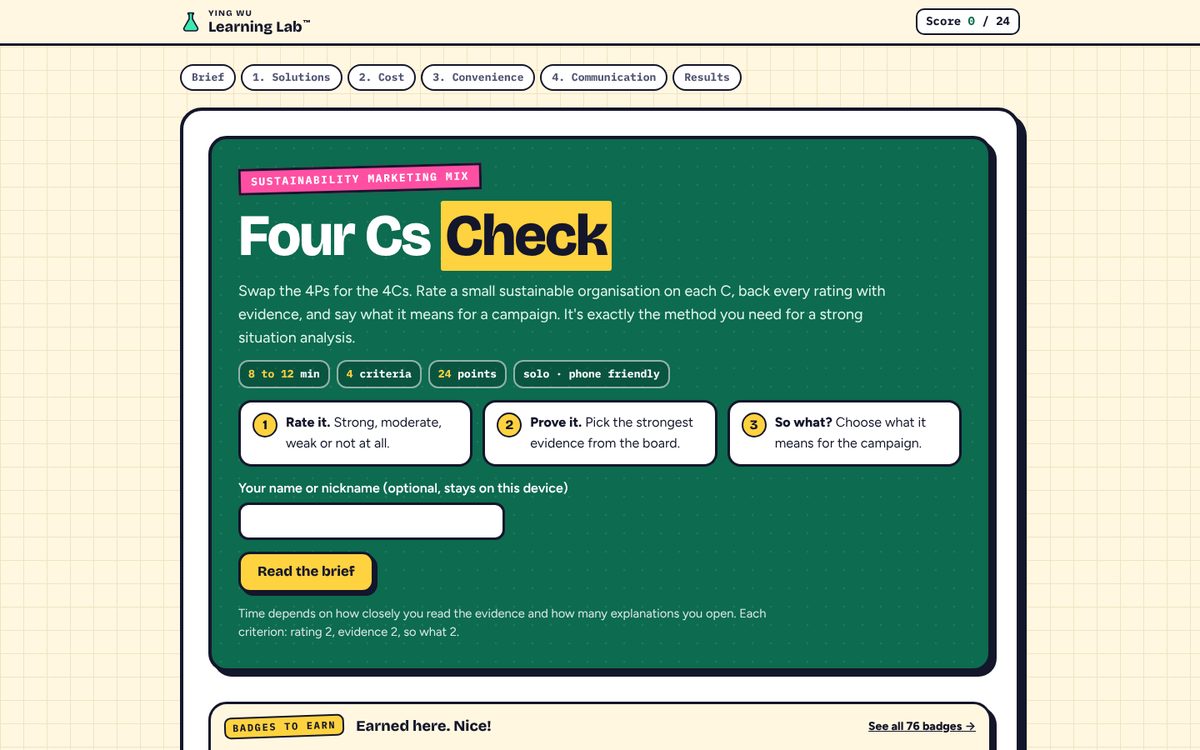
The start screen: rate it, prove it, so what. 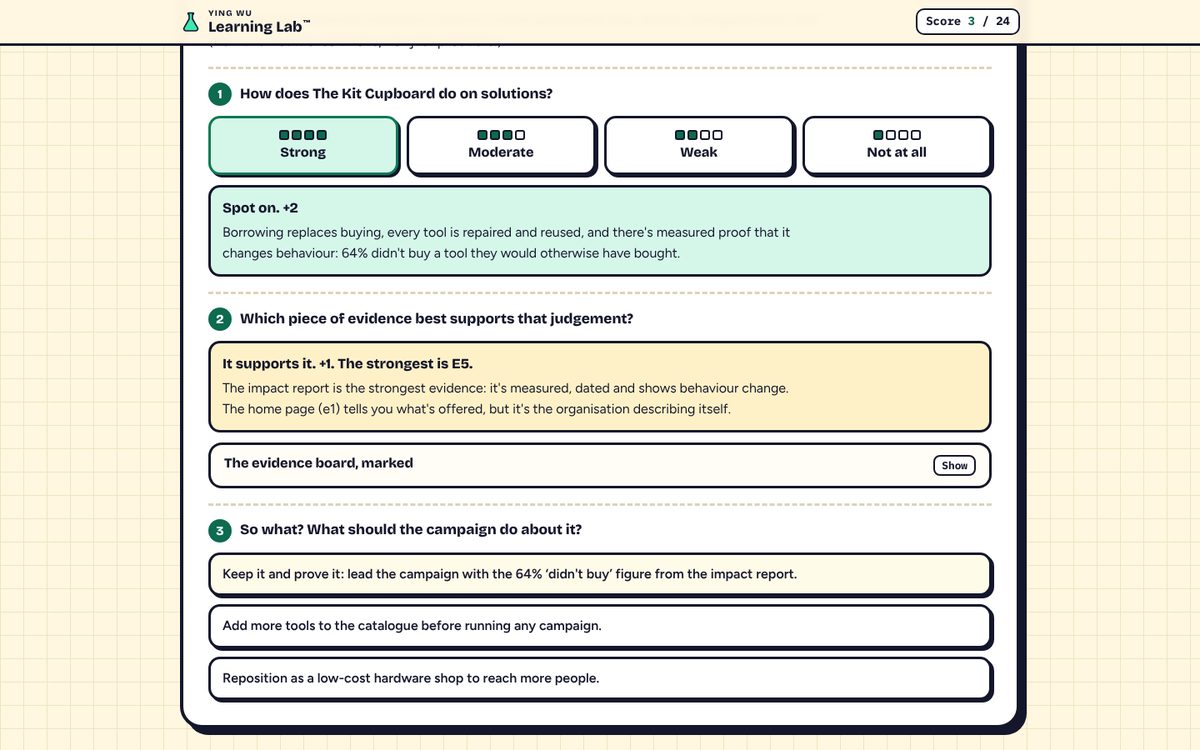
Each answer is explained straight away. 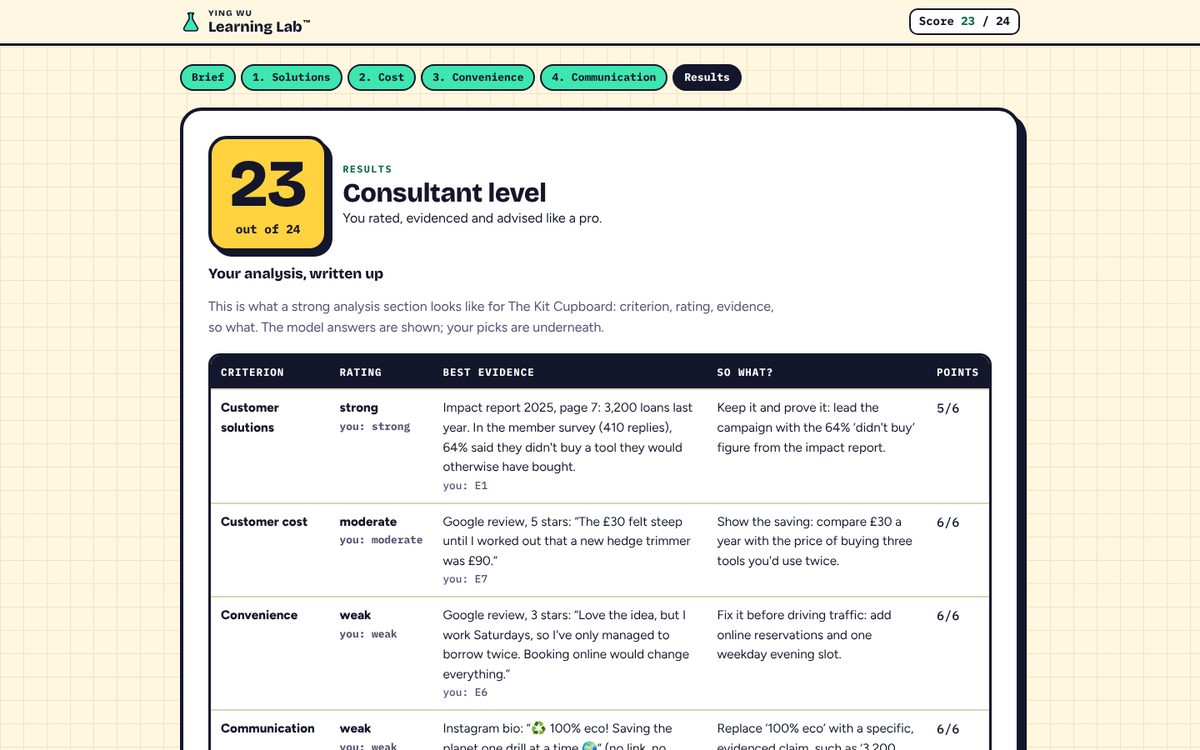
The end screen: a model analysis table to copy. 2 Debrief
3 to 8 min- Ask
- “Which rating did you disagree with? What evidence would change it?”
- “Which so what would you put first in the campaign, and why?”
3 Apply it
2 to 5 min- Say
- “Now do one row for your own client: criterion, rating, one dated piece of evidence, so what.”
Linking it to a report
- The end screen shows a model analysis table: criterion, rating, best evidence, so what. Students can copy it as text as a template for their own work.
- Use the framework as one core framework, with its criteria as subheadings, and the four-point scale (strong, moderate, weak, not at all) for each one.
- The case is fictional on purpose, so nobody gets the answers for a real client. Students apply the method, not the answers.
If something goes wrong
| Problem | What to do |
|---|---|
| A student reloaded the page | Progress is kept in that browser tab. Closing the tab starts again from the beginning. |
| “Copy the table” does not copy | Some browsers block the clipboard. Students can select the table on screen and copy it by hand. |
| No devices | Put the game on the projector and play it as a whole class: show of hands for each step, then click the room's answer. |
| A student argues for a different rating | Good. Ask what evidence would justify it. Close ratings (one step away) still earn a point. |
Cheat card
- Share the link or QR code
- “Rate it, prove it, so what?”
- 8 to 15 minutes of play
- Customer cost (moderate, not strong): the price is fair, but perceived cost and time costs pull it down.
- Debrief one contested row
- One row for their own client
Behind the game
- Belz, F.-M. and Peattie, K. (2012) Sustainability Marketing: A Global Perspective. 2nd edn. Chichester: Wiley.
- Competition and Markets Authority (2021) Making environmental claims on goods and services (the Green Claims Code). 20 September.
The Kit Cupboard, Northbridge and all the evidence are invented for this game. Any resemblance to a real organisation is coincidental.