What players learn
1. Know the goals
Recognise all 17 goals from the wording of real UN targets, such as 12.3 on food waste or 16.5 on bribery. The goal names alone are easy to learn; the targets are where business decisions meet them.
2. Match the move
Link a real-world business decision, such as a water-saving brewery or a palm oil policy, to the goal it advances most directly, and see the knock-on effects on other goals.
3. Call it
Judge whether a situation is a win-win, a genuine trade-off or SDG-washing: claiming a goal the business is not really advancing.
Goals connect
Every answer shows its "ripples": the other goals the move helps or harms. The point to land is that the goals are interconnected, so good decisions look beyond a single goal.
Goal names and target wording are quoted from the United Nations Department of Economic and Social Affairs SDG pages. The business situations are fictional or general examples. An independent Learning Lab resource, not produced or endorsed by the United Nations or the University of Dundee.
Pick a format
Class mode: teams (25 to 40 minutes)
For a live session with one projected screen and no student devices. On the start screen choose Class mode: teams, set 2 to 6 teams (names optional) and all 18 cards or a single round. For each card, read it aloud, start the optional 30-second timer, let teams agree a letter, tap each team's answer, then Reveal the answer. The leaderboard updates after every card and the results screen gives trophies, the card most teams found hardest and three debrief questions. A link straight to the set-up: lab.yingwu.co.uk/goal-rush/?mode=class
Solo against three rivals (8 to 15 minutes)
Students play on their own phones. Each right answer scores 10 points plus up to 5 for speed, and every third right answer in a row adds a 5-point streak bonus. Three computer rivals (Compost Koalas, Turbine Turtles and Purpose Pandas) answer each card too, and a league table appears after each round. Beat all three to win the trophy and the Top of the table badge. The timer can be switched off on the start screen; without it, each right answer scores a flat 13.
One round as a warm-up
Tap a round on the start screen to play just that round, for example Round 3 before a seminar on corporate sustainability claims. Single rounds don't race the rivals or award badges.
Before a sustainability assignment
Ask students to find one real company's SDG claim and judge it with the Round 3 questions: which targets, measured how, and what about the goals the business harms?
On a learning path
Goal Rush is the first stop on the Responsible business and the SDGs path, followed by Greenwash Detective, Ripple Effect, Bank the Unbanked and Campaign ER.
Five golden rules
- Read every explanation.The ripples and the target line are where the learning is, so read them even when you are right.
- "Most directly" matters.In Round 2 several goals are usually affected. The answer is the goal whose target the move most clearly advances; the others appear as ripples.
- The timer is optional.Switch it off on the start screen for students who need more time; the game still works and still scores.
- Class games survive a reload.Team names and scores are saved in the browser, so you can switch to your slides and resume.
- Nothing leaves the device.There are no accounts and no answers are sent anywhere. The star rating at the end is optional.
The three rounds
| Round | Task | Cards | Options |
|---|---|---|---|
| 1 | Know the goals: which goal is this UN target from? | 6 | 4 goals |
| 2 | Match the move: which goal does this business move advance most directly? | 6 | 4 goals |
| 3 | Call it: win-win, trade-off or SDG-washing? | 6 | 3 |
The right answers are spread across the letters. Solo ranks by right answers out of 18: Goal Champion (16 to 18), Goal Getter (11 to 15) and Rookie (0 to 10). Class mode scores 1 point per right answer per team.
Every answer
Collapsed so students looking over your shoulder don’t see them. Open before the debrief. Ripples show the other goals each move helps (+) or harms (−).
Round 1: Know the goals
| Card | The card | Answer | Ripples | Why |
|---|---|---|---|---|
| 1 | By 2030, halve per capita global food waste at the retail and consumer levels and reduce food losses along production and supply chains. | B. 12 Responsible consumption and production | 12+ 2+ 13+ | Target 12.3 sits under Goal 12, Responsible consumption and production. Food waste is a consumption and production problem. Cutting it also helps Goal 2 (Zero hunger) and Goal 13 (Climate action): the goals connect. |
| 2 | By 2030, achieve full and productive employment and decent work for all women and men, including for young people and persons with disabilities, and equal pay for work of equal value. | A. 8 Decent work and economic growth | 8+ 5+ 10+ | Target 8.5 belongs to Goal 8, Decent work and economic growth. It ripples into Goal 5 (equal pay for women) and Goal 10 (inclusion of disabled people), which is why it's easy to mix up. |
| 3 | By 2030, double the global rate of improvement in energy efficiency. | C. 7 Affordable and clean energy | 7+ 13+ | Target 7.3 sits under Goal 7, Affordable and clean energy. Using less energy for the same output also cuts emissions (Goal 13), and usually cuts bills too. |
| 4 | Substantially reduce corruption and bribery in all their forms. | D. 16 Peace, justice and strong institutions | 16+ | Target 16.5 belongs to Goal 16, Peace, justice and strong institutions. For businesses it covers bribes, kickbacks and small 'facilitation payments' alike. |
| 5 | Ensure women's full and effective participation and equal opportunities for leadership at all levels of decision-making in political, economic and public life. | A. 5 Gender equality | 5+ 10+ | Target 5.5 sits under Goal 5, Gender equality. In business it reaches past hiring to who sits on boards and leadership teams. |
| 6 | Prevent and significantly reduce marine pollution of all kinds, in particular from land-based activities, including marine debris and nutrient pollution. | C. 14 Life below water | 14+ 12+ | Target 14.1 belongs to Goal 14, Life below water. It singles out pollution from activities on land, which is why packaging decisions made far from the coast still matter (Goal 12). |
Round 2: Match the move
| Card | The card | Answer | Ripples | Why |
|---|---|---|---|---|
| 7 | A fashion brand audits its overseas factories and ends a supplier's use of forced, unpaid overtime. | B. 8 Decent work and economic growth | 8+ 12+ | Goal 8, Decent work. Target 8.8 protects labour rights and safe working environments, and target 8.7 calls for immediate action to end forced labour. Responsible sourcing (Goal 12) is how the brand gets there. |
| 8 | A brewery installs new equipment that cuts the water it uses per litre of beer by a third. | A. 6 Clean water and sanitation | 6+ 12+ | Goal 6, Clean water and sanitation. Target 6.4 asks for a substantial increase in water-use efficiency across all sectors, and business is one of them. Using fewer resources also helps Goal 12. |
| 9 | A software firm runs free coding bootcamps for adults returning to work, with an interview guaranteed for every graduate. | C. 4 Quality education | 4+ 8+ 10+ | Goal 4, Quality education. Target 4.4 is about more young people and adults with relevant skills for employment, decent jobs and entrepreneurship. The jobs that follow ripple into Goal 8, and a second chance ripples into Goal 10. |
| 10 | A supermarket stops buying palm oil from suppliers linked to clearing rainforest. | D. 15 Life on land | 15+ 13+ 12+ | Goal 15, Life on land. Target 15.2 calls for halting deforestation. Forests also store carbon, so Goal 13 benefits, and changing what it buys is responsible sourcing (Goal 12). |
| 11 | An exporter stops paying small 'facilitation payments' to officials to get its goods through customs faster. | A. 16 Peace, justice and strong institutions | 16+ | Goal 16. Small payments to speed things up are still bribery, and target 16.5 calls for reducing corruption and bribery in all their forms. In the UK, the Bribery Act 2010 makes no exception for facilitation payments. |
| 12 | A steelworks retrofits its furnaces with cleaner technology that uses less energy and less material for every tonne of steel. | C. 9 Industry, innovation and infrastructure | 9+ 7+ 12+ 13+ | Goal 9, Industry, innovation and infrastructure. Target 9.4 is about retrofitting industries to make them sustainable, with cleaner technologies and more efficient use of resources. It ripples into Goals 7, 12 and 13. |
Round 3: Call it
| Card | The card | Answer | Ripples | Why |
|---|---|---|---|---|
| 13 | A hotel group switches to LED lighting and smart heating controls. Energy bills fall, and so do emissions. | A. Win-win | 7+ 13+ | Win-win. Energy efficiency (target 7.3) cuts costs and emissions at the same time. Moves like this usually pay for themselves, so they're often the first ones to make. |
| 14 | An oil company puts all 17 SDG colours on the front of its annual report and says it 'supports the Global Goals'. There are no targets and no data. | C. SDG-washing | 12− | SDG-washing. Showing every goal, with no targets, no data and no link to what the core business actually does, is a claim, not a contribution. Ask: which targets, measured how, and what about the goals the business harms? |
| 15 | A clothing retailer moves production to a UK factory that pays the real Living Wage. Prices rise, and some shoppers switch to cheaper brands. | B. Trade-off | 8+ 13+ £ cost | Trade-off. Decent work improves (Goal 8) and shipping emissions fall (Goal 13), but higher prices cost sales. Trade-offs aren't failures: name them, then look for ways to soften the downside, such as fewer, longer-lasting products. |
| 16 | A bank says its new credit card 'advances SDG 13' because statements are paperless, while it keeps financing new coal mines. | C. SDG-washing | 13− | SDG-washing. A tiny genuine step is used to claim a whole goal while the core business pulls the other way. A credible claim looks at the whole business, including the harm it does. |
| 17 | A supermarket stops selling air-freighted green beans from Kenya to cut emissions. Kenyan smallholder farmers lose a major buyer. | B. Trade-off | 13+ 2− 8− | Trade-off. Goal 13 gains, but Goals 1, 2 and 8 can lose: target 2.3 aims to double the incomes of small-scale food producers. Fairer options include working with suppliers on lower-carbon transport, or giving them time and support to find new buyers. |
| 18 | A café chain gives a discount for reusable cups. Waste falls, and it spends less on disposable cups. | A. Win-win | 12+ | Win-win. Less waste (target 12.5) and lower costs. It's small, measurable and easy to explain to customers. |
Before the session
- Open lab.yingwu.co.uk/goal-rush/?mode=class on the classroom computer and set up the teams.
- Split the room into 2 to 6 teams of 3 to 6 people.
- Have the answer key above open on your phone, ready for the debrief.
- Optional: pick one real company's sustainability report to judge together at the end.
How long will it take?
Every time in this guide is a range. The low end is a tight run; the top end is what most classes take once teams discuss, decide and react to the results.
In class: 25 to 40 minutesSolo: 8 to 15 minutes
What moves you up or down the range
- How strictly you run the clock. Using the 30-second timer on every card keeps you near the low end; letting teams finish talking moves you to the top.
- Number and size of teams. More teams means more answers to tap in and more scores to read out; bigger teams take longer to agree a letter.
- How much discussion you want. Quick calls, or asking a team to explain its letter before the reveal, especially in Round 3.
- Getting started. Forming teams, explaining the rules and first-time players all take a few minutes.
- Interaction in between. Questions, cheering at the leaderboard, arguments over a trade-off card or a tech hiccup.
- The debrief. One question, or all three on trade-offs and SDG-washing.
- Your group. Familiarity with the topic, reading in a second language, and the room layout.
Short on time? Use the timer, keep to four teams or fewer, play a single round, and take one debrief question. Want the richest discussion? Plan for the top of the range.
Step by step
25 to 40 minutes with one projected screen and teams.
0 Set it up
2 to 4 min- Say
- “Seventeen goals, eighteen cards. Talk each one through in your team and agree a letter. Read the ripples after every answer: that's where the learning is.”
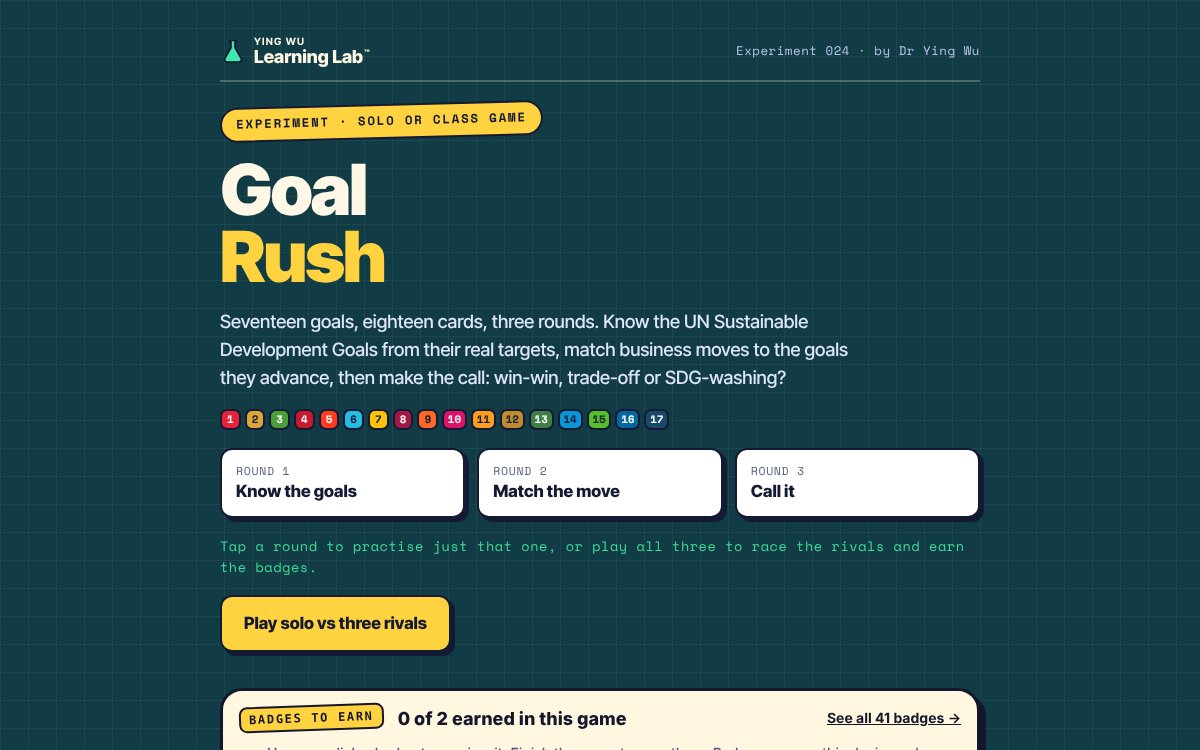
The start screen: three rounds, solo or class mode. 1 Round 1: Know the goals
5 to 10 min- Say
- “Each card is a real UN target. Which of the 17 goals does it belong to?”
- Players
- Teams agree a goal for each target.
- You tap each team's letter, then reveal.
- Watch for
- Card 1, food waste: many teams pick Zero hunger. It's Goal 12, and the ripples show why both matter.
- Card 2, equal pay: Goal 8, not Goal 5.
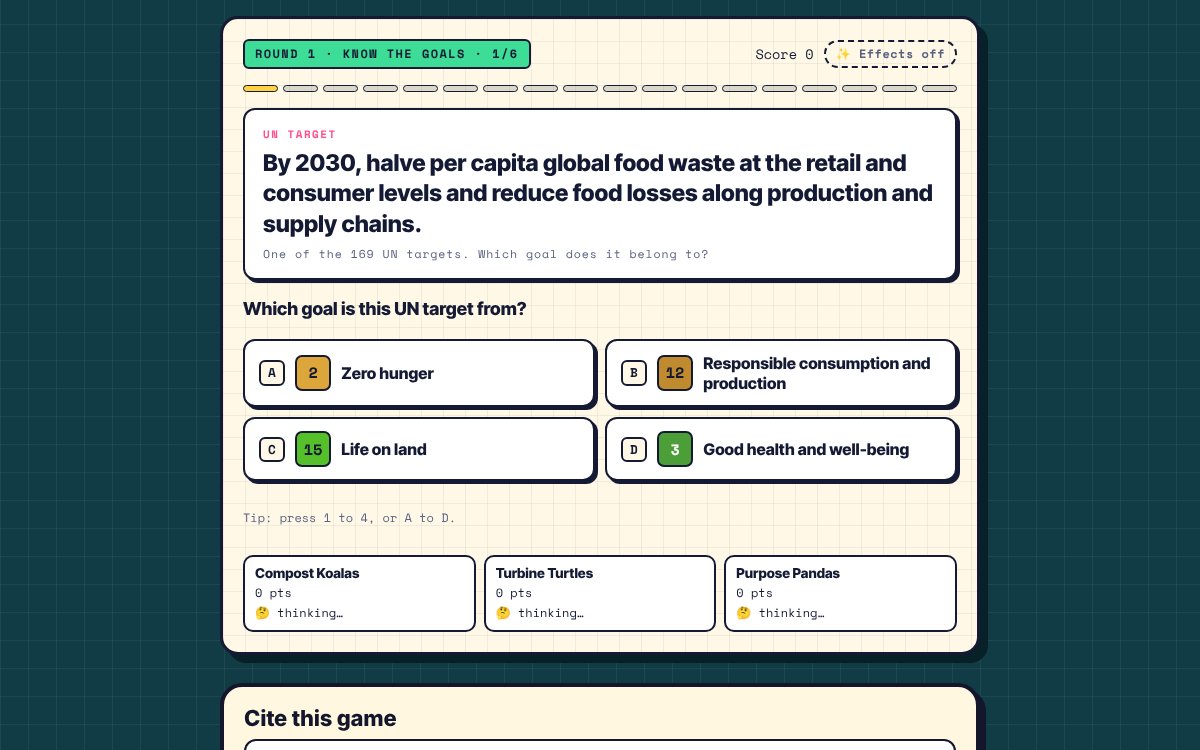
Round 1: the target text, four goals to choose from. 2 Round 2: Match the move
6 to 9 min- Say
- “Now it's business decisions. Which goal does each move advance most directly?”
- Players
- Teams discuss, agree, call out a letter.
- Reveal and read the ripples.
- Watch for
- The coding bootcamp: Goal 4 (skills), with Goal 8 as a ripple.
- The steelworks: Goal 9, because target 9.4 is about retrofitting industry.
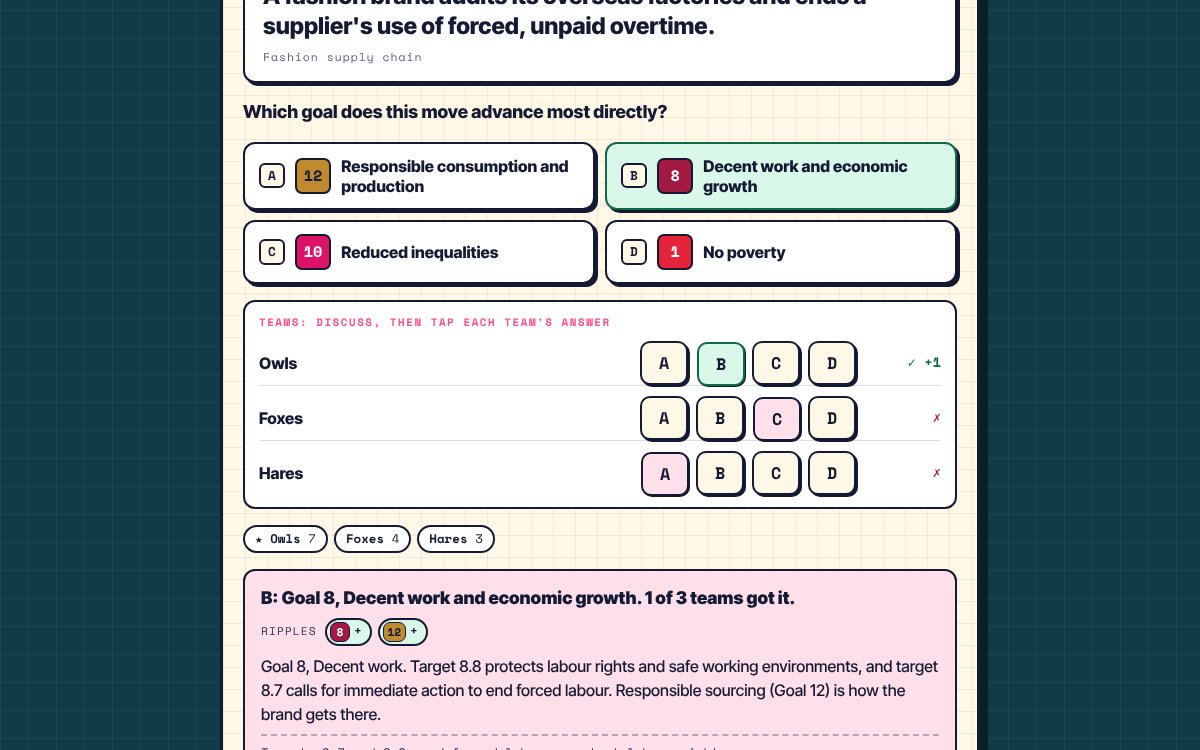
The reveal: ticks for each team, the ripples and the leaderboard. 3 Round 3: Call it
5 to 10 min- Say
- “Win-win, trade-off or SDG-washing? Be ready to say why.”
- Watch for
- Teams calling the Living Wage factory "SDG-washing". It's a real trade-off: real gains, real costs.
- The Kenyan green beans card: an emissions gain that costs smallholder farmers. Ask who should bear that cost.
4 Results and debrief
5 to 10 min- Say
- “Which card split the room? Which trade-off would you make, and how would you soften it?”
- Players
- Trophies for the winning team or teams.
- Use the three debrief questions on the results screen.
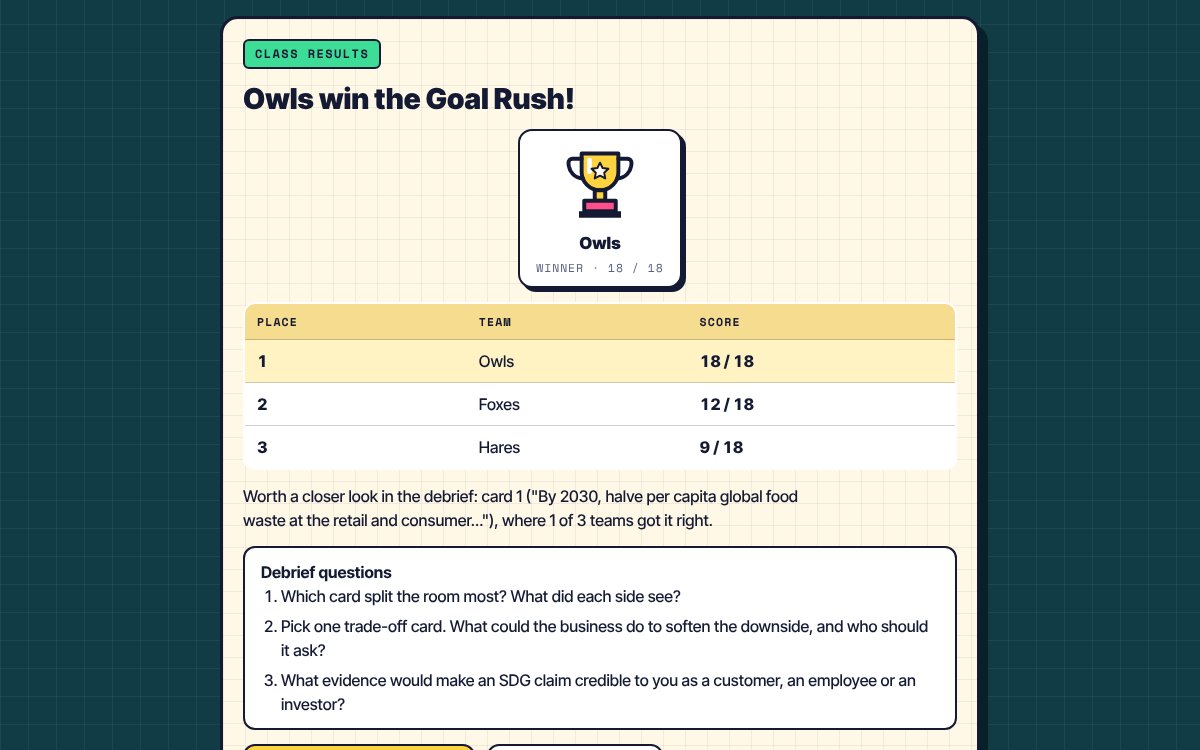
Class results: trophies, the ranking and three debrief questions.
Where it fits
The game supports target 4.7: by 2030, ensure that all learners acquire the knowledge and skills needed to promote sustainable development. It is built on playful learning with the five characteristics in PRME's Impactful Five (i5): meaningful (real targets and real business dilemmas), joyful (rivals, streaks, trophies), socially interactive (teams argue each card out), actively engaging (every card is a decision) and iterative (play again and beat your score).
Pair it with the other games on the Responsible business and the SDGs learning path.
If something goes wrong
| Problem | What to do |
|---|---|
| A team disputes an answer | Good. Ask them to argue it from the target wording on the card. Round 2 asks for the goal the move advances most directly; the others are ripples. |
| The timer is too fast | Switch it off on the start screen. The game remembers the setting on that device. |
| You reloaded mid-game | In class mode, press Resume class game. A solo game starts again. |
| No Wi-Fi | Once the page has loaded it runs without a connection. |
| Short of time | Play one round only: choose it in the class set-up. |
Cheat card
- Class mode, 2 to 6 teams
- “Read the ripples every time.”
- Card 1: food waste is Goal 12
- Living Wage factory: a trade-off, not washing
- Logos without targets or data: SDG-washing
- Debrief: which targets, measured how, and what harm?
Behind the game
- United Nations Department of Economic and Social Affairs (no date) The 17 Goals and the goal and target pages for Goals 1 to 17. Available at: sdgs.un.org/goals (Accessed: 2 November 2026).
- Ministry of Justice (2011) The Bribery Act 2010: guidance about procedures which relevant commercial organisations can put into place to prevent persons associated with them from bribing. London: Ministry of Justice. Available at: gov.uk (Accessed: 2 November 2026).
- PRME (no date) i5: Impactful Five. Available at: i5.unprme.org (Accessed: 2 November 2026).
Business situations are fictional or general examples for discussion, described as at November 2026: a teaching resource, not legal advice. An independent Learning Lab resource by Ying Wu, not produced or endorsed by the United Nations, PRME or the University of Dundee.