What students learn
1. Map the journey, then find the pain
Teams read a customer journey map built from reviews and decide where to spend. The worst moment (a 25-minute check-in queue) is visible from the start; the question is whether teams fix it or chase something shinier.
2. Fix the worst moment, then nail the ending
Guests remember the most intense moments and the end more than the average (the peak-end rule). Fixing check-in and adding a personal ending move NPS far more than free fizz or premium mattresses.
3. Recovery is part of the experience
A boiler fails for everyone. Apology, explanation, fair compensation and follow-up put it right; blaming the supplier makes it worse; a voucher without an apology only half works.
4. Metrics can be gamed
Surveying only happy guests sends the dashboard soaring, until head office surveys everyone. Students see Goodhart's law and sampling bias, and learn how NPS is actually calculated.
Built for services marketing, customer experience and digital marketing classes, and a natural partner to a lecture on customer journey mapping and service quality. Every job's explanation links to the research or regulation behind it; the hotels, guests and numbers are fictional.
Five golden rules
- Reloading is safe.The game remembers where you are in this browser tab, so an accidental refresh will not lose the scores. Closing the tab clears it.
- There is no back button.Once you press Reveal, that round's picks are locked in. Read each team's letters back first.
- The game stops teams going over budget.Letters that would break the £8k fade out. Round 2's housekeeping cut gives £2k back; if a team untakes it, the game asks them to drop something else first.
- Timers never start themselves and never move the game on.Press Start. At 0:00 three bells chime and the clock turns pink.
- The same 100 guests stay at every hotel.Hotels don't compete for guests, so one team's choices never change another team's score. Differences come only from choices.
The scoring model
Remembered score = ½ × (best stage + worst stage + After) ÷ 3 + ½ × average of all six stages
Each guest's 0 to 10 answer = 7.0 + 0.8 × remembered score + their personal tendency, rounded and capped at 0 and 10
Personal tendencies: 100 fixed values from a normal distribution (SD 1.7), the same at every hotel
NPS = % promoters (9–10) − % detractors (0–6). Starting NPS: −31
Budget: £8k a round · Round 3: the boiler hits first (Stay −4), then jobs apply
On inspection day, a fake countdown costs Book −3, and survey gating is exposed: head office surveys every guest, so the "dashboard" figure is replaced by the true one. Closing the loop (Round 3, G) moves guests who scored 5 or 6 up one point. NPS does not depend on other teams' choices.
Round 1: Before they arrive (£8k)
| Job | Cost | Effect | Verdict |
|---|---|---|---|
| A. Show the full price up front | £1k | Book +2 | Good, and the law (DMCC Act drip pricing rules) |
| B. "Only 1 room left!" countdown | £1k | Book +1 now, −3 on inspection day | Risky: fake urgency |
| C. Rebuild the mobile booking form | £4k | Book +3 | Good move |
| D. Pre-arrival email | £1k | Before +3, Arrive +1 | Good move (sets expectations) |
| E. Four upsell pop-ups | £1k | Book −2 | Backfires (effort) |
| F. Brand video for the homepage | £5k | None | Not a pain point |
| G. Live chat on the booking page | £3k | Book +1, Before +1 | Good move (pricier) |
Round 2: During the stay (£8k)
| Job | Cost | Effect | Verdict |
|---|---|---|---|
| A. Free fizz in every room | £5k | Stay +1 | Delight, low return |
| B. Fix check-in | £3k | Arrive +5 | Good move: the worst moment |
| C. Staff can spend £50 to fix problems | £1k | Arrive, Stay, Check-out +1 each | Good move (empowerment) |
| D. Premium mattresses | £6k | Stay +1 | Delight, low return (polishing a strength) |
| E. Greet guests by name | £2k | Arrive +1, Stay +1 | Good move |
| F. Night-one text | £1k | Stay +1, Check-out +1 | Good move |
| G. Quietly cut housekeeping | +£2k back | Stay −2 | Backfires (broken expectations) |
Round 3: After they leave (£8k, boiler alert)
| Job | Cost | Effect | Verdict |
|---|---|---|---|
| The boiler fails (everyone) | – | Stay −4 | Applied before the jobs |
| A. Full service recovery | £3k | Stay +4, Check-out +1 | Good move (perceived justice) |
| B. Lobby notice blaming the supplier | £0 | Stay −1 | Backfires |
| C. 20%-off voucher, no apology | £1k | Stay +2 | Half a fix |
| D. Express check-out | £2k | Check-out +3 | Good move |
| E. Manager's personal thank-you | £1k | After +2 | Good move (the ending) |
| F. Survey only happy guests | £0 | Dashboard only | Risky: survey gating |
| G. Close the loop | £2k | After +2; guests on 5 or 6 move up 1 | Good move |
During the rounds, risky jobs show only a teaser ("Hmm…"), so nobody gives the game away. Their full explanation appears on inspection day. After each reveal, every hotel card shows its 100 guests as dots (mint promoters, yellow passives, pink detractors), its journey map against the previous round (dashed), and which moments guests remember.
Design assumptions and simplifications
The same list appears in the game under "How this game simplifies reality". Share it with students: spotting a model's assumptions is part of the learning.
- Everything is fictional.The hotels, guests, reviews, costs and effects are invented for teaching. Costs only show which jobs are cheap or expensive.
- Feelings are single scores.Each stage has one feeling score from −5 to +5. Real journeys have many touchpoints, channels and personas, and different guests feel them differently.
- The memory formula is a teaching choice.The peak-end rule (Kahneman et al., 1993) is a real finding: people judge experiences largely by their most intense moments and how they end. The exact 50/50 blend of best, worst and end with the overall average is not a research estimate.
- From memory to a score.The constants (7.0 + 0.8 × remembered score, guest tendencies with SD 1.7) were tuned so the game plays well, not estimated from hotel data. Real hotels' NPS varies widely by market and method.
- Effects are fixed, equal and additive.The designer set each job's effect, guided by the cited research and rules. In reality, effects depend on execution and context, and rarely add up this neatly.
- NPS is one lens.It is used because it is widely used, not because it is perfect. Researchers debate how well it predicts growth (Keiningham et al., 2007). CSAT and customer effort scores answer different questions.
- UK rules, simplified.The legal points describe UK rules in 2026 in plain language. They are not legal advice.
Results you can predict
Hotels don't compete for guests, so these paths always give the same NPS, whatever other teams do.
| Path | Picks (R1 · R2 · R3) | After R1 | After R2 | After R3 | Inspection (true NPS) |
|---|---|---|---|---|---|
| Fix the pain (best) | A C D · B C E F · A D E G | 0 | +53 | +85 | +85 |
| No recovery | A C D · B C E F · D E G | 0 | +53 | +75 | +75 |
| Dashboard chaser | A C D · B C E F · A D E F | 0 | +53 | +82 (dashboard) | +75 |
| Delight first | A F · A E · C D E | −24 | −7 | 0 | 0 |
| Cost cutter | A B E · B C F G · B C F | −26 | +5 | +39 (dashboard) | −24 |
| Do nothing | – · – · – | −31 | −31 | −53 | −53 |
The cost cutter is the most memorable line on the NPS tracker: it rises to +39 on the dashboard after Round 3, then falls to −24 when head office surveys everyone. "Delight first" spends almost the whole budget and ends at 0, because fizz, mattresses and a brand video barely touch the moments guests remember.
Step by step
About 15 minutes with one debrief question; allow 18 for the full debrief.
0 Set the scene and form teams
1.5 min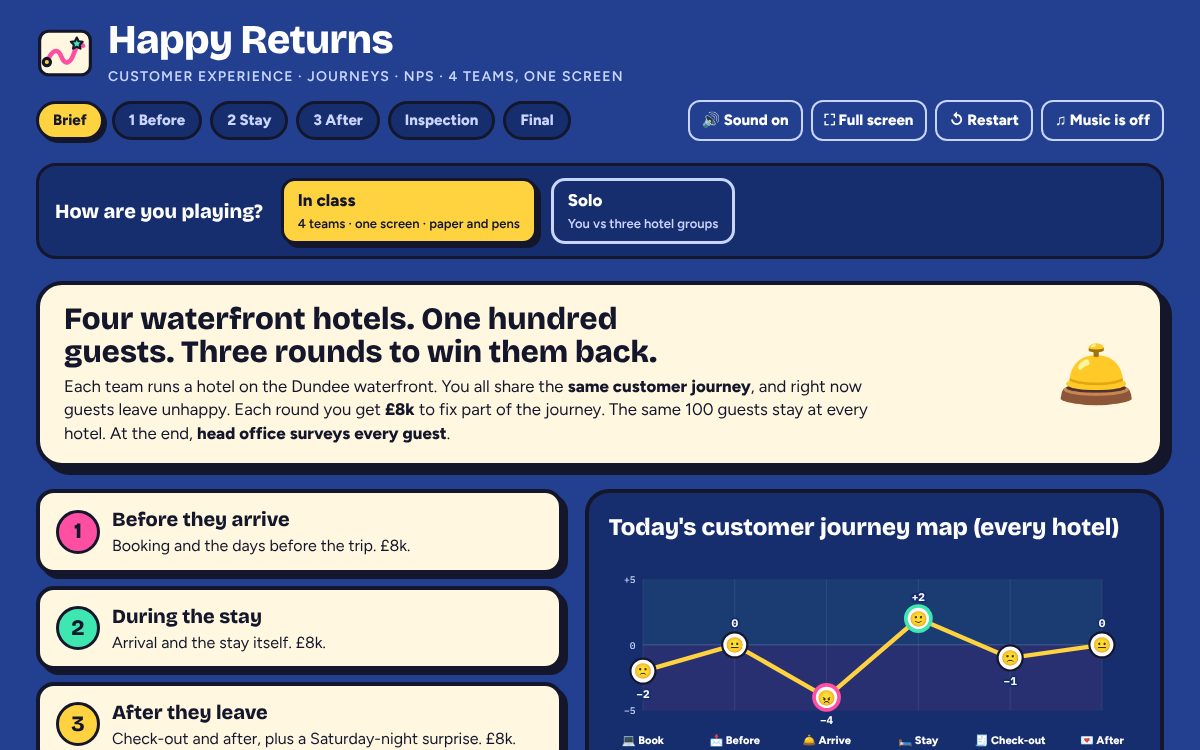
The brief: the shared journey map, the review behind every stage and today's NPS. - Say
- "You each run a hotel on the Dundee waterfront. Same building, same journey, same unhappy guests. Read the reviews: where does it go wrong? You get £8k a round. The same hundred guests stay with each of you, and at the end head office asks every one of them: would you recommend us?"
- Students
- Four teams, each with paper, a pen and a runner. Rename the hotels on screen if you like.
1 Round 1: Before they arrive
3 min · timer 2:00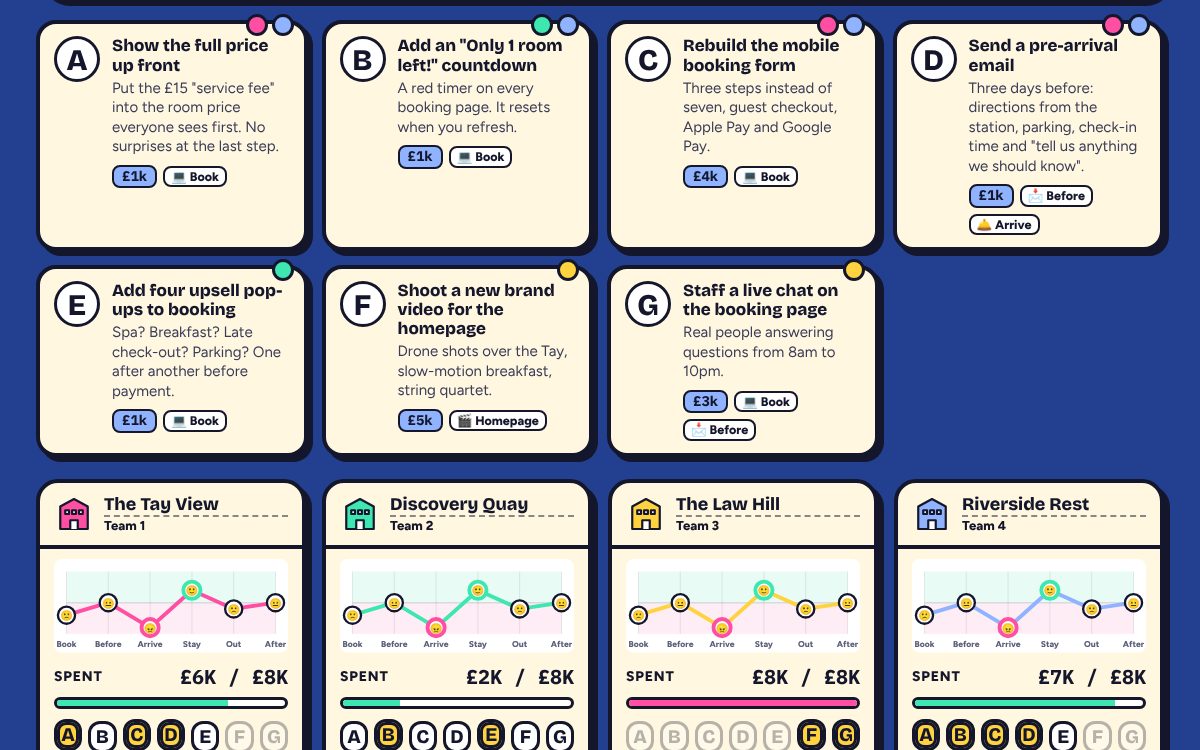
Teams write letters on paper; you tap them in. Each panel shows that hotel's journey map and budget. - Click
- Press Full screen, then Start.
- At 0:00, runners hold up their letters. Tap each team's letters in its panel.
- Read the picks back, then press Reveal the results. The guest dots fill in one by one.
- Watch for
- The brand video (F) is tempting and eats £5k. Let the reveal do the talking.
- Teams rarely notice that the pre-arrival email (D) also improves arrival. Point at the Arrive dot after the reveal.
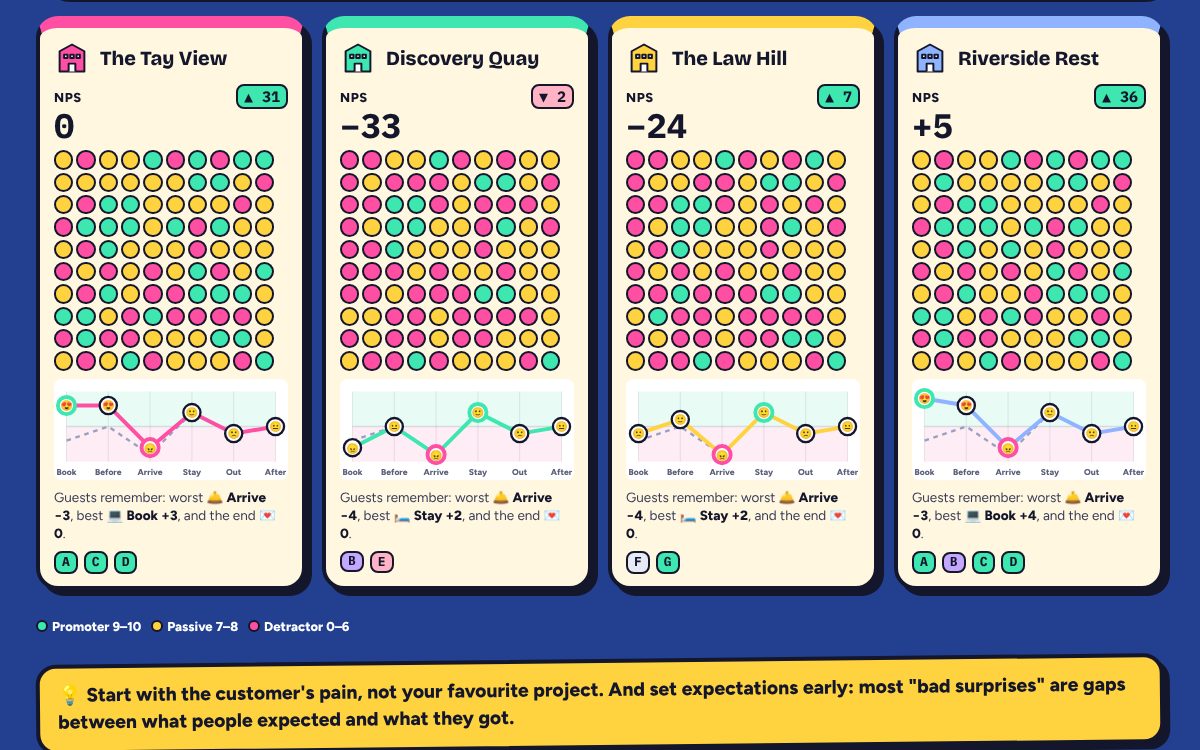
The reveal: same guests, four hotels. The dashed line is the journey before the round. 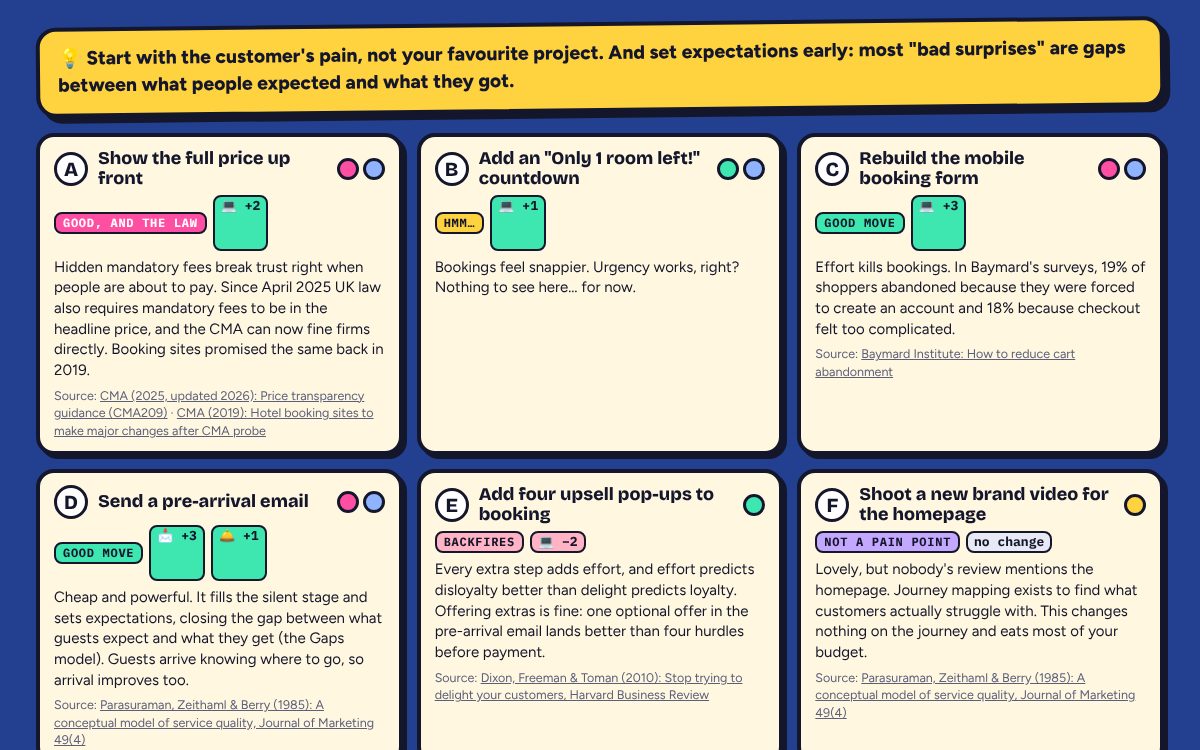
Scroll down for the lesson and why each job worked. The countdown only says "Hmm…" for now. 2 Round 2: During the stay
3 min · timer 2:00- Say
- "Look at your own journey map now. Where is your worst moment?"
- Click
- Next round, Start, tap letters, Reveal the results.
- Watch for
- Fixing check-in (B) is usually the biggest single jump of the game. Teams who bought fizz and mattresses instead are often surprised; ask them which moment guests will tell their friends about.
3 Round 3: After they leave, with a boiler failure
3.5 min · timer 2:00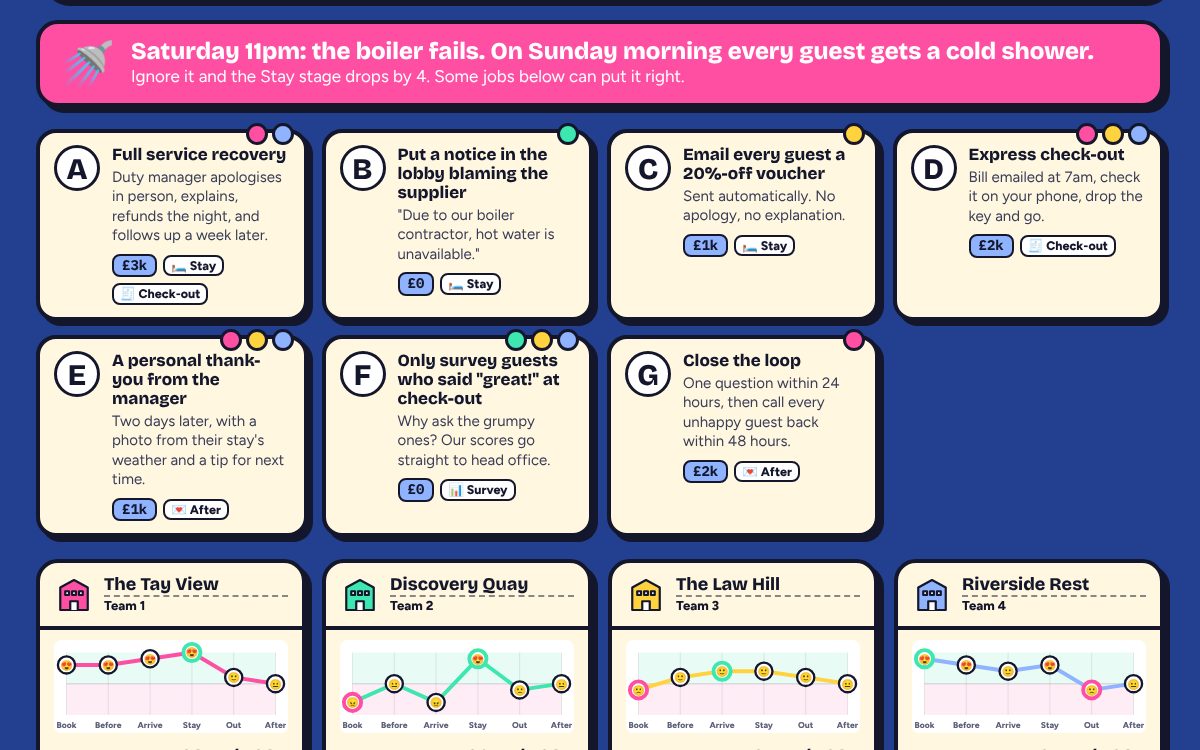
An alarm sounds and the alert appears. Every hotel takes the hit; only some put it right. - Say
- "Read the pink box before you spend anything. Who is going to fix this, and how?"
- Watch for
- Survey gating (F) is free and sounds clever. Teams who pick it see their dashboard jump in the reveal. Don't comment yet: "Interesting. Head office will be pleased… for now."
4 Inspection day and the final results
2 min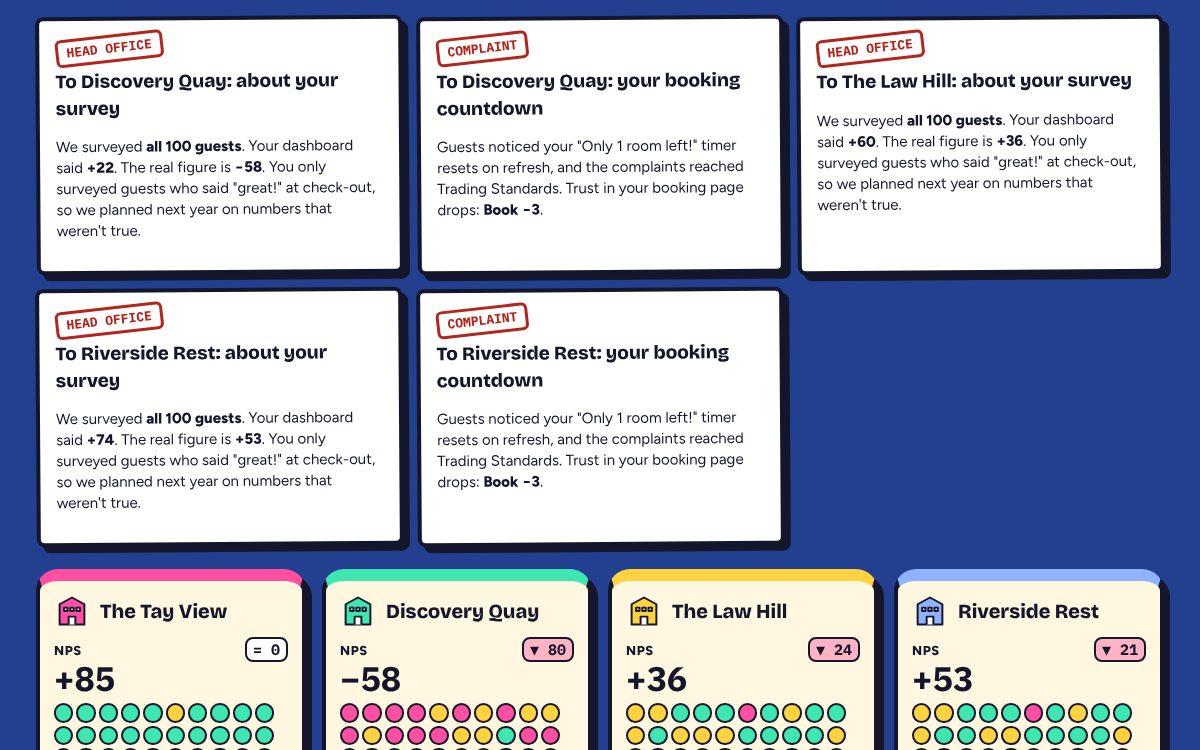
Head office surveys every guest and opens the post. Borrowed numbers fall away. 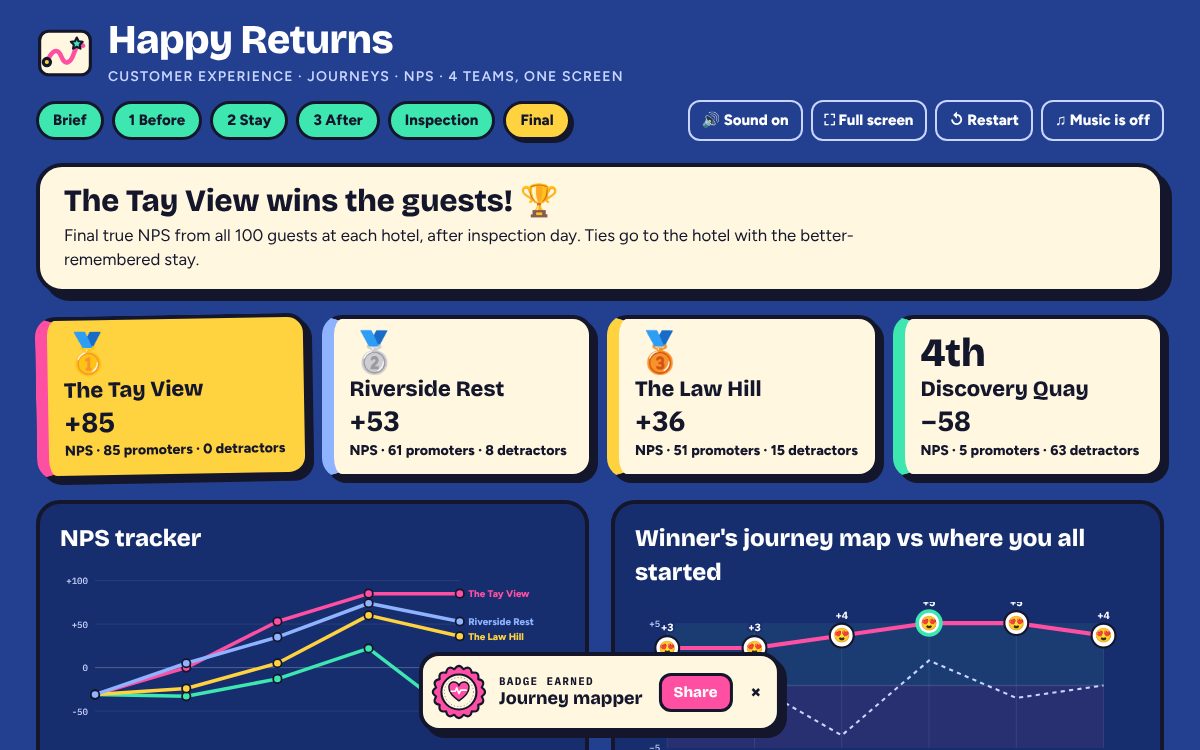
The winner has the highest true NPS. The tracker shows every hotel's journey. - Say
- "A real NPS survey never reaches everyone, and the score you get depends on who you ask, when and how. Here head office did the impossible and asked every guest, so we can see the truth."
5 Debrief
1 to 4 min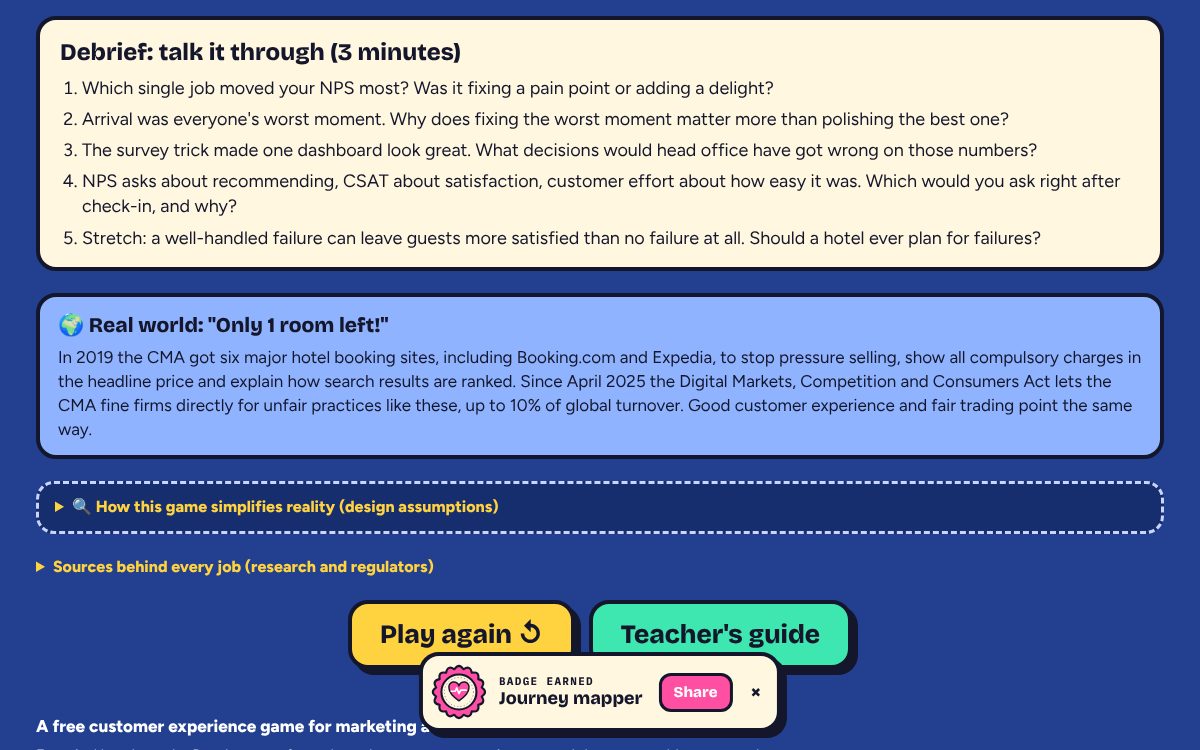
Pick one question, or all five if you have time.
Solo mode
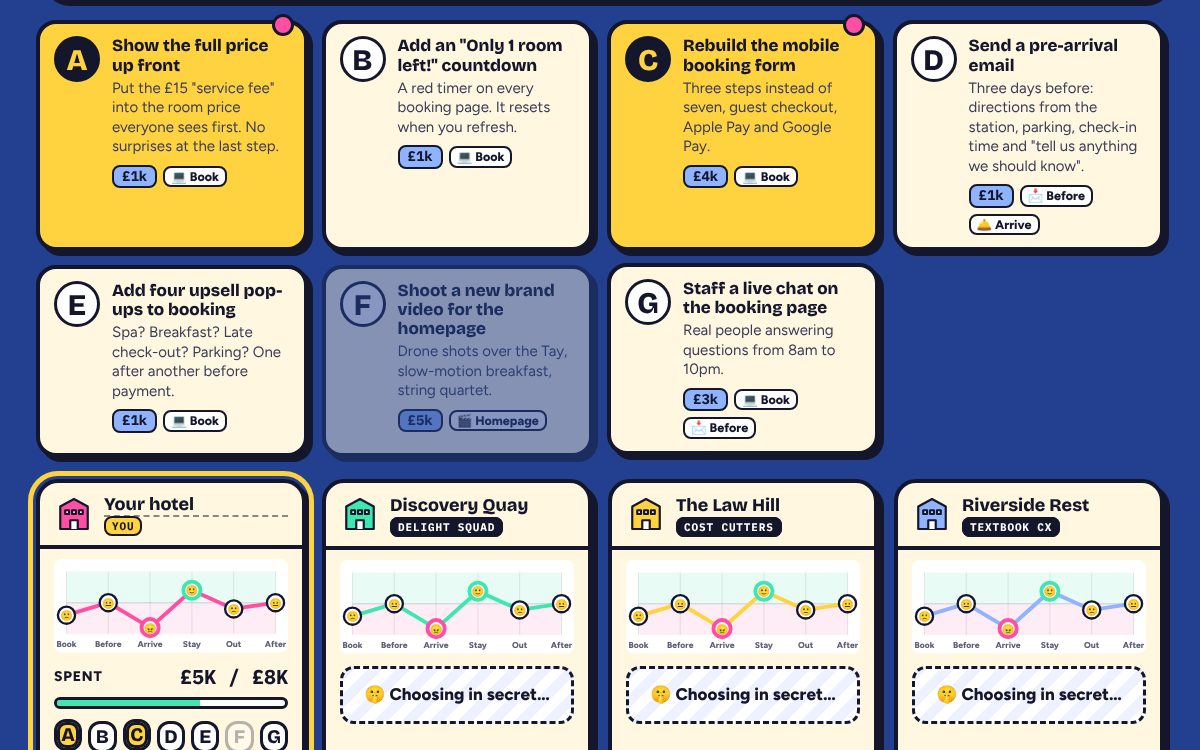
Share lab.yingwu.co.uk/happy-returns/#solo for homework or revision. The player runs one hotel against three rival groups that choose in secret, each with a personality: the Delight Squad loves wow gestures, the Cost Cutters go for cheap tricks, and Textbook CX knows the theory but doesn't always apply it. Their picks have some randomness, so replays differ. Winning the highest true NPS earns the "Guest favourite" badge; finishing any game earns "Journey mapper". Badges are saved only in that browser.
Debrief questions
- Biggest single move? Almost always fixing check-in (Round 2, B): it turns the worst moment of the journey from −4 into a positive one. Delight jobs (fizz, mattresses) add to a stage that is already strong, so they barely move how guests remember the stay.
- Why the worst moment first? The peak-end rule: people judge an experience largely by its most intense moments and its ending, not by averaging every minute. In journey mapping terms, the pain points and the final touchpoints are the moments of truth.
- What would head office have got wrong? They would think service was fine, skip investment in the real problems, reward the wrong managers and never hear from the guests most likely to complain publicly. When a measure becomes a target, people find ways to move the measure rather than the reality (Goodhart's law). Survey design (who, when, how) matters as much as the question.
- NPS, CSAT or effort? Right after check-in, a customer effort or satisfaction question about that interaction ("How easy was it to check in?") tells you most about the touchpoint. NPS is a relationship question about the whole stay and is better asked afterwards. Many firms use all three at different points.
- Plan for failures? No. Well-handled recovery can lift satisfaction (the service recovery paradox), but a meta-analysis found the effect does not extend to repurchase intentions or word of mouth (de Matos et al., 2007), and failures have real costs. Plan the recovery process instead: who apologises, what they can offer, how fast, and how you follow up.
Cheat card: the button order
- Start round 1, Full screen, Start (2:00)
- Tap each team's letters, read them back, Reveal
- Point at the dots and the dashed line; scroll to the lesson; Next round
- Start (2:00), letters, Reveal, Next round
- Read the boiler alert aloud; Start (2:00), letters, Reveal
- Next: inspection day, wait for the letters, See the final results
- Point at the NPS tracker; ask one debrief question
Behind the jobs
- Bain & Company (n.d.) Measuring your Net Promoter Score. nps.bain.com
- Baymard Institute (2026) How to reduce cart abandonment. baymard.com
- Competition and Markets Authority (2019) Hotel booking sites to make major changes after CMA probe, 6 February. gov.uk
- Competition and Markets Authority (2025, updated 2026) Price transparency (CMA209). gov.uk
- de Matos, C.A., Henrique, J.L. and Rossi, C.A.V. (2007) 'Service recovery paradox: a meta-analysis', Journal of Service Research, 10(1), pp. 60–77. doi.org
- Dixon, M., Freeman, K. and Toman, N. (2010) 'Stop trying to delight your customers', Harvard Business Review, July–August. hbr.org
- Hyken, S. (2021) An empowerment lesson from the Ritz-Carlton. hospitalitynet.org
- Kahneman, D., Fredrickson, B.L., Schreiber, C.A. and Redelmeier, D.A. (1993) 'When more pain is preferred to less: adding a better end', Psychological Science, 4(6), pp. 401–405. psychologicalscience.org
- Keiningham, T.L., Cooil, B., Andreassen, T.W. and Aksoy, L. (2007) 'A longitudinal examination of Net Promoter and firm revenue growth', Journal of Marketing, 71(3), pp. 39–51. doi.org
- Parasuraman, A., Zeithaml, V.A. and Berry, L.L. (1985) 'A conceptual model of service quality and its implications for future research', Journal of Marketing, 49(4), pp. 41–50. doi.org
- Slaughter and May (2025) CMA clarifies expectations on consumer reviews but uncertainties remain. thelens.slaughterandmay.com
- Tax, S.S., Brown, S.W. and Chandrashekaran, M. (1998) 'Customer evaluations of service complaint experiences: implications for relationship marketing', Journal of Marketing, 62(2), pp. 60–76. Google Scholar
A simplified classroom model: the scores, costs and effects are illustrative teaching devices, not estimates of real hotel performance. The hotels are fictional.