What students practise
1. Saying it out loud
Most students have never answered an interview question aloud against the clock. "Speak, see it written" is the default: they answer out loud and watch a live transcript appear, which they can check, edit and keep.
2. Telling STAR stories
Five "tell me about a time" questions (teamwork, problem solving, conflict, leadership and a setback) are checked for the four STAR parts: situation, task, action and result. The part students miss most often is the result.
3. Handling the follow-up
The talent partner probes: "What exactly did you do, as opposed to the rest of the team?" Students learn that follow-ups are a normal part of an interview, and that saying "we" hides their own contribution.
4. Knowing what to rehearse
After each answer, students see what the room noticed, tick what a strong answer covers and rate their confidence. The debrief names the three areas to work on, with a structure for each. One click reruns just those three.
It suits placement and graduate job preparation, employability and professional skills modules, MBA career development and careers events. The setup changes the wording to fit the student's career stage, the role, the organisation and the sector.
Two interviewers, two styles
Amara Okafor, hiring manager
Friendly and wants to picture the candidate in the team. Opens the interview and asks about motivation, problem solving, strengths, ambition and the candidate's own questions.
Sam Reid, talent partner
Structured and probes for evidence. Asks the competency questions on teamwork, conflict, leadership and setbacks, plus commercial awareness and judgement, and asks every follow-up.
Both interviewers are fictional. Splitting the styles helps students practise switching between a warm question and a probing one. Real interviews vary: some have one interviewer, some are video or recorded interviews, and many graduate schemes add an assessment centre.
Pick a format
Student on their own
Share the link before placement or graduate applications open. Ask students to bring the copied rehearsal list to a careers or personal tutor meeting. That list becomes the agenda.
In a tutorial or careers appointment
The student drives the room and answers aloud; you listen as the interviewer. At each self-check, say which points you heard before they tick, and add one question about their actual CV.
Peer mock interviews
In class, students rehearse alone, then pair up and interview each other on their weakest areas. This is the 60-minute workshop plan below.
One screen, whole room
Put the room on the projector, set it up for a real job advert, and take two or three answers to each question from the room before checking them against the list. Good for first-year students who have never had an interview.
Five golden rules
- Nothing is saved.The role, answers and ratings stay in the open page and vanish when it closes. Students should press "Copy my rehearsal list" on the debrief before leaving. In "Speak, see it written" mode the browser's own speech service (Google, Microsoft or Apple) turns the student's voice into text; students who prefer not to use it can choose "Say it aloud" or "Type it".
- It is a rehearsal, not a verdict.There is no score and no pass or fail. Confidence is self-rated and the checklist is ticked by the student. The automatic feedback looks at wording only, so it cannot tell whether an answer is good. Say this at the start.
- The questions are typical, not job-specific.They cover what most interviews ask and use the role, organisation and sector the student enters, but no tool has read the job description or their CV. Use it alongside careers advice and a mock interview with a person.
- Say it, don't just think it."Speak, see it written" is the default and works in Chrome, Edge and Safari. In Firefox the room opens on "Say it aloud", and typing works everywhere. Questions appear as text by default, which suits a shared room; choose "Read questions aloud" to hear each interviewer.
- "I", not "we".The room flags answers with more "we" than "I" because employers hire individuals. Encourage students to describe the team in one sentence and spend the rest of the answer on what they did.
The question bank
The short interview asks the 8 questions marked in the last column, in this order. The full interview asks all 12. Follow-up answers are capped at 90 seconds. ★ marks the five competency questions that get the STAR check.
| Area | Asked by | Question | Follow-up | Short |
|---|---|---|---|---|
| Opening | Amara | Tell us a bit about yourself and what brings you to this role.Uses the role title if one is given. | None | ✓ |
| Motivation | Amara | Why do you want to work for us, and why this role in particular?Uses the organisation and role if given. | What do you know about us that you couldn't get from the first page of the website? | ✓ |
| Teamwork ★ | Sam | Tell me about a time you worked in a team to achieve something difficult, at university, at work or elsewhere.Experienced roles: a time you got a team to deliver something difficult under pressure. | What exactly did you do, as opposed to the rest of the team? | ✓ |
| Problem solving ★ | Amara | Describe a problem you solved where the answer wasn't obvious. | How did you know your solution had worked? | ✓ |
| Handling conflict ★ | Sam | Tell me about a time you disagreed with someone you were working with. How did you handle it? | Looking back, would you handle it any differently? | |
| Leadership ★ | Sam | Tell me about a time you took the lead or influenced others without being in charge.Experienced roles: a time you led people through a change they didn't want. | How did you bring round the people who disagreed with you? | |
| Setbacks ★ | Sam | Tell me about a time something went wrong. What happened, and what did you learn? | How have you used that lesson since? | ✓ |
| Strengths | Amara | What are your main strengths, and how would they help you in this role? | And what is something you are still working to improve? | ✓ |
| Commercial awareness | Sam | What is one trend or challenge facing your chosen sector right now, and how might it affect an organisation like ours?Uses the sector and organisation if given. | If you were in charge, what would you do about it? | ✓ |
| Judgement | Sam | Imagine two managers each give you an urgent task due tomorrow, and you can't finish both. What do you do? | And if both of them insist theirs comes first? | |
| Ambition | Amara | Where do you see yourself in three to five years?Placements: what do you hope to get out of this placement, and where do you want it to take you? Experienced roles: where do you want your career to go next, and how does this role fit? | None | |
| Your questions | Amara | We're nearly out of time. Do you have any questions for us? | None | ✓ |
What the room notices
In "Speak, see it written" and "Type it" modes, a "What we noticed" box appears after each answer. Every check runs on the student's own device and looks at wording, not the quality of the answer.
| Check | What it looks for |
|---|---|
| Length | Flags answers under 40 words, or well short of the time allowed, as needing development. |
| STAR check ★ | Situation ("during my placement…"), task ("my role was…"), action ("I organised…") and result ("as a result…", or a number or percentage). Shown as four ticks or crosses. |
| Pace | Spoken answers only. About 120 to 160 words a minute is comfortable; over 170 is flagged as fast. |
| Filler words | "Um", "er", "you know", "sort of", "kind of", "basically", "I mean". Flagged at three or more. |
| Hedging | "I think", "maybe", "probably", "I'm not sure" and similar. Flagged at three or more. |
| "We" versus "I" | Flagged when "we", "our" and "us" outnumber "I", "my" and "me". |
| Example or evidence | A specific moment, project, customer, number or "for example". |
| Signposting | "First… second… finally" or "two reasons", in answers over 60 words. |
| "Heard" tags | Marks checklist points where the wording suggests the student covered them. The student still decides what to tick. |
The debrief adds a "Your delivery" summary: total words, average pace, filler words, how many competency answers covered all four STAR parts and which part was missing most often. Speech recognition can drop some "um"s and mishear accents or technical terms, so treat the counts as a guide.
Every checklist
These are the points students tick after each answer, with the model structure the room suggests. Use them as a listening sheet when you play interviewer.
Open the 12 checklists
Opening
- Keeps it focused: about two minutes
- Picks two or three highlights that fit the role
- Links your background to this job
- Ends with why you want it
Present → past → future: what you do now, two highlights that fit the role, and why this job is your next step.
Motivation
- Shows specific research on the organisation
- Links its values or work to your own
- Explains why this role, not just any job
- Avoids generic praise
Them → the role → you: one specific thing you found out about them, why it appeals, and what you would bring.
Teamwork ★
- Sets the scene briefly (Situation)
- Makes your own part clear (Task)
- Describes what you did, using "I" (Action)
- States the result, ideally with a number (Result)
STAR: Situation in one sentence → your Task → the Actions you took, with "I" → the Result, ideally a number → what you learned.
Problem solving ★
- Explains the problem and why it was hard
- Shows how you weighed up options
- Explains what you decided and did
- Gives evidence that it worked
Problem → the options you weighed → what you decided and did → evidence it worked.
Handling conflict ★
- Stays professional about the other person
- Shows you listened to their view
- Explains how you reached a resolution
- Reflects on what you learned
Their view, fairly put → how you listened → how you found common ground → what you learned. Never criticise the other person.
Leadership ★
- Sets out the goal and what was at stake
- Explains how you influenced or motivated others
- Shows how you handled resistance
- States the result for the team or organisation
Goal → how you brought people with you → how you handled pushback → the result for the team.
Setbacks ★
- Chooses a real setback, not a disguised strength
- Takes ownership without blaming others
- Explains what you did to put it right
- Shows what you do differently now
What went wrong (own it) → what you did to fix it → what you learned → how you have used it since.
Strengths
- Names two or three specific strengths
- Backs each one with an example
- Links them to the job
- Answers the development area honestly, with what you are doing about it
Strength → example → why it matters for this role. Then one genuine development area and what you are doing about it.
Commercial awareness
- Names a specific, current trend
- Explains why it matters for the organisation
- Shows a view of your own
- Suggests a sensible response
Trend → why it matters for them → your view → what you would do.
Judgement
- Gathers the facts before acting
- Communicates early and openly
- Prioritises by impact on the organisation
- Proposes a practical solution or compromise
Clarify → communicate early → prioritise by impact → propose a solution. Show calm judgement, not heroics.
Ambition
- Shows realistic ambition
- Links your goals to this role and organisation
- Shows commitment, not just a stepping stone
Realistic next steps → the skills you want to build → how this role and organisation help you get there.
Your questions
- Asks one or two thoughtful questions
- Your questions show you researched the role
- Avoids asking only about pay or holidays at this stage
- Ends with a confident close
Ask two genuine questions about the role, the team or what success looks like, then thank them and say you are keen.
How the debrief ranks areas: each answer scores its confidence rating (1 to 5) plus up to 2 points for the share of checklist points ticked. The three lowest become "Rehearse these next", and the missed points become "Add next time".
Before the session
- Share lab.yingwu.co.uk/interview/ as a link or QR code.
- Run a short interview yourself for a real job advert. It takes about 20 minutes and shows you where students will hesitate.
- Ask students to bring a job or placement advert and their CV, and to think of three stories: a team success, a problem they solved and something that went wrong.
- Plan the space. Answering aloud needs room: spread pairs out, use breakout rooms online, or let students use "Type it" with headphones for the solo run. In a shared room, ask them to set the interviewers' voices to "Text only".
- For the live transcript, students need Chrome, Edge or Safari and must allow the microphone when asked.
A 60-minute mock interview workshop
For 4 to 40 students, each with a phone or laptop. They rehearse alone first, then interview each other.
0 Set the tone
5 min- Say
- "Most interview questions are predictable, so we will rehearse those today and save your thinking for the ones that are not. Nobody sees your answers, and there is no score here."
- Students
- Open the room, press "Enter the room" and set the scene: career stage, plus the role, organisation and sector from their advert. Choose Short and 2 minutes. Keep Speak, see it written unless the room is too noisy, and set the voices to Text only.
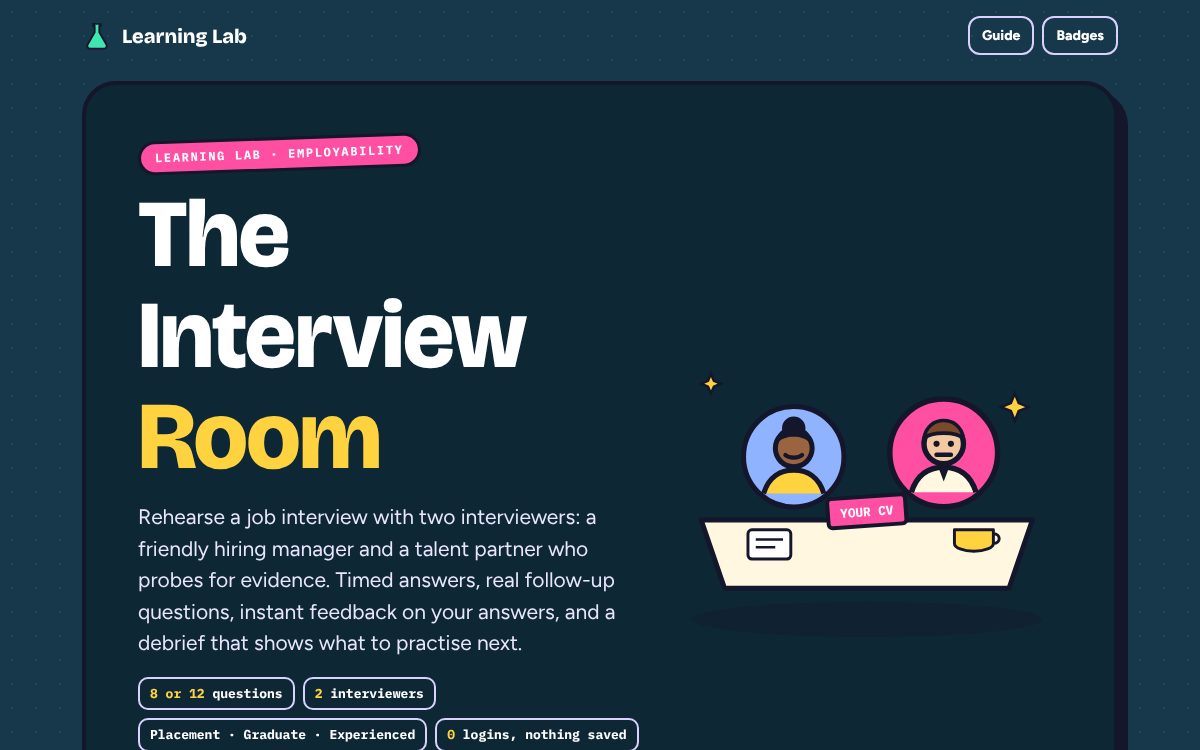
The start screen introduces the two interviewers. 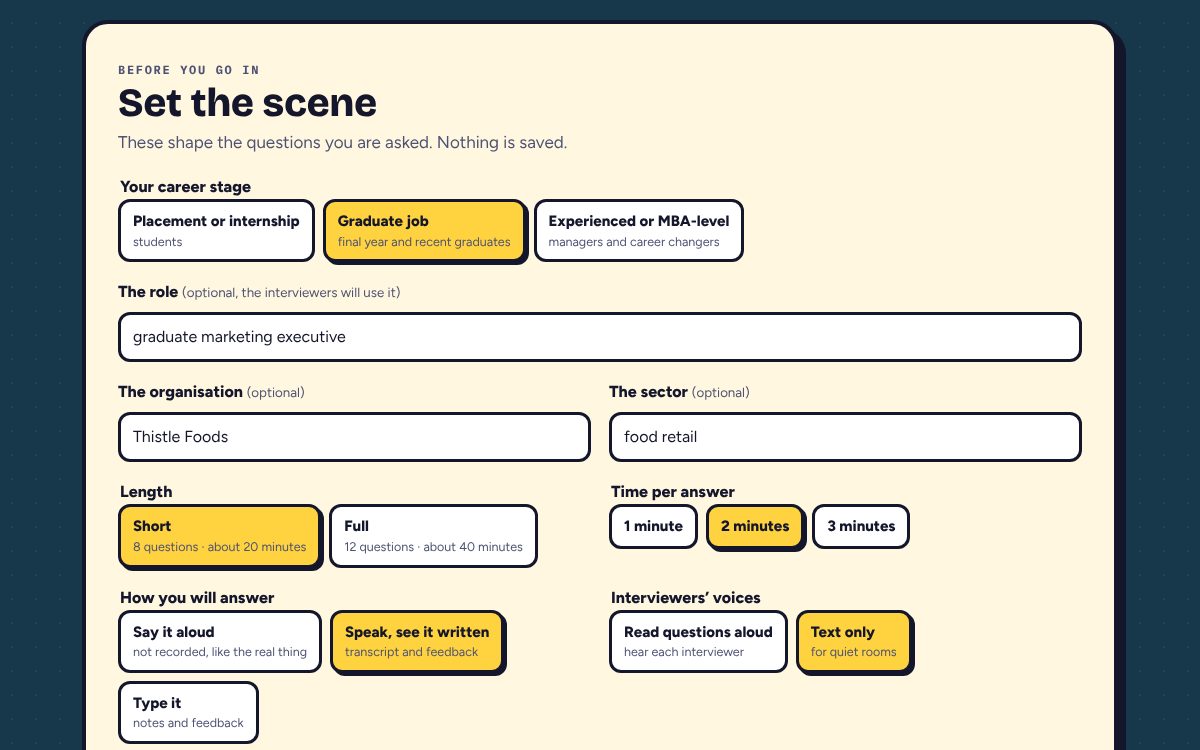
Setting the scene: the role, organisation and sector appear in the questions. 1 Solo run
20 min- Students
- Read or listen to the question, press "Start answering" and speak. Their words appear as they talk.
- Press "I have finished". The talent partner usually follows up.
- Read "What we noticed", tick what the answer really covered and rate their confidence.
- After 8 questions, read the debrief and press "Copy my rehearsal list".
- Watch for
- Students ticking a point because the room "heard" a word. Ask them to tick only what they really said.
- Long silences on "tell me about a time" questions. Suggest they jot down three stories before starting again.
- Fast finishers: point them to "Rehearse just these 3".
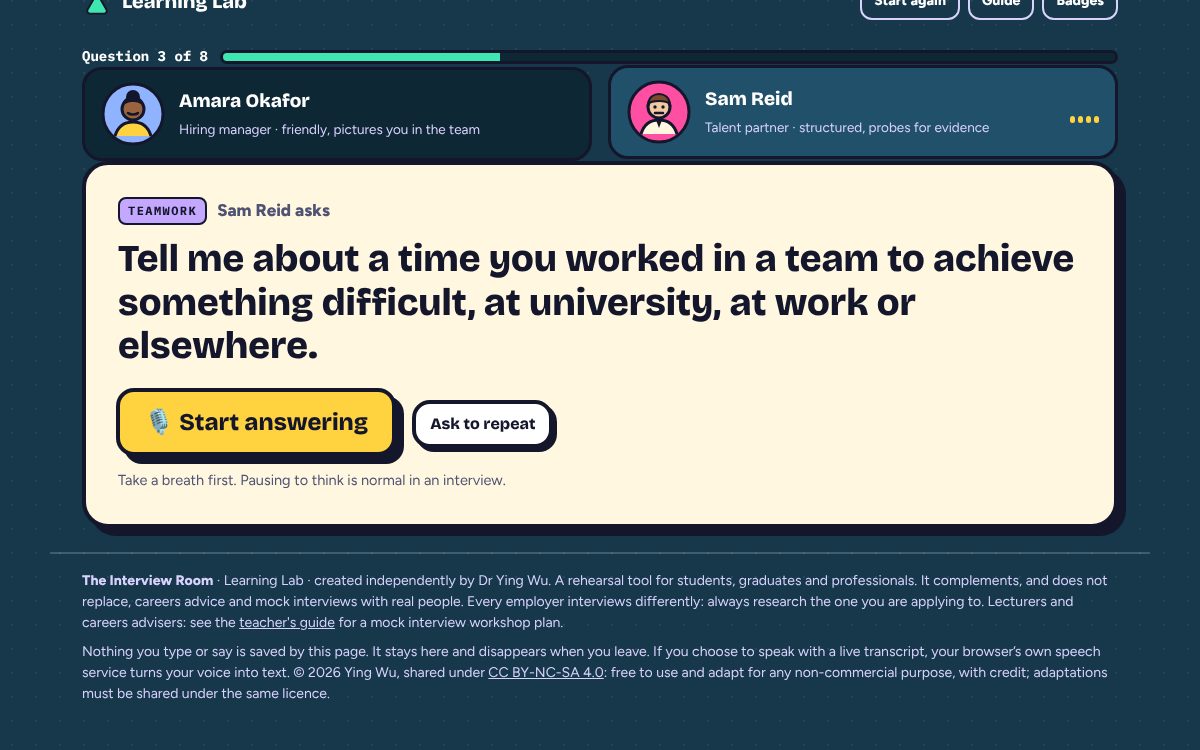
The talent partner asks the competency questions. 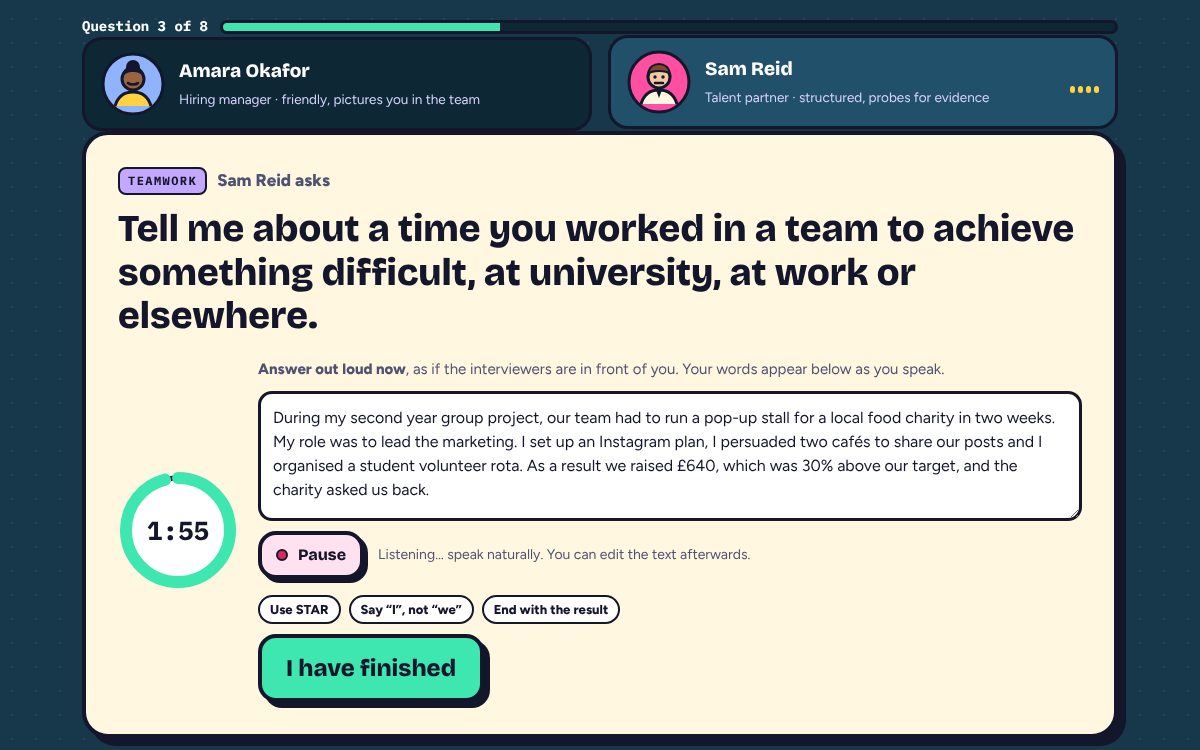
Answering aloud: the transcript appears as the student speaks. 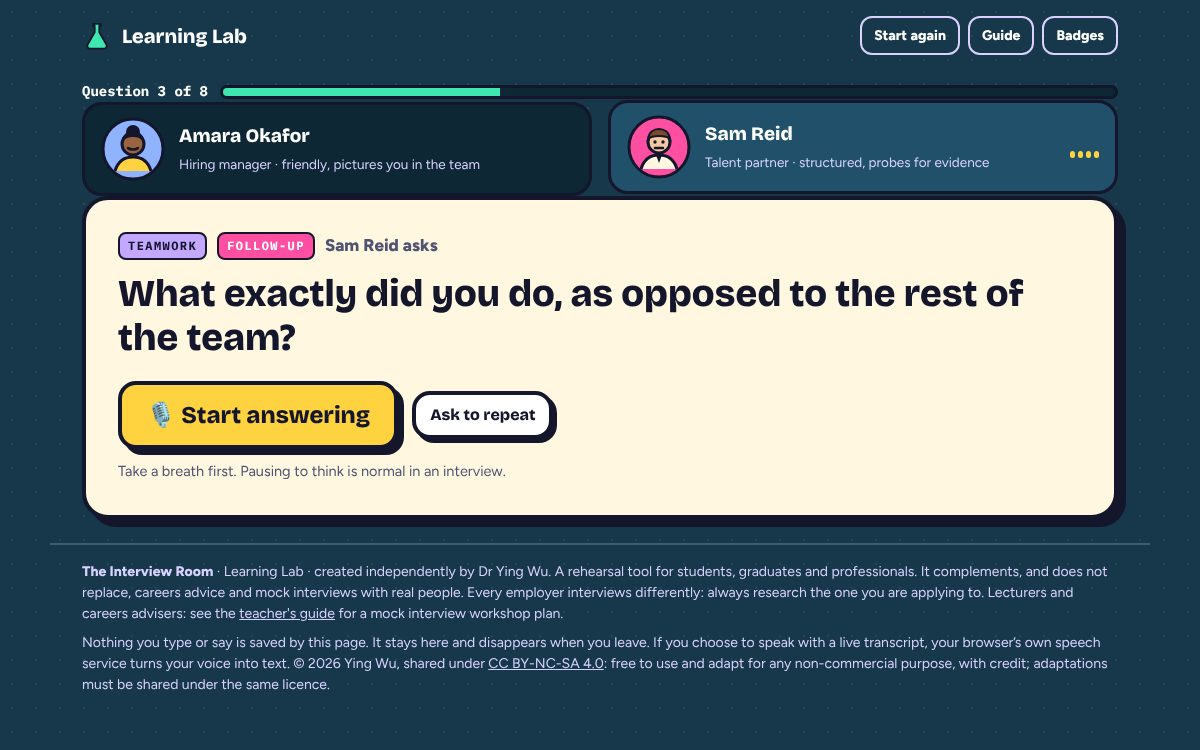
The follow-up pushes for the student's own part. 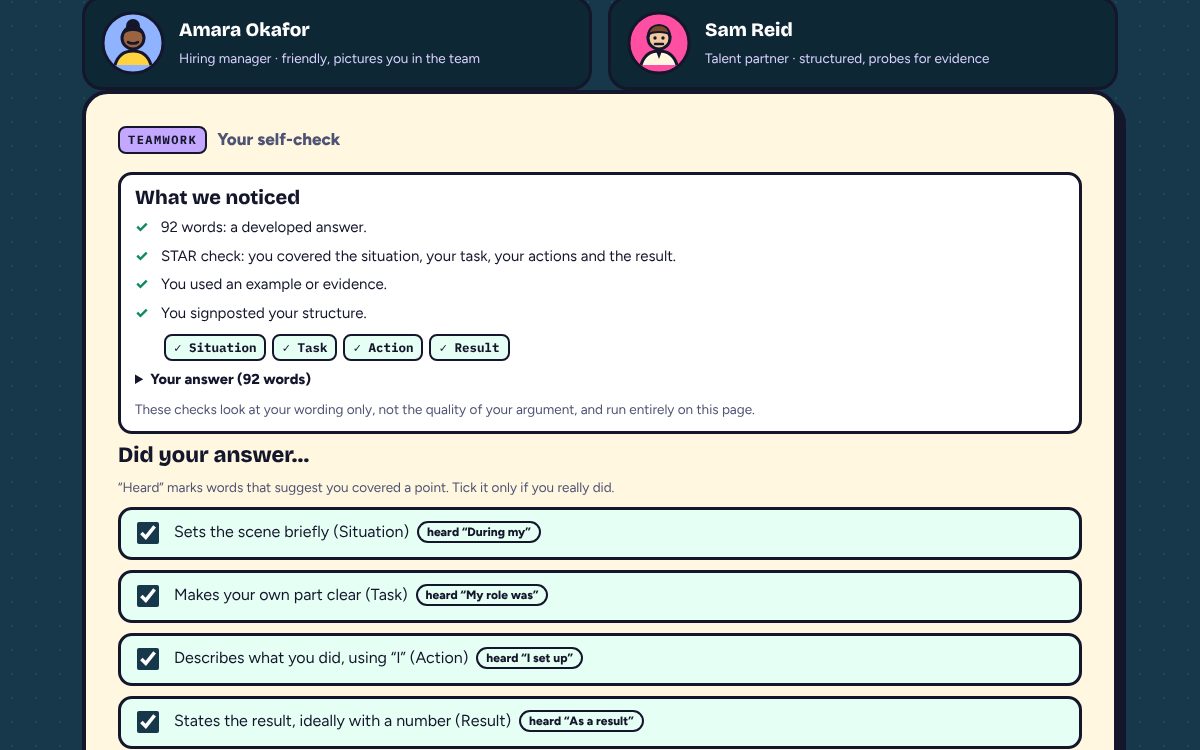
Instant feedback, including the STAR check. 2 Pair mock interview
20 min- Set up
- Pair students, ideally applying for different roles. Each student gets 10 minutes as the candidate and 10 as the interviewer.
- Candidate
- Presses "Rehearse just these 3", keeps or changes the answer mode, and hands the device to their partner.
- Interviewer
- Reads each question and follow-up aloud, and starts the timer.
- Listens for the four STAR parts in each story.
- At the self-check, says which points they heard before the candidate ticks.
- Adds one question about the candidate's CV: "Tell me more about…"
- Watch for
- Interviewers being too kind. Remind them that a probing follow-up is a gift today.
- Candidates reading from notes. Ask them to put the screen face down while they answer.
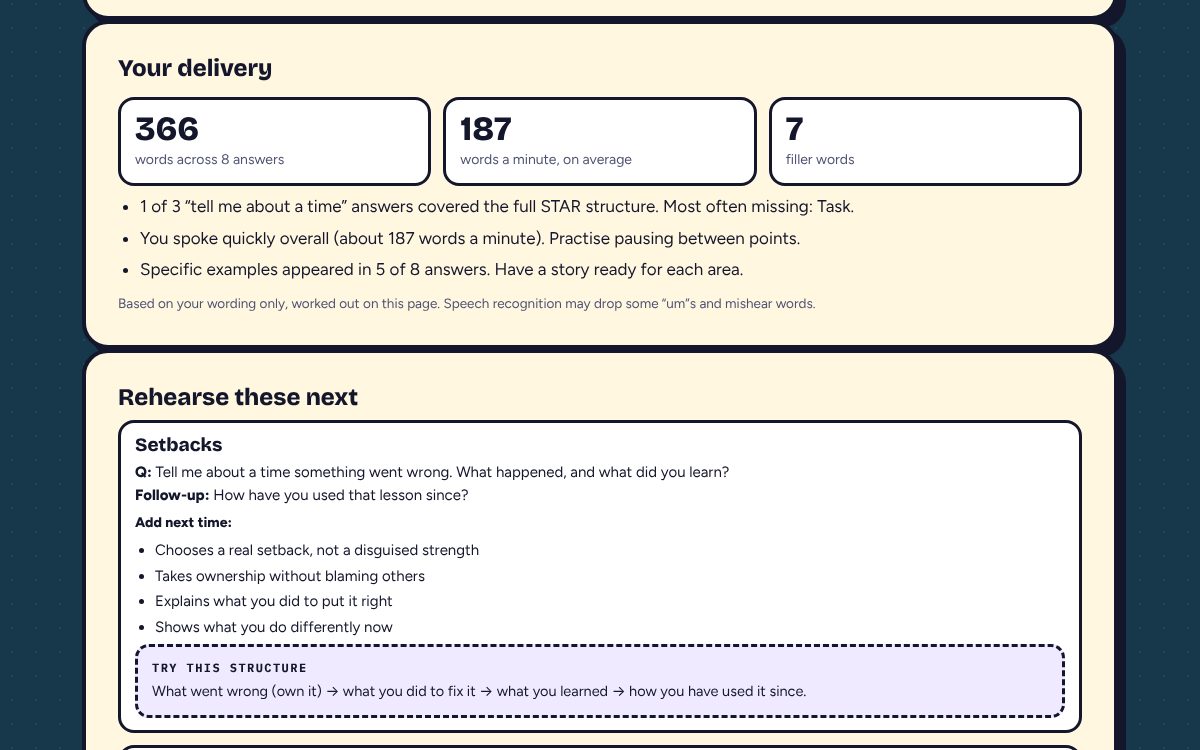
"Your delivery" gives each pair habits to work on. 3 Debrief
10 min- Ask
- "Which area came up as your weakest? Was it the one you expected?"
- "Which STAR part did you miss most often? For most people it is the result."
- "Tell the person next to you why you want this job in two sentences. Was it specific to the organisation?"
- "Retell one story using 'I' for everything you did. What changed?"
- "What will you prepare before your real interview?"
- Takeaway
- Predictable questions deserve prepared stories. Rehearsing them aloud frees you to think on your feet for the rest.
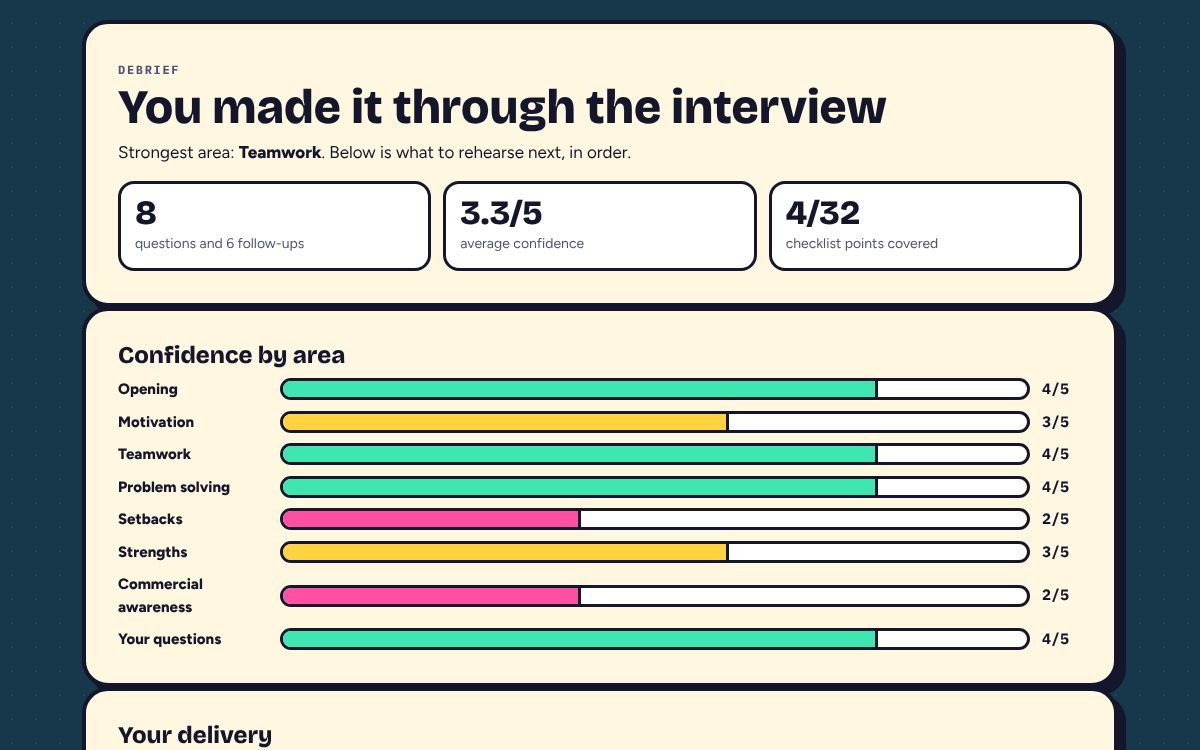
The debrief shows confidence by area at a glance. 4 Close
5 min- Students
- Copy their rehearsal list (it includes their answers and the feedback) and keep it with the job advert. Finishing an interview also earns the Interview ready badge on their device, if they want to share it.
- Say
- "Run it again the day before your interview, aloud, with the real job advert."
If something goes wrong
| Problem | What to do |
|---|---|
| A student closed or reloaded the page | The run is gone: nothing is stored. The browser warns before leaving mid-interview. A short run takes 20 minutes, or "Rehearse just these 3" gives a quicker second go. |
| "Speak, see it written" is missing | The browser does not support live transcripts, usually Firefox. Use Chrome, Edge or Safari, or choose "Say it aloud" or "Type it". |
| "Microphone blocked" | Allow the microphone for the site in the browser's address bar, then press the microphone button again. Typing still works in the meantime. |
| The transcript mishears words | Students can edit the text before pressing "I have finished". Accents, names and technical terms can trip up speech recognition, so treat the feedback counts as a guide. |
| The timer ran out mid-answer | Nothing is cut off. The button changes to "Time is up: finish answer". Real interviews have no timer, but most competency answers should take about two minutes. |
| "Copy my rehearsal list" does not copy | Some browsers block the clipboard. A message says so; take a screenshot of the debrief instead. |
| The room is too noisy | Use "Type it" and "Text only" for the solo run, then answer aloud in pairs, spread out or in breakout rooms. |
| The questions do not fit the job | Check the career stage chosen in setup. Then add role-specific questions yourself: that is the interviewer's part. |
Cheat card
- Share lab.yingwu.co.uk/interview/
- "A rehearsal, not a test. Nobody sees your answers."
- Setup: Short, 2 minutes, their real advert, voices "Text only"
- 20 min solo run, then copy the rehearsal list
- Pairs: "Rehearse just these 3", partner as interviewer
- Debrief: weakest area, missing STAR part, "I" not "we"
Use it before placement and graduate applications, in professional skills modules or at careers events. It works for experienced and MBA-level candidates too: choose "Experienced or MBA-level" for questions on leading change and career direction. Open the Interview Room →
Behind the room
- Huffcutt, A.I., Conway, J.M., Roth, P.L. and Stone, N.J. (2001) 'Identification and meta-analytic assessment of psychological constructs measured in employment interviews', Journal of Applied Psychology, 86(5), pp. 897-913.
- Janz, T. (1982) 'Initial comparisons of patterned behavior description interviews versus unstructured interviews', Journal of Applied Psychology, 67(5), pp. 577-580.
- Latham, G.P., Saari, L.M., Pursell, E.D. and Campion, M.A. (1980) 'The situational interview', Journal of Applied Psychology, 65(4), pp. 422-427.
- Levashina, J., Hartwell, C.J., Morgeson, F.P. and Campion, M.A. (2014) 'The structured employment interview: narrative and quantitative review of the research literature', Personnel Psychology, 67(1), pp. 241-293.
The questions reflect themes common in competency-based (behaviour description), strengths-based and situational interviews. They are not taken from any employer's process. Interview formats vary by employer and sector.