What students learn
1. One plan, several lenses
A plan can do real good and still fail on rights or fairness. Looking through each lens in turn shows more of the ethical picture.
2. Consequences are weighed
The utilitarian lens weighs benefits against harms with evidence; it doesn't demand zero harm.
3. Credit isn't consent
Reposting customers' photos, especially children's, in adverts needs permission, whatever the reach.
4. Character shows in the small print
An unchecked ‘carbon neutral’ claim and a plan to deflect questions fail on honesty, and on the Green Claims Code.
Pick a format
Seminar warm-up
Students play solo for 10 minutes, then you debrief the rows that split the room. The plan below.
Assessment preparation
Set it before students write the analysis section of a report: the end screen shows a model criterion, rating, evidence, so what table.
Homework or revision
Share the link. It works on a phone and keeps progress if the page is reloaded.
Whole class on one screen
No devices? Put it on the projector, read each item aloud, take a show of hands and click the room's answer.
Brimwell
Brimwell is a small reusable water-bottle brand with three shops in Northbridge, a made-up city. Its marketing lead has drafted a back-to-school campaign and wants it signed off this week. You're asked to check it through four ethical lenses first.
| Step | What students do | Points |
|---|---|---|
| 1 | Rate the criterion: strong, moderate, weak or not at all. | 2 if exact, 1 if one step away |
| 2 | Pick the piece of evidence that best supports the rating. | 2 for the best, 1 for a supporting piece |
| 3 | Choose the so what: what the campaign should do about it. | 2 |
The evidence board (7 pieces, all invented)
| Card | Source | What it says |
|---|---|---|
| E1 | Campaign plan, page 1 | “Free Brimwell bottle for every pupil at five schools near our shops. Big logo on every bottle.” |
| E2 | Campaign plan, appendix | The five schools are all in the city's three most affluent postcodes. Schools in the lowest-income areas weren't considered “because they're not near a shop”. |
| E3 | Social media plan | “Repost customers' tagged photos, including families with children, in paid ads. They tagged us, so we don't need to ask.” |
| E4 | Pack copy | “Carbon neutral bottle”, based on offsets bought from the cheapest scheme available. Nobody has checked the scheme. |
| E5 | 2025 pilot results | A bottle in daily use replaces about 150 single-use bottles a year. But 40% of free bottles in the pilot were never used. |
| E6 | Team chat | Marketing lead: “If anyone asks about the offsets, just say it's industry standard.” |
| E7 | Pilot feedback | Pupils liked the bottles. Some parents complained about brand logos being handed out to children in school. |
Answer key
Collapsed, so students skimming this page don't meet the answers by accident. Each criterion is worth 6 points; 21 or more earns the second badge.
Show the answer key
| Criterion | Rating | Best evidence | So what |
|---|---|---|---|
| Consequences (utilitarian lens) | moderate There's a real benefit (each bottle in use replaces about 150 single-use bottles a year), but 40% go unused, and misleading claims could harm trust. Good and harm are both significant. | E5 (2025 pilot results) Also accepted (1 point): none | ✓ Give bottles where they'll be used: pair them with refill points in school, and measure how many are used. ✗ Double the number of free bottles to double the benefit. With 40% unused, doubling also doubles the waste. ✗ Cancel the campaign: any waste means it's unethical. This lens weighs outcomes; it doesn't demand zero harm. There's a better option that keeps the benefit. |
| Rights | weak Using people's photos, including children's, in paid ads without asking ignores consent, and handing branded items to pupils raises concerns that parents have already voiced. | E3 (Social media plan) Also accepted (1 point): E7 | ✓ Ask for permission before reposting any photo, never use children's images in ads, and drop the big logo on school bottles. ✗ Keep the reposts but credit the account holder's handle. Credit isn't consent. People can agree to be tagged but not to be in your advert. ✗ Blur the faces and carry on. Better than nothing, but it still uses people's posts in ads without asking. |
| Justice (fairness) | weak All the benefit goes to pupils in the most affluent areas, chosen for the shops' convenience, while pupils in the lowest-income areas, who might gain most, are left out. | E2 (Campaign plan, appendix) Also accepted (1 point): E1 | ✓ Choose schools by need, including the lowest-income areas, even if they aren't near a shop. ✗ Give a bottle to every pupil in the city. It sounds fair but isn't affordable, and the unused-bottle problem would grow. ✗ Keep the plan: the schools near the shops are its customers. That's a commercial reason, not a fair one. This lens asks who benefits and who's left out. |
| Virtue (character) | not at all The brand plans to make an unchecked ‘carbon neutral’ claim and then to deflect questions about it. That shows no honesty or integrity. | E6 (Team chat) Also accepted (1 point): E4 | ✓ Drop ‘carbon neutral’ unless you can evidence it, and say plainly what the bottle does instead. ✗ Keep the claim but add ‘terms apply’ in small print. Small print doesn't make a misleading claim honest. ✗ Switch to a more expensive offset scheme and keep the claim. Better offsets help, but offset-based ‘carbon neutral’ claims still need clear evidence, and the plan to deflect questions remains. |
The one that splits the room: Virtue (not at all): many students pick ‘weak’. Ask what the team chat tells you about intent.
How long will it take?
Every time in this guide is a range. The low end is a tight run; the top end is what most classes take once students discuss, decide and react to the results.
In class: 15 to 30 minutesSolo: 8 to 12 minutes
What moves you up or down the range
- When you call time. Students play at their own pace. Moving to the debrief once most have finished keeps you near the low end; waiting for everyone moves you to the top.
- Reading the evidence and explanations. Students who read every card and every explanation, as they should, take longer than those who click through.
- Phones joining or loading. Sharing the link or QR code, and patchy Wi-Fi.
- Interaction in between. Pairs comparing ratings, questions, or arguing about a borderline row.
- The debrief. One contested row, or every row plus the step to your students' own client.
- Your group. Familiarity with the framework, reading in a second language, and the room layout.
Short on time? Call time when most have finished and debrief one row. Want the richest discussion? Run it in pairs and plan for the top of the range.
Step by step
15 to 30 minutes, with students on their own phones or laptops, alone or in pairs.
0 Set it up
2 to 4 min- Say
- “Four criteria. For each one: rate it, prove it with the strongest evidence, then say what it means for the campaign. That last step is where the marks are.”
1 Play
8 to 15 min- Students
- Read the brief and skim the evidence board.
- Work through the four criteria: rating, evidence, so what.
- Read the explanation after every answer.
- Watch for
- Students picking the organisation's own claims as evidence instead of measured or customer evidence.
- Students choosing a so what that fixes something that's already strong.
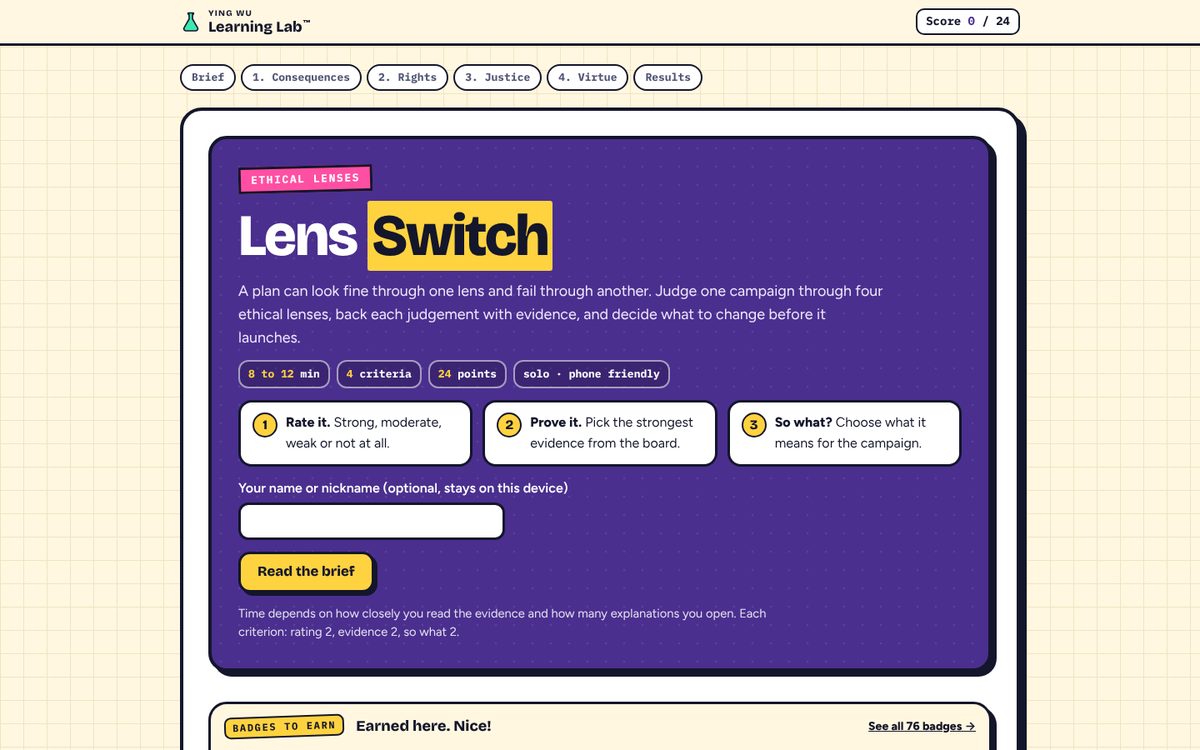
The start screen: rate it, prove it, so what. 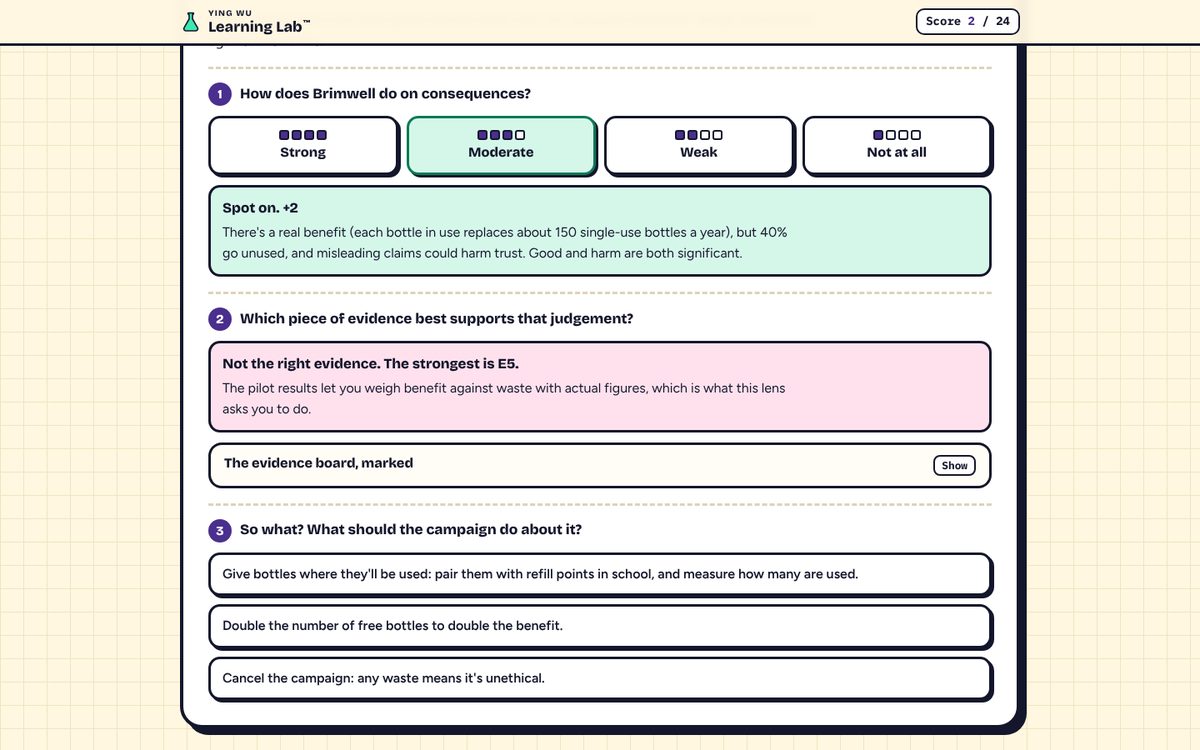
Each answer is explained straight away. 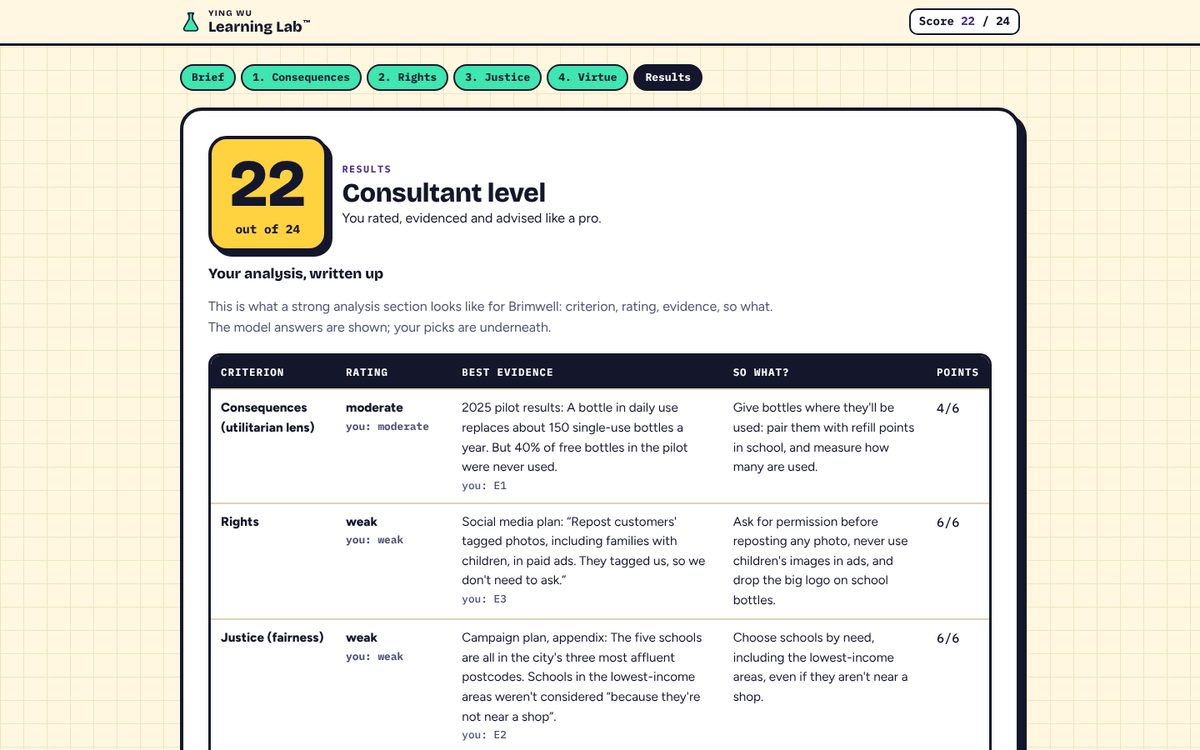
The end screen: a model analysis table to copy. 2 Debrief
3 to 8 min- Ask
- “Which rating did you disagree with? What evidence would change it?”
- “Which so what would you put first in the campaign, and why?”
3 Apply it
2 to 5 min- Say
- “Now do one row for your own client: criterion, rating, one dated piece of evidence, so what.”
Linking it to a report
- The end screen shows a model analysis table: criterion, rating, best evidence, so what. Students can copy it as text as a template for their own work.
- Use the framework as one core framework, with its criteria as subheadings, and the four-point scale (strong, moderate, weak, not at all) for each one.
- The case is fictional on purpose, so nobody gets the answers for a real client. Students apply the method, not the answers.
If something goes wrong
| Problem | What to do |
|---|---|
| A student reloaded the page | Progress is kept in that browser tab. Closing the tab starts again from the beginning. |
| “Copy the table” does not copy | Some browsers block the clipboard. Students can select the table on screen and copy it by hand. |
| No devices | Put the game on the projector and play it as a whole class: show of hands for each step, then click the room's answer. |
| A student argues for a different rating | Good. Ask what evidence would justify it. Close ratings (one step away) still earn a point. |
Cheat card
- Share the link or QR code
- “Rate it, prove it, so what?”
- 8 to 15 minutes of play
- Virtue (not at all): many students pick ‘weak’. Ask what the team chat tells you about intent.
- Debrief one contested row
- One row for their own client
Behind the game
- Laczniak, G.R. and Murphy, P.E. (2006) ‘Normative perspectives for ethical and socially responsible marketing’, Journal of Macromarketing, 26(2), pp. 154–177. doi:10.1177/0276146706290924.
- Markkula Center for Applied Ethics (n.d.) A Framework for Ethical Decision Making. Santa Clara University. Available at: https://www.scu.edu/ethics/ethics-resources/a-framework-for-ethical-decision-making/.
- Competition and Markets Authority (2021) Making environmental claims on goods and services (the Green Claims Code). 20 September.
Brimwell, Northbridge and all the evidence are invented for this game. Any resemblance to a real brand is coincidental. The Markkula Center's framework has six lenses; this game uses four of them. Common good and care ethics are good next steps.