What players learn
1. Notice
Read what the client says and tap the sentences that really matter: something missing, something that doesn't fit, a pattern or the feeling behind the facts. Plain detail and loud-but-irrelevant lines burn lantern oil.
2. Ask, don't tell
Choose the question that helps the client see their situation differently. Advice dressed up as a question, and rushing to the number they asked about, both close the conversation down.
3. Light the way
See how the client's thinking shifts, read the lantern note and the link to one of Lachie's observations from the book.
Skills
Active listening, asking powerful questions, spotting what's missing, client advisory judgement, holding back the quick answer and empathy in difficult conversations.
Where it comes from
The game is a practitioner and educator collaboration. Dr Ian Thomson, a chartered accountant and the founder of Leadership International, wrote Above the Dry Cleaners, in which the adviser Lachie helps clients by noticing and asking rather than telling. Dr Ying Wu designed and built the game: the clients, the scaffolded chairs, the scoring and the feedback. The clients and businesses are fictional (marked with an asterisk in the game). Each one links to an observation from the book, so players who want to go deeper know where to read next.
| # | Client | Lachie's observation | Explored in |
|---|---|---|---|
| 1 | Morag Lennie | Identity and Intent | Three Roads |
| 2 | Doug & Alan Reid | Stewardship | Stewardship |
| 3 | Priya Nair | Patterns | Three Stories, One Set of Accounts |
| 4 | Sandy Gallacher | Management Accounts | Two Sets of Numbers |
| 5 | Isla Fraser | Capability | – |
| 6 | Callum Shaw | Opportunity Cost | Bright Shiny Things and The Mix |
Above the Dry Cleaners on Amazon · Dr Ian Thomson's author page
Pick a format
Solo (about 15 minutes)
Players work on their own phones or laptops. Start on the Apprentice chair; strong players move up with Try a harder chair at the end.
In class (25 to 40 minutes)
Project the game and choose In class on the start screen (or share lab.yingwu.co.uk/noticing-game/?mode=class). The text gets larger and every client ends with a Talk about it prompt. The room calls out which sentences to tap and votes on the question.
Pairs
One player reads the client aloud, the other taps. Swap after each client. Good for practising listening rather than reading.
Before or after a role play
Use one client as a warm-up, then have students role-play the next conversation: one plays the client, one the adviser, one observes which questions opened things up.
Five golden rules
- Read the feedback, even when you are right.The why under each question is where the learning is.
- Tapping everything costs oil.Players who tap every sentence run dry and move to the question with whatever they have noticed.
- “Ready to ask” unlocks when all but one clue is found.The last clue is optional, so a strong reader can move on.
- Each run shuffles the question order.Letters change between plays, so players can't share “it's B”.
- Nothing is sent anywhere.Only the best score (and any Lab badges) is remembered, on that device.
The three chairs
| Chair | Clue types | Hints | Questions | Lantern oil | Score |
|---|---|---|---|---|---|
| Apprentice | Shown | 3 | 3 to choose from | 12 drops | × 1 |
| Adviser | Hidden | None | 4 to choose from | 9 drops | × 1.5 |
| Master of the Wynd | Hidden | None | 4 to choose from, 90 seconds per client | 8 drops; loud red herrings cost 2 | × 2, plus a time bonus |
Scoring: clue 100 · hidden bonus clue 150 · powerful question 300 · good question 120. Powerful questions in a row build a streak (+25% each). On Master, every second left when the powerful question is picked adds 5 more (× 2). Players down to their last 2 drops get up to 3 back before the next client. Stars compare the score with the most possible on that chair: 85% or more is three stars, 60% or more is two.
Four kinds of question appear for every client: a powerful question (open, built on what was noticed), a good, not great question (open but vague; left out on the Apprentice chair), an answer in disguise (advice phrased as a question) and rushing to the number (answers the technical question the client brought).
Every answer
Collapsed so students looking over your shoulder don’t see them. Open before the debrief.
Client 1: Morag Lennie, Owner, Lennie's Bakery · 12 years
Says they're here about: Wants the tax side of a bank loan checked, to open a second shop. Lachie's observation: Identity and Intent · Three Roads
| What to notice | Sentence | Why it matters |
|---|---|---|
| Loud, not the point | “We've had our best year ever, takings up eighteen per cent.” | A great number, but she didn't come up the stairs because of it. |
| Doesn't fit | “Well, she hasn't actually said yes yet.” | The whole plan rests on someone who hasn't agreed to it. |
| Feeling behind the facts | “My husband says I never stop. He's probably right.” | Tiredness is sitting underneath the growth plan. |
| A pattern | “Everyone keeps telling me it's the obvious next step.” | Whose next step is it? Other people keep deciding for her. |
| Question type | Question | Why |
|---|---|---|
| Powerful question | “If the second shop opened tomorrow, what would you hope it changes about your own week?” | Open, personal and built on what you noticed: her tiredness and other people's expectations. |
| Good, not great | “How do you feel about the expansion overall?” | Open, but vague. It doesn't use anything you noticed. |
| Answer in disguise | “Have you thought about hiring a manager instead of relying on Kirsty?” | Advice dressed up as a question. You've solved it for her. |
| Rushing to the number | “Shall we run the loan repayments through a cash-flow forecast?” | Answers the question she brought, not the one she needs. |
Lantern note: She arrived with a question about tax. The question she needed was about her life. Talk about it: Why might a client bring a ‘safe’ technical question first?
Client 2: Doug & Alan Reid, Reid Joinery · family firm since 1987
Says they're here about: Want the share split sorted before their father hands over the business. Lachie's observation: Stewardship · Stewardship
| What to notice | Sentence | Why it matters |
|---|---|---|
| Loud, not the point | “We just need it fifty-fifty, nice and clean.” | Sounds decisive, but it's the answer before the conversation. |
| A pattern | “The paperwork, the customers, the quotes, the hiring, the bank…” | The list keeps growing. Alan feels the load isn't shared. |
| Doesn't fit | “Dad still comes in every day anyway, so nothing really changes.” | A handover where nothing changes isn't a handover. |
| Something missing | “We've never really talked about it either.” | The real conversation hasn't happened yet. |
| Question type | Question | Why |
|---|---|---|
| Powerful question | “When your dad steps back, what will each of you be doing that he does now?” | Makes the hidden question visible: who carries what, once he's gone. |
| Good, not great | “What would a fair split look like to each of you?” | Open and fair, but it still starts from the numbers. |
| Answer in disguise | “Fifty-fifty is usually best for siblings, shall I draft that?” | Settles it for them and buries the real issue. |
| Rushing to the number | “Is your father keeping any shares?” | Closed and technical. Useful later, not now. |
Lantern note: ‘Nothing really changes’ is often the sentence that tells you everything is about to. Talk about it: What makes ‘we've never argued’ a warning sign rather than a reassurance?
Client 3: Priya Nair, Founder, Rota · scheduling app for care homes
Says they're here about: Has an investor offering £500k to scale. Wants a second opinion by Friday. Lachie's observation: Patterns · Three Stories, One Set of Accounts
| What to notice | Sentence | Why it matters |
|---|---|---|
| Loud, not the point | “We've grown to 140 care homes in two years.” | Impressive growth, but growth isn't what's worrying. |
| Doesn't fit | “Renewals dipped a bit this spring, but that's seasonal.” | ‘Love it’ and falling renewals don't sit together. And it was explained away very fast. |
| A pattern | “That's the second one in a year, actually.” | Two sales leads gone in a year. Something keeps repeating. |
| Feeling behind the facts | “Once we've got the money, everything else sorts itself out.” | A belief that money will fix what isn't about money. |
| Question type | Question | Why |
|---|---|---|
| Powerful question | “What would need to be true about your customers before you'd feel sure more money will help?” | Takes her back to the renewals she skipped past, without saying ‘you're wrong’. |
| Good, not great | “Why do you think the sales leads didn't stay?” | A good specific question, but it only opens one of the doors. |
| Answer in disguise | “You should push the investor for a longer deadline.” | Pure advice. She hasn't seen the problem yet. |
| Rushing to the number | “What valuation are they offering?” | Rushes to the deal she asked about. |
Lantern note: When a number is explained away quickly, slow down right there. Talk about it: Why do we reach for money as the solution when the problem is something else?
Client 4: Sandy Gallacher, Owner, The Wee Cup café
Says they're here about: Got a tax bill far bigger than expected and doesn't understand why. Lachie's observation: Management Accounts · Two Sets of Numbers
| What to notice | Sentence | Why it matters |
|---|---|---|
| Loud, not the point | “We were rammed all summer, queued out the door.” | Busy is good news. The puzzle is somewhere else. |
| Doesn't fit | “Funny thing is, the bank never seems to match how busy we are.” | Busy café, flat bank account. Something is leaking between the two. |
| A pattern | “Staff come and go, I've had six new starts since June.” | High turnover: lots of new hands on the till. |
| Something missing | “I let the new ones cash up at night, I'm too tired by then.” | Nobody checks the takings at the end of the day. |
| Feeling behind the facts (bonus) | “I'd never want to accuse anyone of anything.” | She half-suspects already, and it frightens her. |
| Question type | Question | Why |
|---|---|---|
| Powerful question | “Can you walk me through what happens to the takings between the till closing and the bank?” | Gentle and practical. She'll see the gap herself, without anyone pointing fingers. |
| Good, not great | “What do you think might explain the difference?” | Open, but it leaves her alone with a frightening thought. |
| Answer in disguise | “It sounds like someone's stealing. You need to check the cameras.” | Accusing, and it takes the discovery away from her. |
| Rushing to the number | “Shall we set up a payment plan with HMRC?” | Fixes this year's bill. The leak keeps leaking. |
Lantern note: A good question lets someone see it for themselves, without you pointing a finger. Talk about it: How do you raise something sensitive without accusing anyone?
Client 5: Isla Fraser, Treasurer, Westfield Community Garden
Says they're here about: Needs help writing the budget for a new grant application. Lachie's observation: Capability
| What to notice | Sentence | Why it matters |
|---|---|---|
| Loud, not the point | “Our £30,000 grant runs out in March.” | The date matters, but it isn't the deeper risk. |
| A pattern | “The same twelve people do absolutely everything.” | Everything depends on a small, tiring group. |
| Feeling behind the facts | “Nobody else wanted to be treasurer, so I'm doing secretary as well.” | Isla is carrying two roles alone, and it shows. |
| Something missing | “The funder asked for a ‘sustainability plan’, whatever that means.” | There's no plan for life after this one grant, and the funder has noticed. |
| Question type | Question | Why |
|---|---|---|
| Powerful question | “If the grant didn't come through, what would still be here in a year, and who would be carrying it?” | Opens up both risks at once: money and people. That's exactly what the funder means. |
| Good, not great | “What do you think the funder means by sustainability?” | Useful, but it stays on paper, away from the people. |
| Answer in disguise | “You should recruit more volunteers on social media.” | A quick fix, and it skips the conversation about the load. |
| Rushing to the number | “How much are you asking for this time?” | Straight to the budget. The real gap stays hidden. |
Lantern note: The question on the form is rarely the question underneath it. Talk about it: What does ‘sustainability’ mean for a small organisation, beyond money?
Client 6: Callum Shaw, Co-founder, Glenmorrow Blending Co.
Says they're here about: A big drinks group has made an offer. The three founders can't agree. Lachie's observation: Opportunity Cost · Bright Shiny Things and The Mix
| What to notice | Sentence | Why it matters |
|---|---|---|
| Loud, not the point | “We've had an offer. A very good one.” | A tempting headline, but the offer isn't the dilemma. |
| Feeling behind the facts | “I keep saying we should just stay as we are for now.” | Standing still feels safe. It rarely is. |
| A pattern | “We haven't launched a new blend in four years.” | The company stopped creating some time ago. |
| Something missing | “Our master blender retired last year and we never replaced him.” | The heart of the craft has quietly left the building. |
| Question type | Question | Why |
|---|---|---|
| Powerful question | “What would each of you need to be true in five years to feel this was all worth it?” | Moves three people from defending options to sharing what matters, and makes standing still visible. |
| Good, not great | “What's stopped you creating a new blend?” | Sharp, but it only explores one of the three futures. |
| Answer in disguise | “Take the offer. The market's peaked.” | Exactly what he asked for, and exactly what won't help. |
| Rushing to the number | “How much is the offer?” | Starts the negotiation before the conversation. |
Lantern note: Standing still is rarely still. Ask what each person is really protecting. Talk about it: When is ‘let's stay as we are’ actually a decision to go backwards?
Before the session
- Share lab.yingwu.co.uk/noticing-game/ as a link or QR code.
- Play it once yourself on the Adviser chair: about 15 minutes.
- Decide the format: solo, in class on one screen, or pairs.
- Pick two or three Talk about it prompts for the debrief (below).
- Sound effects are on by default; turn them off with Sound on at the top if you are projecting in a quiet room. Background music is optional and off by default (Music is off at the top).
- For anyone who prefers to listen, Hear it reads each client’s conversation aloud in the device’s own voice.
How long will it take?
Every time in this guide is a range. The low end is a focused run; the top end is what most learners take once they stop to think, read the feedback and talk it through.
Solo: 10 to 20 minutesClass plan: 25 to 40 minutes
What moves you up or down the range
- The chair. Master of the Wynd gives 90 seconds per client; Apprentice has no clock.
- Whether you read every explanation. The lantern notes and the why under each question are the point, and they add a few minutes.
- Replays. Trying a harder chair straight away.
- Reading in a second language. The conversations are text, so allow extra time.
- In class: discussion. Each Talk about it prompt can take two to five minutes.
Short on time? Play three clients together and take one debrief question. Want the richest discussion? Plan for the top of the range.
Step by step
25 to 40 minutes, on one projected screen or on players' own devices.
0 Set it up
2 to 4 min- Say
- “Six clients are about to climb the stairs with a question about tax, cash or growth. Your job is not to answer it. Notice what they don't say, then ask the one question that helps them see it.”
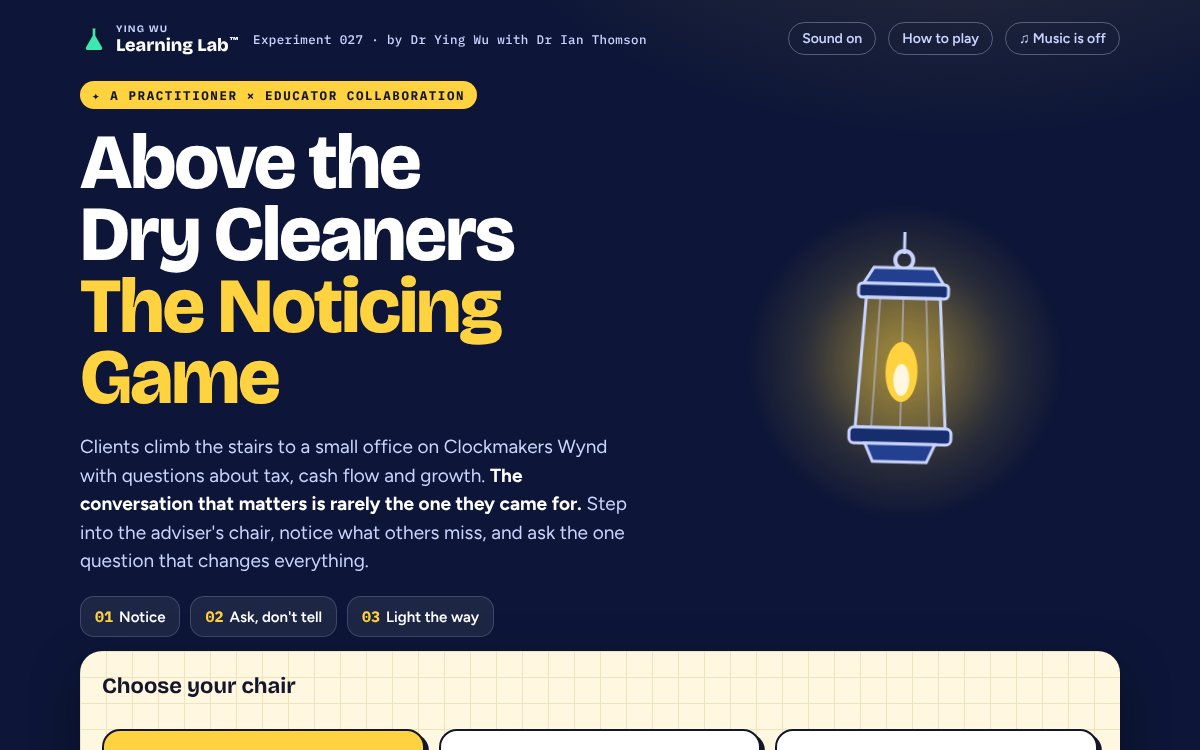
The start screen: pick a chair, then Solo or In class. 1 Notice
8 to 15 min- Players
- Read the client's words and tap the sentences that matter.
- Watch the notes fill up on the client card.
- Press Ready to ask.
- Watch for
- Players tapping the big, loud numbers (“takings up eighteen per cent”). Ask: “Is that why she came up the stairs?”
- Players tapping everything. Remind them that plain detail burns oil.
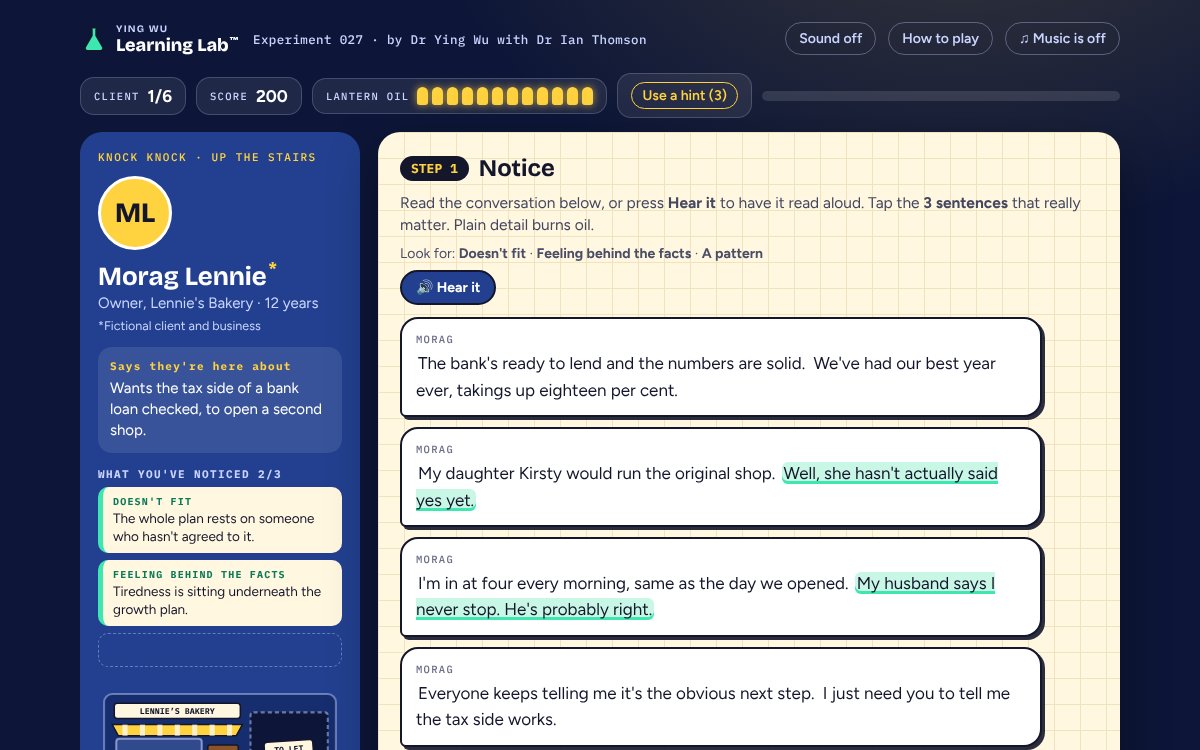
Step 1: tap what matters; the notes build on the client card. 2 Ask, don't tell
8 to 15 min- Players
- Choose a question.
- Read the verdict and the why for every option.
- Read the outcome and the lantern note.
- Watch for
- Advice phrased as a question (“Have you thought about…?”). Name it: an answer in disguise.
- In class, pause on the Talk about it prompt before moving on.
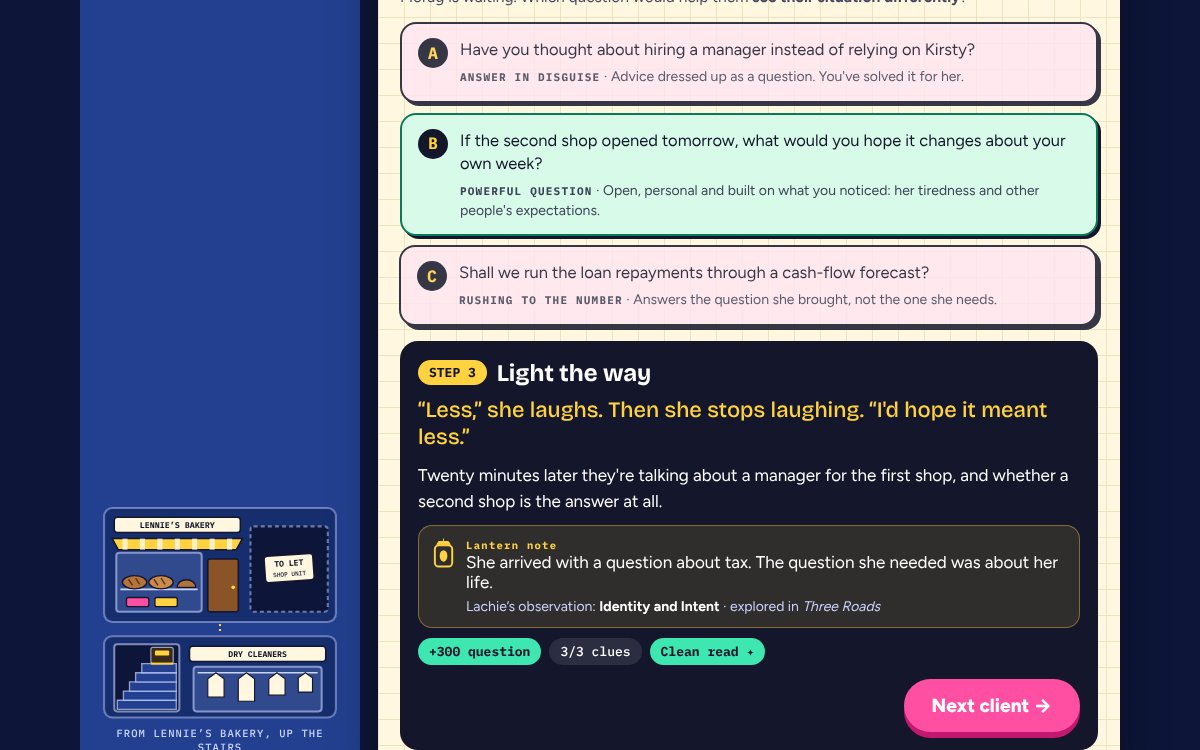
Step 3: the client's thinking shifts, with a lantern note. 3 Debrief
5 to 10 min- Ask
- “Which client was hardest to read? What did the powerful questions have in common? When would you still give advice?”
- Land it
- Powerful questions are open, personal and built on something the adviser noticed. The technical answer usually comes later, and lands better.
Debrief prompts
The same prompts appear in class mode after each client.
- Morag: Why might a client bring a ‘safe’ technical question first?
- Doug: What makes ‘we've never argued’ a warning sign rather than a reassurance?
- Priya: Why do we reach for money as the solution when the problem is something else?
- Sandy: How do you raise something sensitive without accusing anyone?
- Isla: What does ‘sustainability’ mean for a small organisation, beyond money?
- Callum: When is ‘let's stay as we are’ actually a decision to go backwards?
- Wider: Think of a time someone asked you a question that changed how you saw a problem. What made it work?
If something goes wrong
| Problem | What to do |
|---|---|
| A player reloaded the page | The game starts again from the first client. Only the best score is kept. |
| “Ready to ask” stays grey | Find at least all but one of the clues for that client, or keep tapping until the lantern runs dry, which moves on automatically. |
| The timer is too fast for the room | Use the Apprentice or Adviser chair in class: neither has a clock. |
| No devices | Project it with In class selected; the room calls out which sentences to tap and votes on the question. |
| Sound in a quiet room | Press Sound on at the top to switch it off. |
| A learner would rather listen than read | Press Hear it above the conversation. It reads each line aloud and highlights it; press Stop to end. On a projector, check the room’s speakers first. |
Cheat card
- Share the link or QR code
- “Notice what they don't say.”
- Plain detail burns oil
- Powerful question: open, personal, built on a clue
- Watch for answers in disguise
- “Ask, don't tell. Then light the way.”
Behind the game
- Thomson, I. Above the Dry Cleaners. amazon.co.uk