What players learn
Win-wins exist
Recycled fibre, sea freight with recycled mailers, efficient lighting and heating, and honest reporting all help the goals at little or no net cost. The best brands start there.
Trade-offs are choices
Organic cotton, a UK factory and rooftop solar deliver real gains at a real price. Players see the cost before they choose, and the ripples only afterwards.
Shortcuts come back
The cheapest factory and the vague claims pay off at first, then cost far more when a documentary or a regulator arrives. Risk is part of sustainability.
Claims need evidence
"We support all 17 Global Goals" and "carbon neutral" via cheap offsets are SDG-washing. An honest impact report is the claim that pays off.
Score = cash (£k) + 5 × impact points. Impact points are a deliberately simple teaching model to prompt discussion, not a measurement of real-world impact. Tay Threads, its rivals and every event are fictional; goal names and targets come from the UN SDG pages.
Pick a format
Class mode: teams (25 to 40 minutes)
One projected screen, no student devices. Choose Class mode: teams and set 2 to 6 teams. Each team runs its own Tay Threads. For each decision, teams see the three options and their cash cost, agree A, B or C, and you tap their letters. Reveal the ripples shows every option's ripples and each team's score change. After decisions 3 and 6, a past decision comes back for each team. The results screen gives trophies, every team's route and four debrief questions. A link straight to the set-up: lab.yingwu.co.uk/ripple-effect/?mode=class
Solo against three rival brands (8 to 15 minutes)
Players race three computer brands: Cheap Chic Co. always takes the cheapest option, All-Out Organic always takes the option with the most impact, and Steady Stitch plays it middle of the road. Beat all three for the trophy and the Balanced books badge.
After a lecture on CSR or sustainable supply chains
Use it to make trade-offs concrete. Then ask students to write a 300-word memo to the Tay Threads board justifying their route, citing at least two UN targets.
On a learning path
Ripple Effect is the third stop on the Responsible business and the SDGs path, after Goal Rush and Greenwash Detective.
Every option, its cost and its ripples
Players see the cash cost before they choose. The ripples appear only after the reveal.
| Decision | Option | Cash | Ripples | Score change | Why |
|---|---|---|---|---|---|
| 1. The cotton | A. The cheapest cotton on the market | +£10k | 6− 8− 15− | −5 | Cheap, but you can't say how it was grown or who picked it. Conventional cotton is thirsty and often pesticide-heavy, and untraceable supply chains can hide forced labour (target 8.7). |
| B. Certified organic cotton | −£15k | 3+ 6+ 15+ | +0 | Less chemical pollution of water and soil (targets 6.3 and 3.9) and healthier land (Goal 15). A real gain, at a real price. | |
| C. A recycled cotton blend | −£5k | 6+ 12+2 | +10 | Turns textile waste into new fibre (target 12.5) and avoids the water used to grow new cotton (target 6.4), for a smaller premium than organic. The win-win of this round. | |
| 2. The factory | A. The lowest bid, no questions asked | +£15k | 8−2 | +5 | The biggest saving on the table, and the biggest risk. Without audits you can't know about pay, hours or safety (target 8.8). |
| B. An audited factory, overtime paid | −£10k | 8+2 12+ | +5 | Protects labour rights and safe working conditions (target 8.8) and makes your supply chain something you can stand behind (target 12.6). | |
| C. A small UK factory paying the real Living Wage | −£20k | 8+3 13+ | +0 | Decent work (target 8.5) plus far less shipping. The most expensive choice, and the most impact on Goal 8. | |
| 3. Shipping and packaging | A. Air freight and plastic polybags | +£5k | 13−2 14− | −10 | Early sales, but flying freight has a far bigger carbon footprint than shipping it, and polybags too often end up in rivers and seas (target 14.1). |
| B. Sea freight and recycled paper mailers | £0k | 12+ 13+ | +10 | Lower emissions (Goal 13) and less plastic (Goal 12) for no extra cost. A win-win. | |
| C. Sea freight and reusable mailers customers send back | −£5k | 12+2 13+ | +10 | Reuse beats recycling (target 12.5). It costs a little to run the returns scheme. | |
| 4. Your studio's energy | A. Renew the same deal and keep the old gas boiler | £0k | 13− | −5 | Nothing to pay now, but your bills and emissions stay where they are. |
| B. LED lighting and smart heating controls | +£10k | 7+ 13+ | +20 | Pays for itself within the year: lower bills and lower emissions (target 7.3). A classic win-win. | |
| C. Join a community energy co-op for rooftop solar | −£10k | 7+2 13+ 17+ | +10 | More renewable energy (target 7.2) through a local partnership (target 17.17). It costs more this year. | |
| 5. Growing the team | A. Unpaid graduate internships | +£5k | 8− 10− | −5 | Only people who can afford to work for free can take them (target 10.2), and it isn't decent work (Goal 8). In the UK, an intern who counts as a worker is entitled to the National Minimum Wage. |
| B. Paid apprenticeships with a local college | −£10k | 4+2 8+ 17+ | +10 | Skills for employment (target 4.4), decent jobs (Goal 8) and a partnership with education (Goal 17). | |
| C. A women-in-leadership pathway | −£5k | 5+2 8+ | +10 | Equal opportunities for leadership (target 5.5). Many of the people who make clothes are women, but fashion's leadership often doesn't reflect that. | |
| 6. Your big marketing claim | A. “We support all 17 Global Goals!” | +£10k | 12− | +5 | Catchy, but vague and impossible to back up. Broad claims like this are what the UK's Green Claims Code warns against, and it tells customers nothing true about your products. |
| B. Publish an honest impact report, the good and the bad | −£5k | 12+ | +0 | Target 12.6 encourages companies to include sustainability information in their reporting. Honesty costs a little now and builds trust. | |
| C. “Carbon neutral!” using the cheapest offsets you can find | £0k | 13− | −5 | Cheap offsets don't cut your own emissions, and carbon neutral claims that rely on them face growing scrutiny from regulators. |
"Score change" is the immediate effect on the score: cash change + 5 × impact points. It does not include the events below, which is exactly what catches players out.
The two events
Each brand gets its own event, based on its own earlier choices.
| When | If… | What happens | Cash | Ripples |
|---|---|---|---|---|
| After decision 3 | You chose the lowest-bid factory (2A) | A TV documentary films at your factory. Workers describe unpaid overtime and locked fire exits. Stockists pause your orders while you fix it. | −£30k | 8− |
| Otherwise, if you chose the cheapest cotton (1A) | Your cotton is linked to forced labour. Your untraceable cotton is traced to a region where forced labour has been reported. You recall a product line to check it. | −£15k | 8− | |
| Otherwise | A big retailer wants traceable suppliers. Because you know where your cotton and your clothes come from, you pass its audit first time and win an order. | +£10k | none | |
| After decision 6 | You claimed "all 17 Global Goals" (6A) or "carbon neutral" (6C) | Your claim is challenged. The regulator challenges the claim; you pull the campaign and reprint. | −£20k | 12− |
| You published an honest impact report (6B) | Your honest report wins a new stockist. A local business award shortlists your impact report, and an independent shop chain asks to stock you. | +£15k | none |
The best route and the rivals
The best possible score is 180: recycled cotton (1C), an audited factory (2B), efficient lighting and heating (4B) and an honest impact report (6B), with either green shipping option (3B or 3C) and either people option that builds skills or leadership (5B or 5C). Every one of these routes is a mix of win-wins and well-chosen trade-offs.
The rivals finish on: All-Out Organic 155 (most impact, but it spends the most), Steady Stitch 110 (its vague carbon neutral claim and old boiler cost it) and Cheap Chic Co. 25 (both events hit it). Of the 729 possible routes, 34 beat All-Out Organic.
Ranks: Ripple Master (170 or more), Steady Steward (120 to 169), Short-termist (below 120). No route ever runs out of cash.
How long will it take?
Every time in this guide is a range. The low end is a tight run; the top end is what most classes take once teams discuss, decide and react to the results.
In class: 25 to 40 minutesSolo: 8 to 15 minutes
What moves you up or down the range
- How quickly you call for letters. There is no round timer. Calling for letters as soon as most teams are ready keeps you near the low end; letting every team finish arguing moves you to the top.
- Number and size of teams. More teams means more letters to tap in and more ripples to read out; bigger teams take longer to agree.
- How much discussion you want. Quick calls, or asking each team to explain its choice before you reveal the ripples.
- Getting started. Forming teams, explaining "cost now, ripples after" and first-time players all take a few minutes.
- Interaction in between. Questions, groans when a past decision comes back in one of the two events, or a team arguing with an impact score.
- The debrief. One question, or all four debrief questions on the results screen.
- Your group. Familiarity with the topic, reading in a second language, and the room layout.
Short on time? Call for letters quickly, keep to four teams or fewer, and take one debrief question. Want the richest discussion? Plan for the top of the range.
Step by step
25 to 40 minutes with one projected screen and teams.
0 Set it up
2 to 4 min- Say
- “Each team runs Tay Threads, a small fashion brand in Dundee. You'll see what each option costs, but not what it does to the goals until we reveal it. Score is cash plus five times impact.”
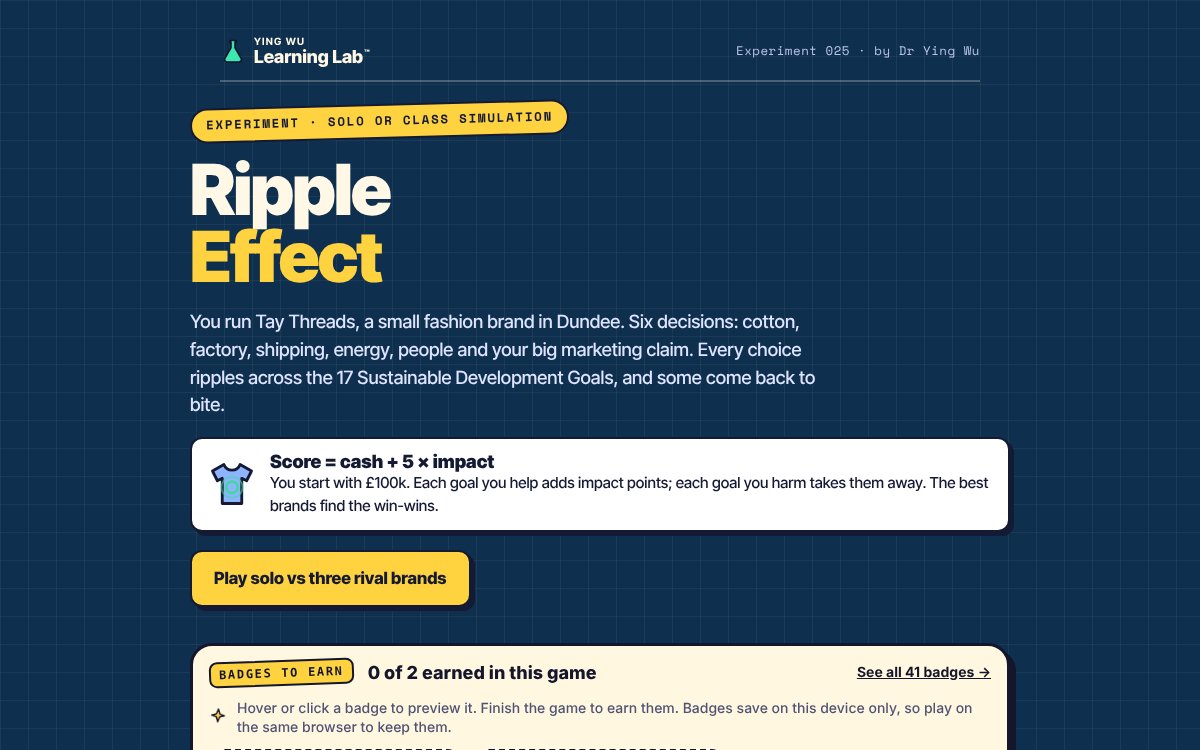
The start screen: the scoring rule, solo or class mode. 1 Decisions 1 to 3
7 to 11 min- Say
- “Cotton, factory, shipping. Agree A, B or C, and be ready to say why.”
- Players
- Teams agree a choice for each decision.
- Tap each team's letter, then Reveal the ripples.
- Watch for
- Teams taking the cheapest factory for the cash. Don't comment: the event after decision 3 will.
- Teams spending on everything. Ask: is every gain worth what it costs?
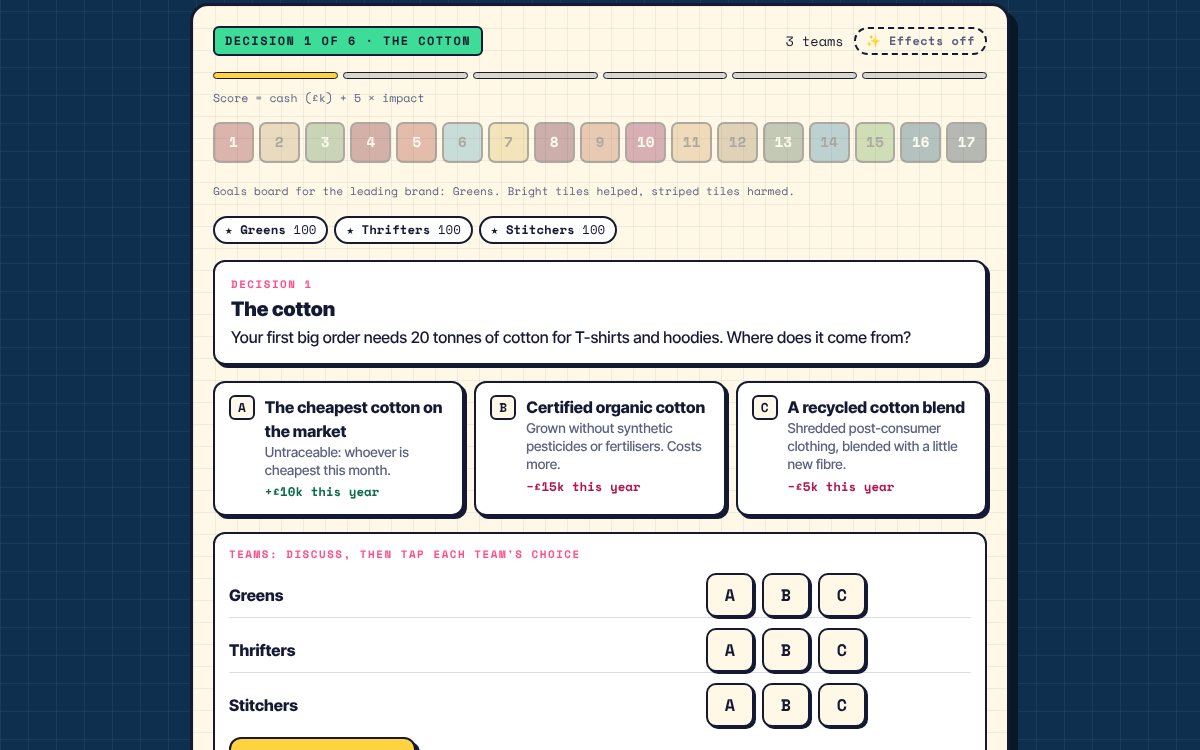
A decision: the cash cost is visible, the ripples are not. 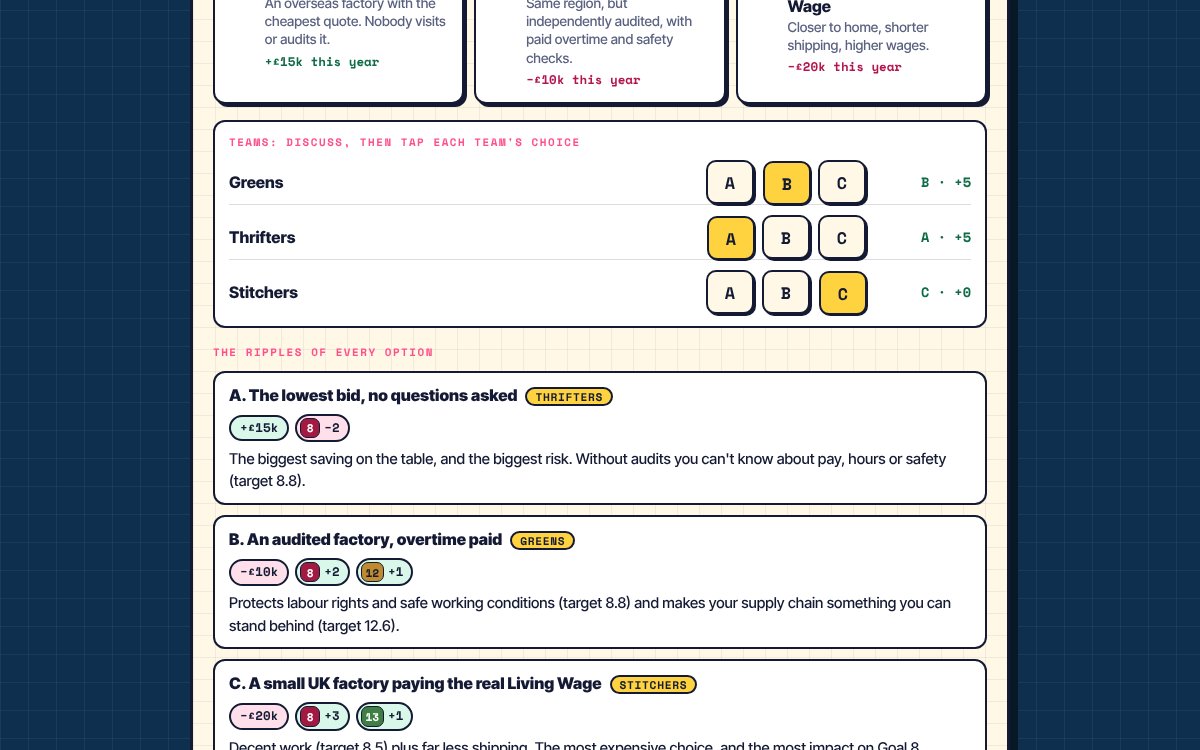
The reveal: every option's ripples and each team's score change. 2 The first event
2 to 4 min- Say
- “A past decision comes back. Who saw this coming?”
- Watch for
- Teams hit by the documentary: ask what due diligence would have cost them in decision 2.
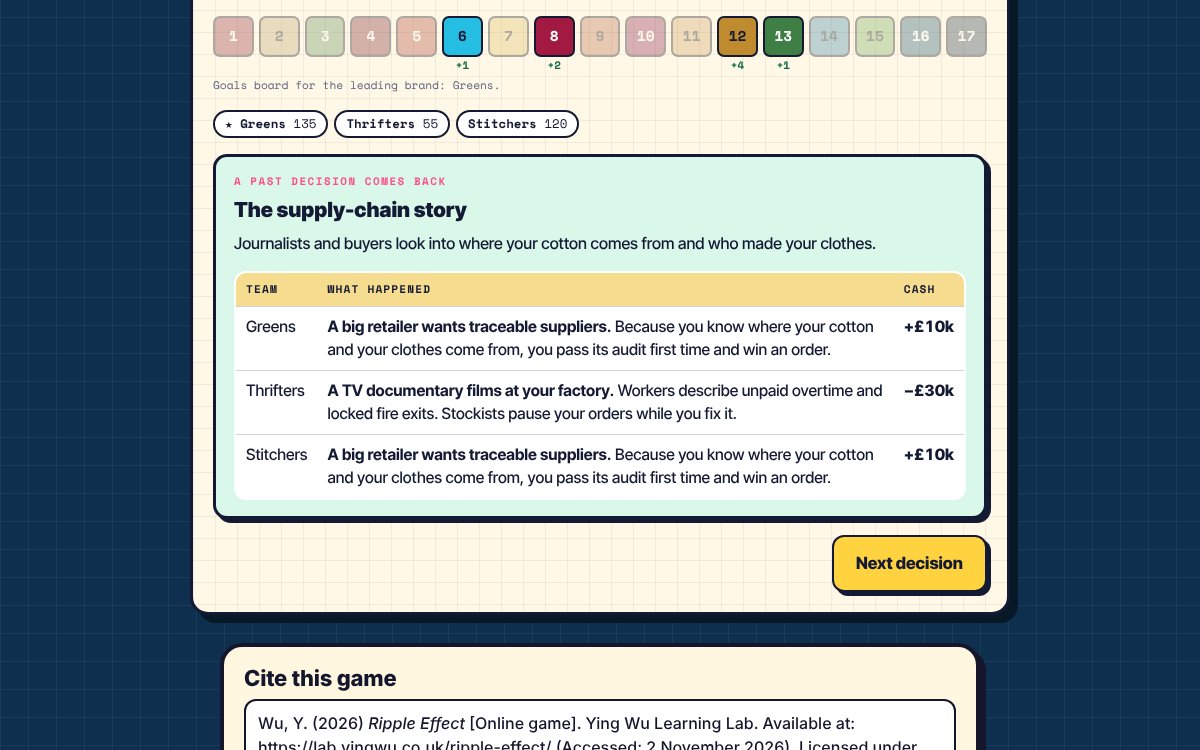
Ripple returns: each team gets its own consequence. 3 Decisions 4 to 6 and the second event
6 to 9 min- Say
- “Energy, people, and your big marketing claim.”
- Watch for
- The LED and smart heating option pays back within the year: the clearest win-win in the game.
- "We support all 17 Global Goals" looks like free sales. The claims check comes straight after.
4 Results and debrief
5 to 10 min- Say
- “Which decision was a genuine win-win, and why didn't every team take it?”
- Players
- Trophies for the winning team.
- Use the four debrief questions on the results screen.
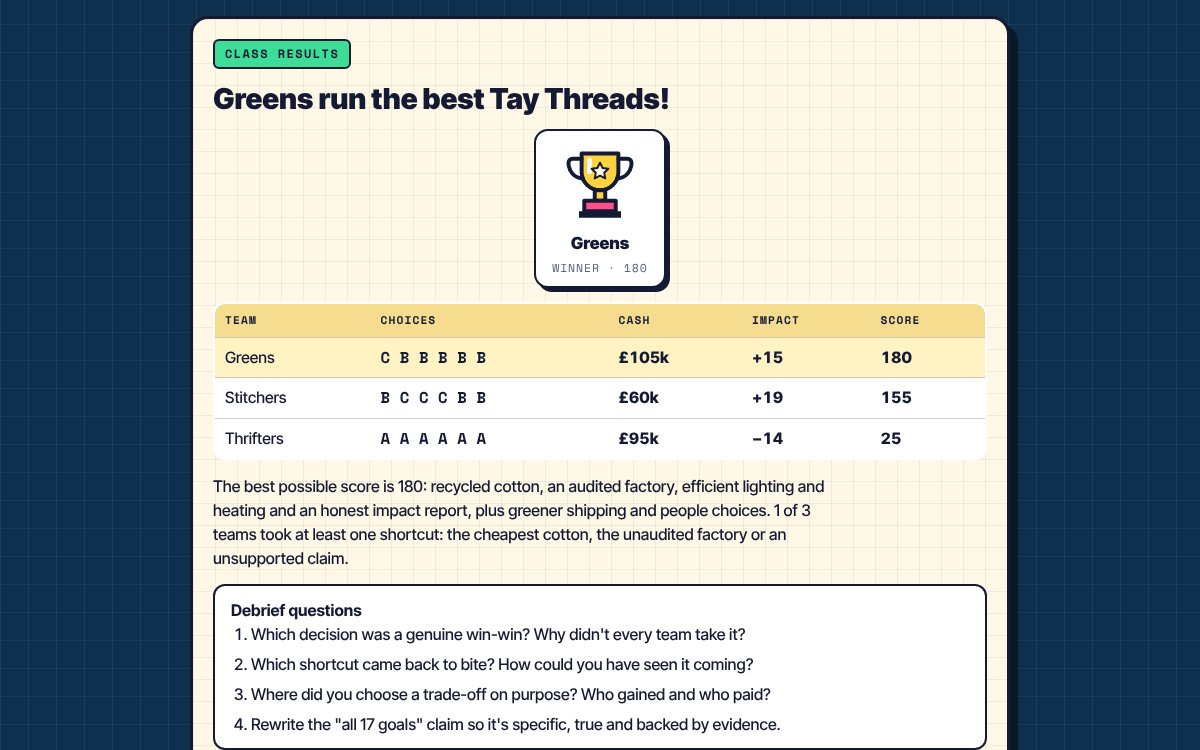
Class results: each team's route, cash, impact and score.
Where it fits
The game supports target 4.7: by 2030, ensure that all learners acquire the knowledge and skills needed to promote sustainable development. It is built on playful learning with the five characteristics in PRME's Impactful Five (i5): meaningful (real trade-offs in a real industry), joyful (ripples, rivals, trophies), socially interactive (teams argue each decision out), actively engaging (every choice has consequences) and iterative (play again and find the best route).
Pair it with the other games on the Responsible business and the SDGs learning path.
If something goes wrong
| Problem | What to do |
|---|---|
| A team argues with an impact score | Good: the numbers are a simple teaching model. Ask them what evidence would change the score, and which UN target it relates to. |
| A team hasn't chosen | The reveal waits until every team has a letter. Tap one for them, or ask for a quick show of hands. |
| You reloaded mid-game | Press Resume class game. Every team's brand, choices and events are saved in the browser. |
| No Wi-Fi | Once the page has loaded it runs without a connection. |
| Short of time | Run decisions 1 to 3 and the first event, then debrief: 15 to 25 minutes in all. |
Cheat card
- Class mode, 2 to 6 teams
- “Cost now, ripples after.”
- Score = cash + 5 × impact
- Best: 1C, 2B, 4B, 6B = 180
- Events after decisions 3 and 6
- Debrief: win-wins, shortcuts, trade-offs, claims
Behind the game
- United Nations Department of Economic and Social Affairs (no date) The 17 Goals and the goal and target pages for Goals 1 to 17. Available at: sdgs.un.org/goals (Accessed: 2 November 2026).
- Competition and Markets Authority (2021) Green claims code: making environmental claims. Available at: gov.uk (Accessed: 2 November 2026).
- GOV.UK (no date) Employment rights and pay for interns. Available at: gov.uk (Accessed: 2 November 2026).
- PRME (no date) i5: Impactful Five. Available at: i5.unprme.org (Accessed: 2 November 2026).
Tay Threads, its rivals, figures and events are fictional, described as at November 2026: a teaching resource, not legal or business advice. An independent Learning Lab resource by Ying Wu, not produced or endorsed by the United Nations, PRME or the University of Dundee.