What students learn
One theory per stage
Situation uses the Theory of Planned Behaviour, Objectives uses SMART and the hierarchy of effects, Strategy uses positioning, Tactics uses PESO and integrated communications, Actions covers budget and timing, and Control uses the AMEC framework.
Judgement, not recall
Every option is plausible. The best answer applies the theory to the evidence in the case; the “backfires” answer is the mistake students most often make in assessed plans.
Same case, start to finish
All twelve calls follow one charity, so students see how a weak situation analysis leads to a weak objective, a weak budget and a KPI that cannot be measured.
Green claims bonus
An optional leg on the CMA Green Claims Code and the fines now possible under the Digital Markets, Competition and Consumers Act 2024.
Pick a format
Class race (recommended)
Two to four teams on the projector. Teams call out A to D, you tap them in, then reveal. Run one leg after each stage of your lecture, 19 to 35 minutes across a two-hour session.
Solo
Students play on their own devices at their own pace, with a timer that reveals the answer when it runs out. Good for revision before a SOSTAC assessment, or for students who missed the session.
Five golden rules
- Best move +10, half right +5, no effect 0, backfires −5.The scale rewards judgement: a confident wrong call costs more than a cautious one.
- One Boost per team per game.It doubles that answer’s points, including negative points, so teams should save it for a leg they know well.
- No answer scores 0.When the timer runs out, teams that have not answered are not penalised.
- Legs can run in any order.Open a leg from the track, or jump straight to one with a link (see “With slides” below).
- Nothing leaves the device.There are no accounts. Team names and scores are kept in that browser only, so you can switch back to your slides and return to the same race.
The seven legs
| Leg | Stage | Theory | Direct link |
|---|---|---|---|
| S | Situation | Theory of Planned Behaviour (Ajzen, 1991); attitude–behaviour gap (Carrington et al., 2010) | ?leg=sit |
| O | Objectives | SMART (Doran, 1981); hierarchy of effects (Lavidge and Steiner, 1961) | ?leg=obj |
| S | Strategy | Segmentation, targeting and positioning (Moore, 1991; Chaffey and Smith, 2022) | ?leg=str |
| T | Tactics | PESO model (Dietrich, 2014); integrated marketing communications (Batra and Keller, 2016) | ?leg=tac |
| A | Actions | People, timing and budget (Chaffey and Smith, 2022) | ?leg=act |
| C | Control | AMEC Integrated Evaluation Framework (2016); Barcelona Principles 3.0 (2020) | ?leg=con |
| + | Green claims (bonus) | CMA Green Claims Code (2021); DMCC Act 2024 | ?leg=grn |
Each leg has two questions with four options. Maximum score: 150 points (14 questions at 10 points, plus 10 more from a well-placed Boost). After each leg, a “Use it in your plan” card gives the takeaway and a “Now your client” prompt for students’ own assessments.
Three levels. Pick one on the set-up screen. Each level has its own 14 questions on the same charity, with the same legs, scoring and timer.
| Level | What changes | Good for | Direct link |
|---|---|---|---|
| Heat | The original questions: one clear theory per call. | First run, undergraduates, introducing SOSTAC | ?level=heat |
| Semi-final | Closer calls: evidence quality, segment choice, the leak in the customer journey, Barcelona Principles. | A second run, revision, students who did well in the Heat | ?level=semi |
| Final | Expert judgement: TPB paths, Binet and Field, Jobs to be Done, influencer rules, objective-and-task budgets, attribution. | Postgraduate and MBA classes, assessment preparation | ?level=final |
Each level is saved separately in the browser, so switching to the Final never wipes a Heat race.
Badges: Relay runner for finishing all six SOSTAC legs, and Gold medal for scoring 100 or more playing solo. Like all Lab badges, they are saved on the device only. At the podium, players can leave an optional, anonymous star rating.
Every answer
Collapsed so students looking over your shoulder don’t see them. Points in brackets.
Heat
S · Situation
| Question | Best move | Why, and the trap |
|---|---|---|
| Which part of the Theory of Planned Behaviour is the real blocker? | A (+10) | Perceived control: Saturday-only hours and hidden steps. Trap: B, attitude (−5); the survey shows attitudes are already positive. |
| Which sentence earns the most marks? | D (+10) | One framework, a judgement per element, evidence named. Trap: B, “framework tourism” (−5). |
O · Objectives
| Question | Best move | Why, and the trap |
|---|---|---|
| Which rewrite is a SMART objective? | B (+10) | Audience, baseline (1,200), target (3,000) and deadline. Trap: A, “Post every day”, a tactic dressed as an objective (−5). |
| Which measure proves Goal 2 worked? | D (+10) | The same poll before, during and after, against a 35% baseline. Trap: B, ad reach, which measures a different stage (−5). |
S · Strategy
| Question | Best move | Why, and the trap |
|---|---|---|
| Which target segment is sharpest? | A (+10) | Renting students aged 18–24 who need a tool a few times a year. Trap: B, everyone in Dundee (−5). |
| What goes in Moore’s “Unlike (alternative)” slot? | B (+10) | Buying the tool, the real choice at the moment of need. Trap: C, Instagram: a channel is not a competitor (−5). |
T · Tactics
| Question | Best move | Why, and the trap |
|---|---|---|
| Which channel does the trust-building job best? | B (+10) | Earned media: a students’ union feature with a real borrower. Paid ads (A) reach but are discounted (+5). |
| Which plan is most integrated? | C (+10) | One message, each channel doing a different job: commonality and complementarity. Trap: A, a different slogan per channel (−5). |
A · Actions
| Question | Best move | Why, and the trap |
|---|---|---|
| Which £1,000 split is best justified? | B (+10) | £550 ads, £200 event, £150 how-to cards, £100 contingency. Trap: A, all on one influencer post (−5). |
| What has to happen before the ads go live? | A (+10) | Fix the how-to-borrow page and add weekday collection: remove the barrier first. Trap: D, running the end survey now (−5). |
C · Control
| Question | Best move | Why, and the trap |
|---|---|---|
| Agreement rises from 35% to 52%. Which AMEC level? | C (+10) | Outcome: a change in what the audience thinks. Outtake (B) is close (+5). |
| Week 4 reach is 1,400 against 2,000 planned. Best Plan B? | C (+10) | Move £150 to creator posts and re-check in week 6. Trap: B, lower the target so it looks met (−5). |
+ · Green claims bonus
| Question | Best move | Why, and the trap |
|---|---|---|
| Which claim would survive the CMA Green Claims Code? | D (+10) | “Last term, 410 loans meant 410 tools nobody had to buy”, with its source. Trap: A, “saves the planet” (−5). |
| “Greener than last year!” breaks which principle most clearly? | A (+10) | Comparisons must be fair and meaningful: greener than what, measured how? |
Semi-final
Semi-final: all 14 answers
| Leg | Question | Best move | Why, and the trap |
|---|---|---|---|
| S | What is the biggest problem with using the figure this way? | B (+10) | Members chose to join. The campaign is aimed at students who haven’t, so the plan needs evidence from them. Trap: D, “Surveys can’t measure attitudes, so drop it” (−5). |
| S | Which change makes this SWOT most useful for the plan? | D (+10) | The same trend can cut both ways. For a free service, money worries are the strongest reason to borrow, and a message to lead with. Trap: A, “Add more points so every box has at least five” (−5). |
| O | What is the strongest reason to rewrite it? | A (+10) | An objective should follow from the situation analysis. Followers measure awareness, not the gap you found. Trap: D, “Replace it with “Boost engagement on social media”” (−5). |
| O | Where should the main objective sit? | C (+10) | That’s where people drop out. The objective should name the behaviour you want, with supporting goals underneath. Trap: B, “Liking: make borrowing feel cool” (−5). |
| S | Judging by size, need and reachability, which choice is best justified? | D (+10) | A real need, a clear trigger and a date to plan around. The campaign ends in March, so January is the moment. Trap: B, “Both, with half the budget each” (−5). |
| S | What is the biggest flaw? | B (+10) | “Good for the planet” and “we care” don’t set Charity A apart, and the alternative named isn’t what students actually weigh up. Trap: D, “Add “the best tool library in Scotland”” (−5). |
| T | In PESO terms, where is the weakest link? | A (+10) | Earned media did its job. The owned page has to turn interest into a loan, and it hides the steps. Trap: D, “Shared: add more hashtags” (−5). |
| T | Ad B gets three times the clicks. Which explanation belongs in your plan? | C (+10) | It speaks to the segment at its moment of need and answers “is it hard?” before anyone asks. Trap: B, “Longer ads always win” (−5). |
| A | Which action plan is most realistic? | B (+10) | Matched to the people available, and everyone knows who does what. Trap: A, “Daily posts on four platforms, plus a weekly event” (−5). |
| A | Which part of the action plan should already have covered this? | D (+10) | The risk, its likelihood and the back-up are written down before launch, so the team can act the same day. Trap: B, “Nothing: you can’t plan for venue problems” (−5). |
| C | What is the best next step? | C (+10) | The data shows where people drop out. Fix that step, and set a date to check it worked. Trap: A, “Cut the ads: they’re wasting money” (−5). |
| C | Using the Barcelona Principles, what is the biggest gap? | A (+10) | The principles say to set goals first and measure outcomes and impact, not just activity. Trap: D, “Convert the coverage into advertising value equivalents (AVEs)” (−5). |
| + | What is the best call? | D (+10) | Claims must be substantiated for the product as described. Charity A’s own loan log already supports an honest claim. Trap: A, “Use it: specific numbers are what the CMA wants” (−5). |
| + | Under the Green Claims Code, what is the main problem? | B (+10) | The code asks for evidence and for offsetting to be open, not hidden behind a headline. Trap: A, “Charities are exempt, so there is no problem” (−5). |
Final
Final: all 14 answers
| Leg | Question | Best move | Why, and the trap |
|---|---|---|---|
| S | Which does the Theory of Planned Behaviour favour, and why? | C (+10) | Ajzen’s model has a direct path from control to behaviour when perceived control reflects real control. Telling people it is easy doesn’t make it easy. Trap: A, “Option 1: attitude is the strongest predictor in every study” (−5). |
| S | Which critique would an examiner rate highest? | A (+10) | It questions both the fit of the evidence and what it can show, then points to the evidence the plan really needs. Trap: D, “It’s fine: a big global sample beats a small local one” (−5). |
| O | What is most clearly missing from this objective set? | D (+10) | Communication objectives should serve a business objective. Without one, the campaign can hit every target and still not cut any waste. Trap: A, “More events, to show the board real activity” (−5). |
| O | What is the best response? | B (+10) | Binet and Field say the balance varies. This applies their evidence to the case rather than quoting a number. Trap: A, “Follow it: put £600 into a brand film” (−5). |
| S | Which repositioning is most defensible? | A (+10) | It moves the frame to what Charity A owns and the rival can’t match, instead of fighting on the rival’s strength. Trap: D, “Become a premium tool brand” (−5). |
| S | How should this change the strategy? | C (+10) | Jobs to be Done: people hire a product to make progress. Charity A can own the whole job, not just the tool. Trap: A, “Lead with tool specs: power, brand, battery life” (−5). |
| T | Which is best justified, and how must the posts appear? | D (+10) | Their followers are the segment, they’re trusted peers, and the label keeps it honest and legal. Trap: B, “The five local creators, with no label because the fees are small” (−5). |
| T | Which fix matters most for integration? | B (+10) | Integration is the whole journey, not just the ads. One wrong page undoes the message. Trap: A, “Change the ad so it doesn’t mention opening hours” (−5). |
| A | Which budgeting method is most defensible for this plan? | C (+10) | It links every pound to an objective and shows the board what a smaller budget would cut. Trap: D, “Percentage of sales: 10% of last year’s loan income” (−5). |
| A | What is the best call? | A (+10) | Grab the opportunity, but re-sequence so the barrier is gone before people arrive. Trap: D, “Turn it down to stick to the Gantt chart” (−5). |
| C | How can you tell which channel is pulling its weight? | B (+10) | Two sources of evidence, one digital and one self-reported, cover both online and offline channels. Trap: D, “Assume the channel that cost most worked best” (−5). |
| C | What is the most honest claim for the board? | D (+10) | It separates the campaign from other causes and is open about what is uncertain. Trap: A, “The campaign caused the 30% rise” (−5). |
| + | What is the main problem? | A (+10) | The figure overstates the benefit, so the claim isn’t accurate even though the data is real. Trap: D, “It’s fine, because the data is real” (−5). |
| + | What should Charity A do? | C (+10) | The code asks claims to be clear about their scope and not to leave out information that would change the picture. Trap: A, “Nothing: the claim is true” (−5). |
The best debrief starter is the Situation leg’s first question: most rooms pick attitude, because that is what campaigns usually try to change. The evidence says attitudes are fine and the barrier is ease.
Before the session
- Open lab.yingwu.co.uk/sostac-sprint/ in a browser tab next to your slides.
- Pick a level: Heat for a first run, Semi-final or Final for stronger or postgraduate groups.
- Name the teams by table or row, choose the number of teams (2 to 4) and the time per question (30, 45 or 60 seconds, or no timer).
- Click “Go to the start line”. The race is saved in that browser, so you can close the tab and come back.
- Open the answer key above if you want it beside you.
How long will it take?
Every time in this guide is a range. The low end is a tight run; the top end is what most classes take once teams discuss, decide and react to the results.
In class: 1 to 3 minutes a leg, 19 to 35 minutes in allSolo: 1 to 3 minutes a leg
What moves you up or down the range
- How strictly you run the clock. A 30-second timer keeps each leg near the low end; 60 seconds, no timer or letting teams finish talking moves you to the top.
- Number and size of teams. More teams means more answers to tap in; bigger teams take longer to agree on A to D.
- How much discussion you want. Quick calls, or asking each team to explain its choice and reading the backfire aloud after the reveal.
- Getting started. Naming teams, picking a level and explaining the relay make the first leg the longest.
- Interaction in between. Questions, cheering at the track, the green claims bonus, or "Now your client" turning into a longer chat.
- How many legs you run. All six legs plus the bonus across a two-hour session, or only the stages your lecture covers.
- Your group. Familiarity with the topic, reading in a second language, and the room layout.
Short on time? Use the 30-second timer, keep to two or three teams, and save "Now your client" for one or two legs. Want the richest discussion? Plan for the top of the range.
Step by step
1 to 3 minutes per leg, spread through your lecture.
0 Set up the race
1 to 2 min- Say
- “Each time we finish a stage of SOSTAC, your team runs a leg: two calls, under a minute each. Save your Boost for the stage you feel surest about.”
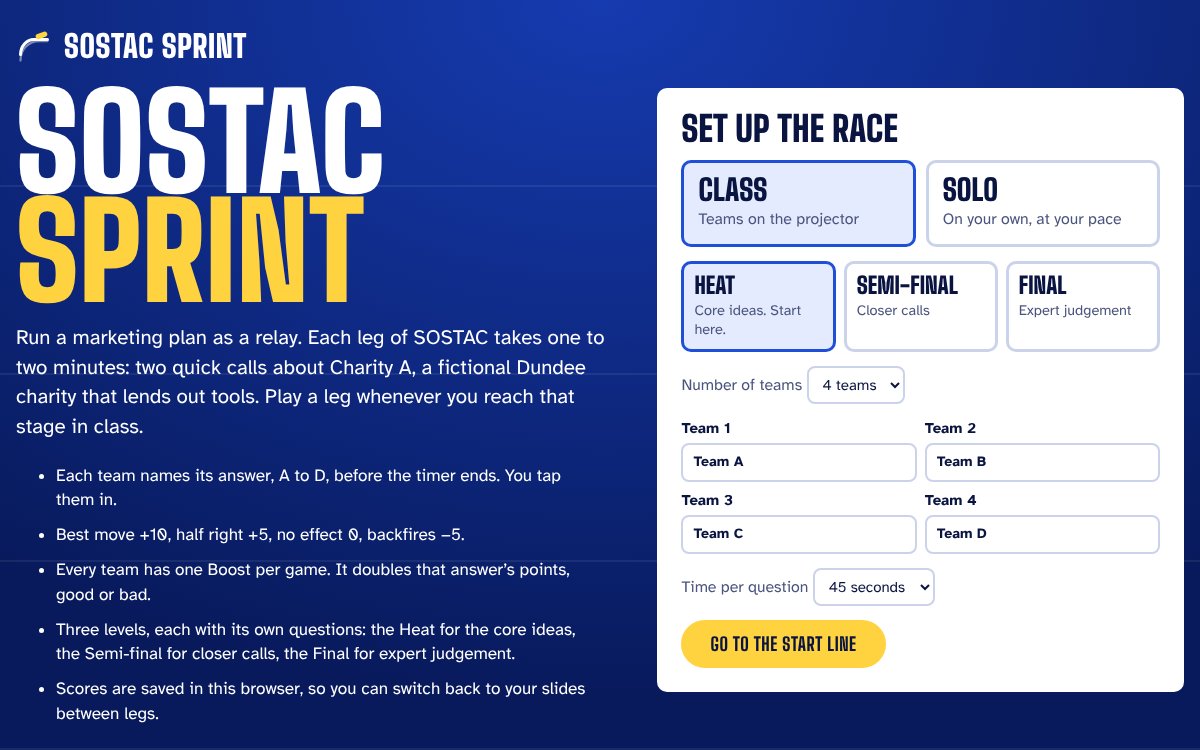
Set-up: class or solo, team names, time per question. 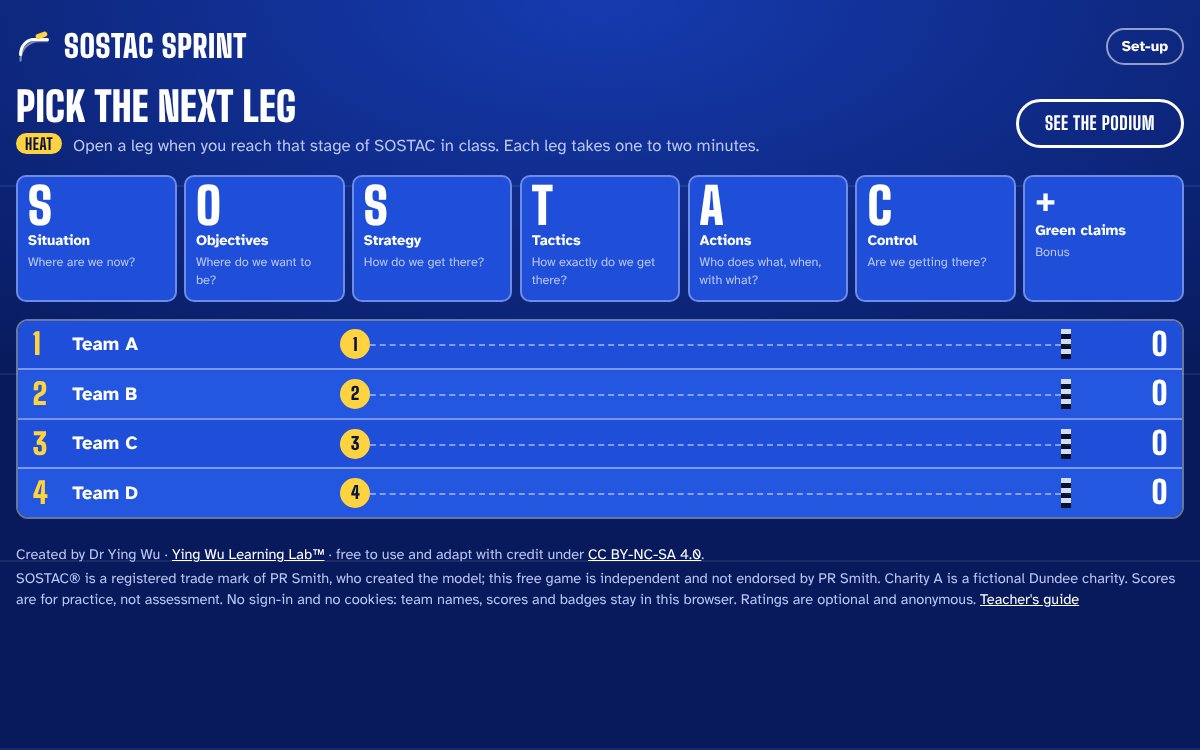
The track: open any leg when your lecture reaches it. 1 Run a leg
2 to 4 min- You
- Open the leg and start the timer (space bar also works).
- Teams call out A, B, C or D; tap each team’s letter in its lane.
- Click Reveal. Read the explanation for the best move and the backfire.
- Next question, then back to your slides.
- Watch for
- Teams picking the “backfires” answer because it sounds most like a textbook.
- Teams using their Boost on the first question they see.
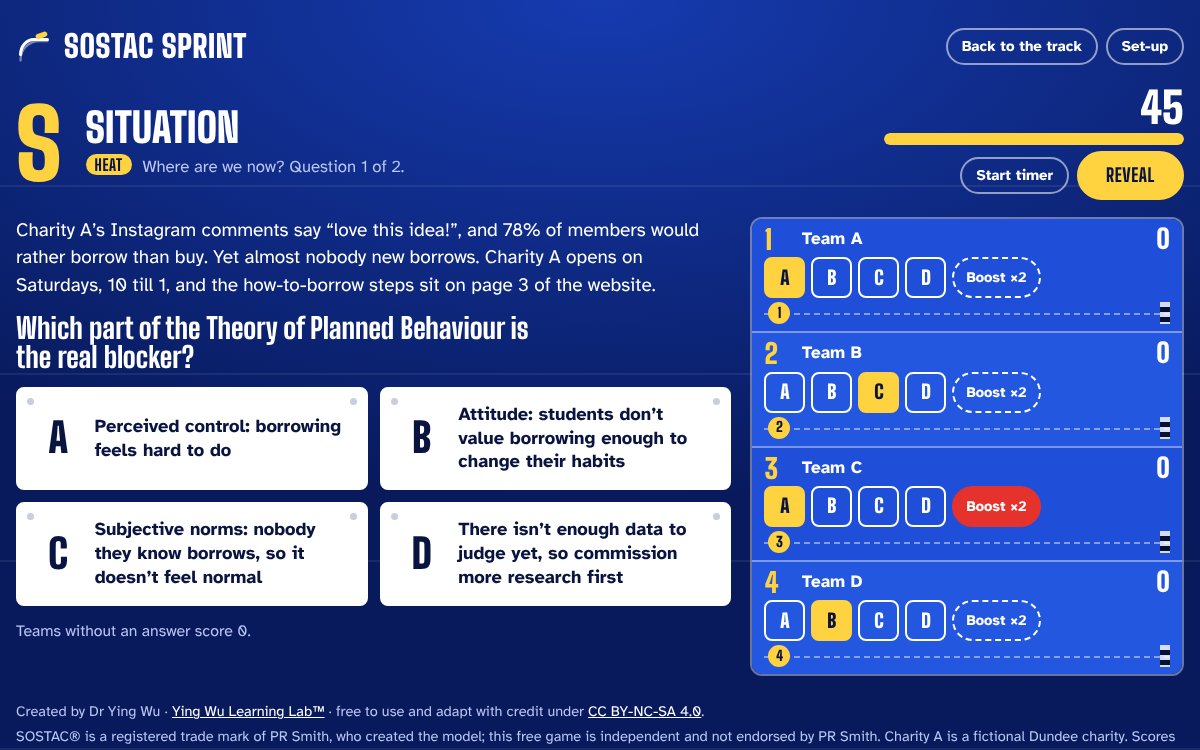
A question: case, ask, four options, timer, and team answers in the lanes. 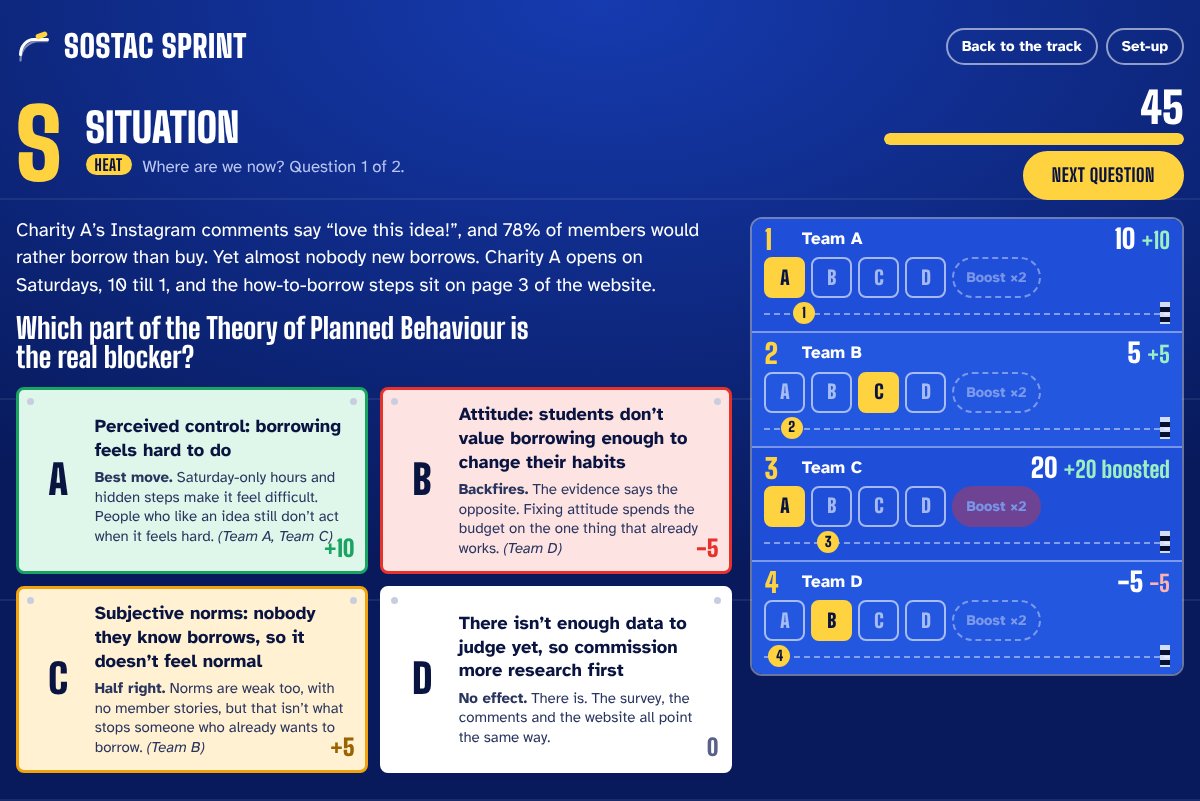
The reveal: every option is explained, and the runners move. 2 Use it in your plan
30 to 60 sec- Say
- “Now do the same for your own client.” Read the “Now your client” prompt aloud; students note it for their assessment.
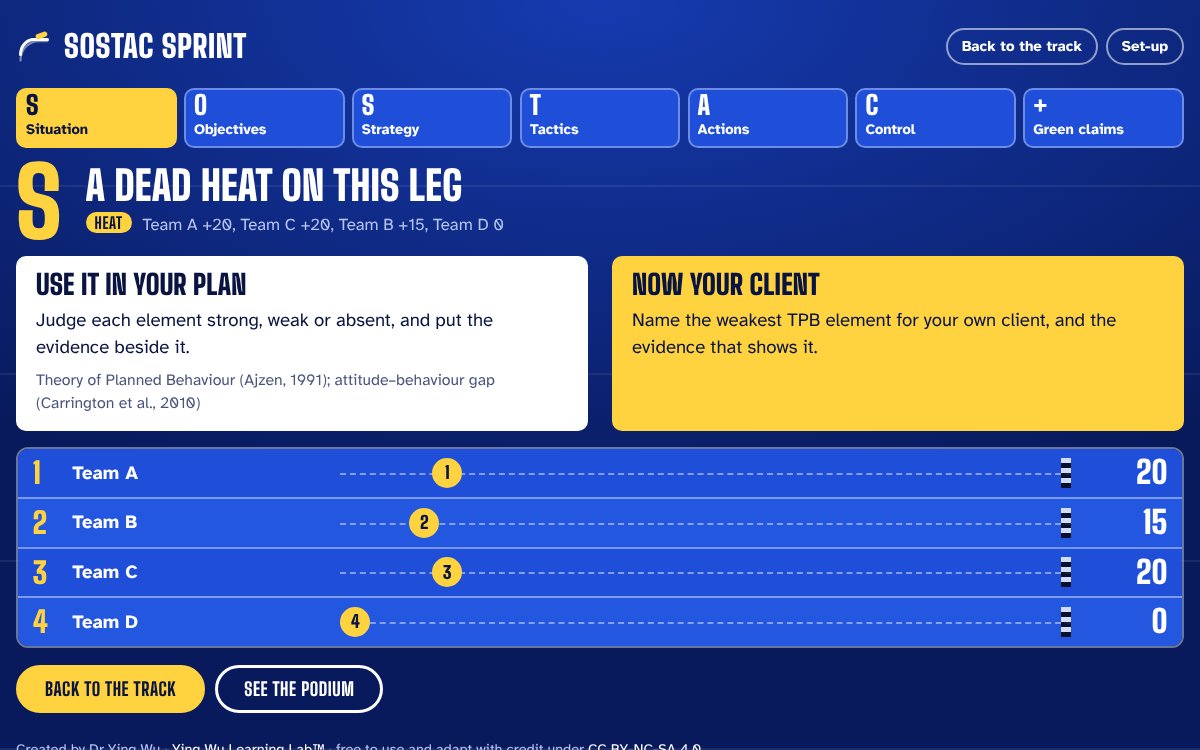
After each leg: the takeaway and a prompt for students’ own plans. 3 Finish
2 to 4 min- Ask
- “Which leg cost your team the most points, and which theory would have saved them?”
- “Where did a weak situation analysis make a later stage harder?”
- Takeaway
- Every SOSTAC stage should follow from the evidence in the one before it.
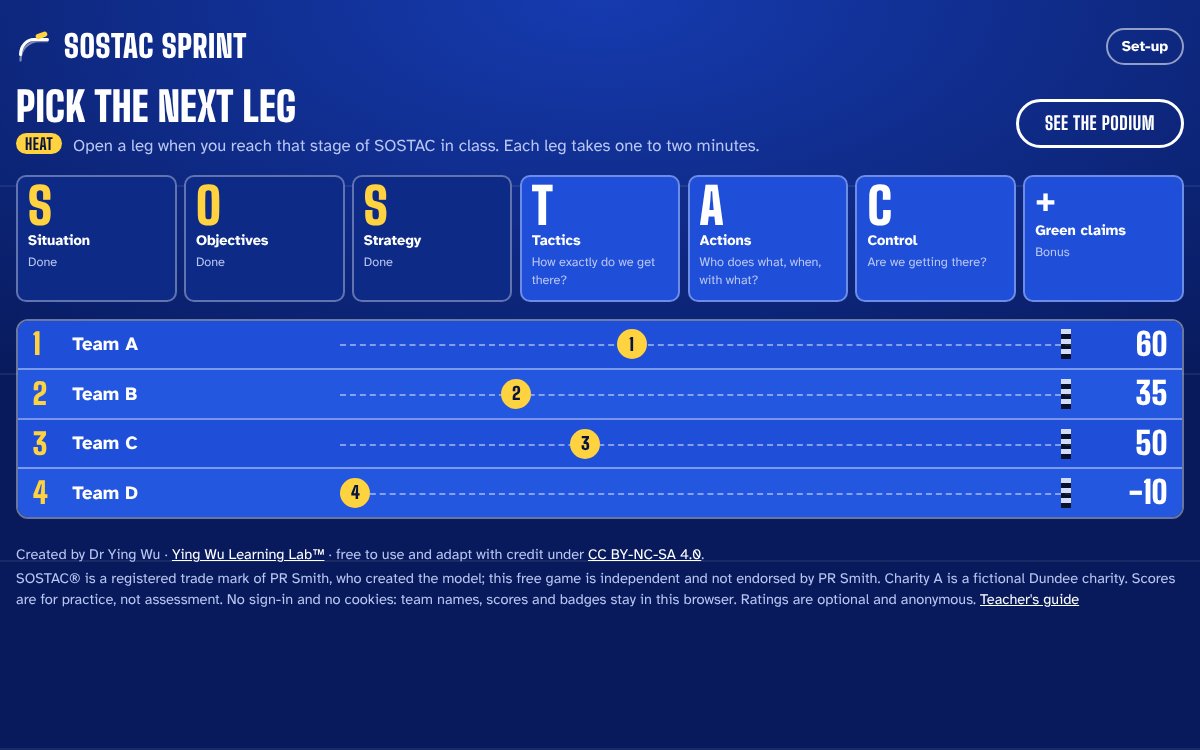
The track mid-session: scores carry over between legs. 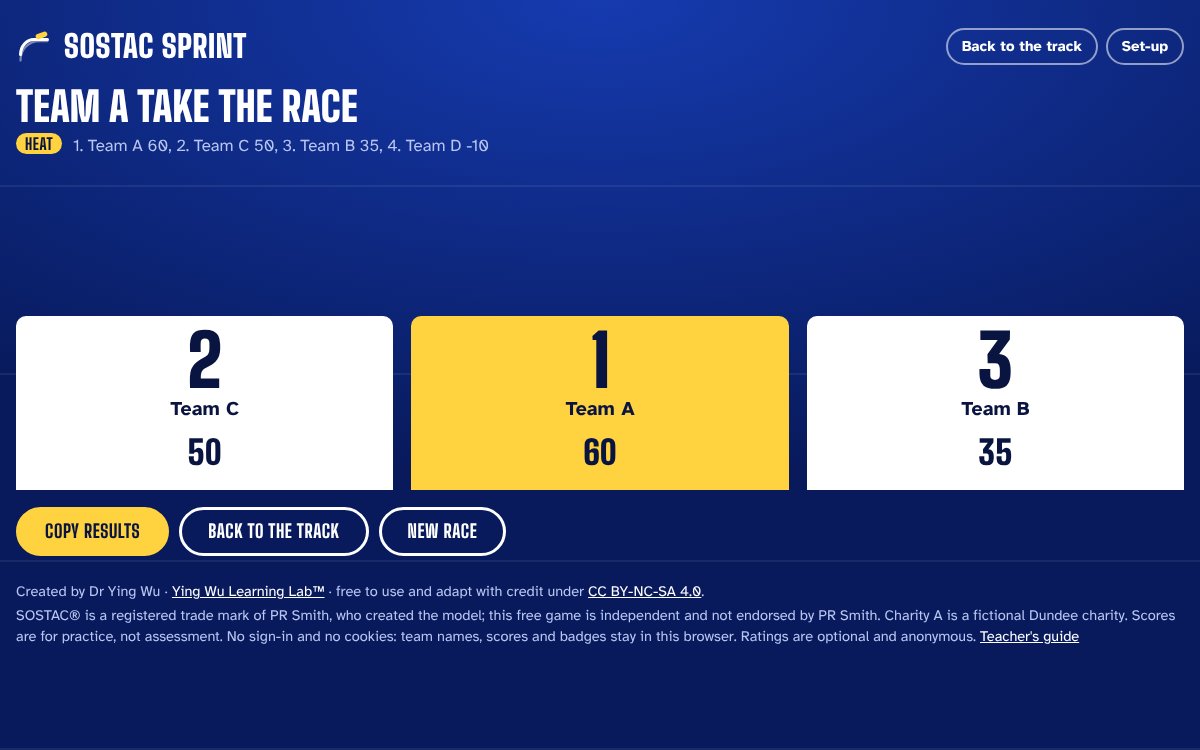
The podium. “Copy results” gives a short summary for your notes.
Linking legs from your slides
- Add a link to the end of each stage of your lecture, for example lab.yingwu.co.uk/sostac-sprint/?leg=obj. It opens that leg directly and keeps the race scores.
- For students on their own devices, add mode=solo: lab.yingwu.co.uk/sostac-sprint/?mode=solo&leg=tac. Solo play never touches the class race.
- To pick a level from a link, add level=semi or level=final: lab.yingwu.co.uk/sostac-sprint/?level=final&leg=obj. Without it, the game opens the level last played in that browser.
- Legs replace short “your turn” exercises: the “Now your client” prompt at the end of each leg does that job.
If something goes wrong
| Problem | What to do |
|---|---|
| I closed the tab | Open the game again in the same browser: the race carries on where you left it. |
| I opened it on a different computer | Scores are kept in one browser only. Start a new race, or add the earlier scores to your notes. |
| A team didn’t answer in time | Unanswered teams score 0. Tap their letter before you click Reveal if they called it in time. |
| “Copy results” does not copy | Some browsers block the clipboard. The text appears on screen instead: select it and copy by hand. |
| No Wi-Fi | Once the page has loaded it runs without a connection. |
| The text is small on the projector | Use the browser’s zoom (Ctrl or Cmd and +). The layout adapts. |
Cheat card
- Pick a level, name the teams, go to the start line
- Finish a stage, open its leg
- Start timer, tap answers, Reveal
- Read the backfire aloud
- “Now your client”
- Back to the slides
Behind the game
- Ajzen, I. (1991) ‘The theory of planned behavior’, Organizational Behavior and Human Decision Processes, 50(2), pp. 179-211.
- AMEC (2016) Integrated Evaluation Framework. amecorg.com
- Batra, R. and Keller, K.L. (2016) ‘Integrating marketing communications: new findings, new lessons, and new ideas’, Journal of Marketing, 80(6), pp. 122-145.
- Carrington, M.J., Neville, B.A. and Whitwell, G.J. (2010) ‘Why ethical consumers don’t walk their talk’, Journal of Business Ethics, 97(1), pp. 139-158.
- Smith, P.R. SOSTAC® planning model. prsmith.org
- Chaffey, D. and Smith, P.R. (2022) Digital Marketing Excellence. 6th edn. Abingdon: Routledge.
- Competition and Markets Authority (2021) Making environmental claims on goods and services (Green Claims Code). gov.uk
- Dietrich, G. (2014) Spin Sucks. Indianapolis: Que.
- Doran, G.T. (1981) ‘There’s a S.M.A.R.T. way to write management’s goals and objectives’, Management Review, 70(11), pp. 35-36.
- Lavidge, R.J. and Steiner, G.A. (1961) ‘A model for predictive measurements of advertising effectiveness’, Journal of Marketing, 25(6), pp. 59-62.
- Moore, G.A. (1991) Crossing the Chasm. New York: HarperBusiness.
SOSTAC® was created by PR Smith and is his registered trade mark (prsmith.org). SOSTAC Sprint is an independent, free teaching resource and is not endorsed by PR Smith. Charity A, its survey figures and its campaign are invented for the game. Fonts are self-hosted under the SIL Open Font License (licence).