What students learn
1. Paraphrase or plagiarism?
Six drafts of one source show the difference between a real paraphrase, a correct quotation, patchwriting, copied words without quotation marks, and an uncredited idea. A highlighter shows the wording each draft shares with the source.
2. Ideas need credit too
One draft shares 0% of its wording with the source and is still plagiarism. Similarity checkers would miss it; students should not.
3. Check every reference
A reference list built with an AI chatbot mixes real papers, garbled details and invented articles. Students get three simulated library lookups, so they must decide where checking matters most.
4. AI: fine, check, or not acceptable
Eight common uses of AI, from asking for an explanation to uploading interview transcripts, sorted green, amber or red for a typical UK university.
Pick a format
Induction
A 15–30 minute activity in the first weeks of any programme, before the first assessment. This is the plan below.
Before a deadline
Post the link a fortnight before the first essay is due, and ask students to bring the AI scenario they disagreed with.
Postgraduate research
For doctoral training, Round 2 opens a conversation about reference management and checking sources, and Round 3 about data and AI tools.
Academic skills teams
Library and study skills teams can use it in drop-ins or embed the link in a referencing guide.
Five golden rules
- Answers lock when clicked.The explanation appears straight away. That is where the learning is.
- Three lookups only.In Round 2 students can check three of the six references. All six must be marked before submitting.
- Round 3 is about local rules.Answers reflect a typical UK university in October 2026. Rules differ between institutions and assessments, so follow it with your own policy (see “Your rules” below).
- The source is invented.Moreno (2021) and its passage are fictional, so nobody can look up the answer. The six references in Round 2 are a mix of real and fabricated items.
- Nothing leaves the device.There are no accounts, and no answers are sent anywhere.
The three rounds
| Round | Task | Items | Points |
|---|---|---|---|
| 1 | Judge each draft: acceptable, missing citation, too close to the original, or needs quotation marks | 6 drafts | 18 (3 each) |
| 2 | Mark each reference genuine or suspicious, with three library lookups | 6 references | 18 (3 each) |
| 3 | Sort each use of AI: usually fine, check the rules and declare it, or not acceptable | 8 scenarios | 24 (3 each) |
Bands: Integrity Pro (51+), Careful Scholar (39+), Getting There (27+), At Risk. Badges: Source checked for finishing, Integrity pro for 51 or more.
Every answer
Collapsed so students looking over your shoulder don’t see them. Open before the debrief.
Round 1: six drafts of Moreno (2021, p. 44)
| Draft | Answer | Shared wording | Why |
|---|---|---|---|
| A | Acceptable | 0% | A real paraphrase with new structure and vocabulary, credited. |
| B | Missing citation | 96% | Almost every word copied, no citation. |
| C | Too close to the original | 76% | Cited, but only a few words swapped: patchwriting. |
| D | Acceptable | 68% | Exact words, in quotation marks, with author, year and page. |
| E | Missing citation | 0% | Own words, but Moreno’s idea and finding, uncredited. |
| F | Needs quotation marks | 60% | Credited, but the second half copies exact words without quotes. |
Round 2: the reference list
| Reference | Answer | Why |
|---|---|---|
| Braun and Clarke (2006), Qualitative Research in Psychology | Genuine | One of the most cited methods papers in the social sciences. |
| Kahneman and Tversky (2011), Psychological Review | Fabricated | Tversky died in 1996; the real 2011 work is Kahneman’s book Thinking, fast and slow. |
| Watson and Crick (1953), Nature | Genuine | The double helix paper. |
| Vaswani (2017), Nature | Not genuine as cited | A real paper with eight authors, published at NeurIPS, not Nature; page numbers invented. |
| Braun and Clarke (2014), “Thematic analysis in the age of generative AI” | Fabricated | Real authors and journal, but public generative AI arrived in late 2022. |
| Hardin (1968), Science | Genuine | “The tragedy of the commons”. |
Round 3: AI use
| Scenario | Answer | Why |
|---|---|---|
| Asking AI to explain a statistics concept from a lecture | Green | AI as a tutor; check against your notes. |
| Submitting what AI writes from the assignment brief | Red | Not your own work, under every university’s rules. |
| Adding AI-suggested references without reading them | Red | AI invents references; citing unread sources misrepresents your research. |
| Brainstorming research questions with AI, then developing your own | Amber | Often allowed; check and declare. |
| Uploading interview transcripts to a free public AI tool | Red | Breaks participants’ consent and data protection. |
| Running a finished draft through AI for grammar and spelling | Amber | Proofreading-level help is often allowed but sometimes restricted. |
| Turning lecture notes into practice quiz questions | Green | Studying, not submitting. |
| Writing in your first language and translating with AI | Amber | Rules vary widely; ask first. |
Draft E is the best debrief starter: a similarity checker would score it 0%, and it is still plagiarism. Draft D shows the opposite: 68% shared wording, and perfectly acceptable.
Before the session
- Share lab.yingwu.co.uk/source-check/ as a link or QR code.
- Have your own university’s academic integrity and AI guidance open, ready for the Round 3 discussion.
- Play it once yourself: 12 to 20 minutes when you know the answers.
- Open the answer key above, ready for the debrief.
How long will it take?
Every time in this guide is a range. The low end is a tight run; the top end is what most classes take once teams discuss, decide and react to the results.
In class: 15 to 30 minutesSolo: 12 to 20 minutes
What moves you up or down the range
- When you call time. Students play at their own pace. Moving to the debrief once most have finished keeps you near the low end; waiting for everyone moves you to the top.
- Reading every explanation. Students who read each explanation, as they should, take longer than those who rush to the next item.
- Phones joining or loading. Sharing the link or QR code, patchy Wi-Fi and the three library lookups in Round 2.
- Getting started. Explaining the three rounds and why integrity matters takes a few minutes, more with first-year students.
- Interaction in between. Questions about your own university's rules, students comparing answers, or a tech hiccup.
- The debrief. Draft E alone, or a full discussion of the AI scenarios with your own guidance on screen.
- Your group. Familiarity with the topic, reading in a second language, and the room layout.
Short on time? Call time when most students have finished and debrief Draft E and one AI scenario. Want the richest discussion? Plan for the top of the range.
Step by step
15 to 30 minutes, with students on their own phones or laptops.
0 Set it up
2 to 4 min- Say
- “Three rounds on the habits that keep your work honest. Read every explanation, even when you are right.”
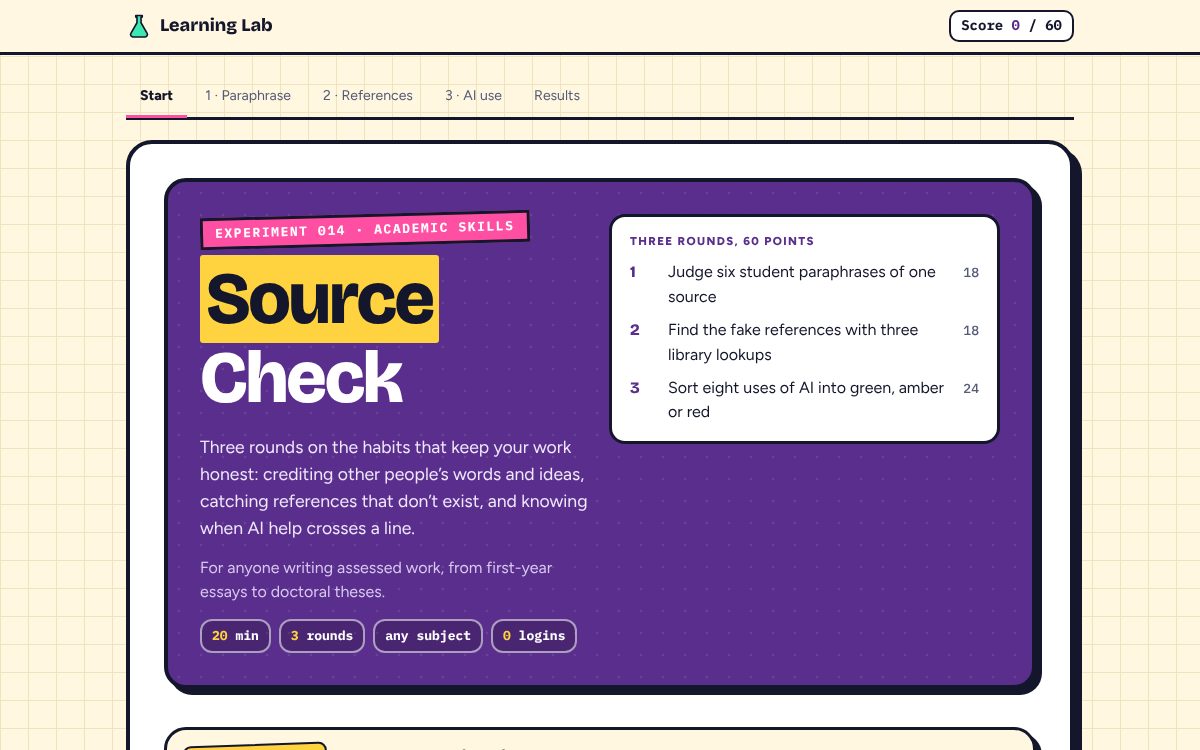
The start screen: three rounds, 60 points. 1 Play
12 to 18 min- Students
- Round 1: judge six drafts of the same source.
- Round 2: mark six references, using three library lookups.
- Round 3: sort eight uses of AI.
- Watch for
- Students marking Draft E acceptable because the wording is their own.
- Students using all three lookups on the first three references.
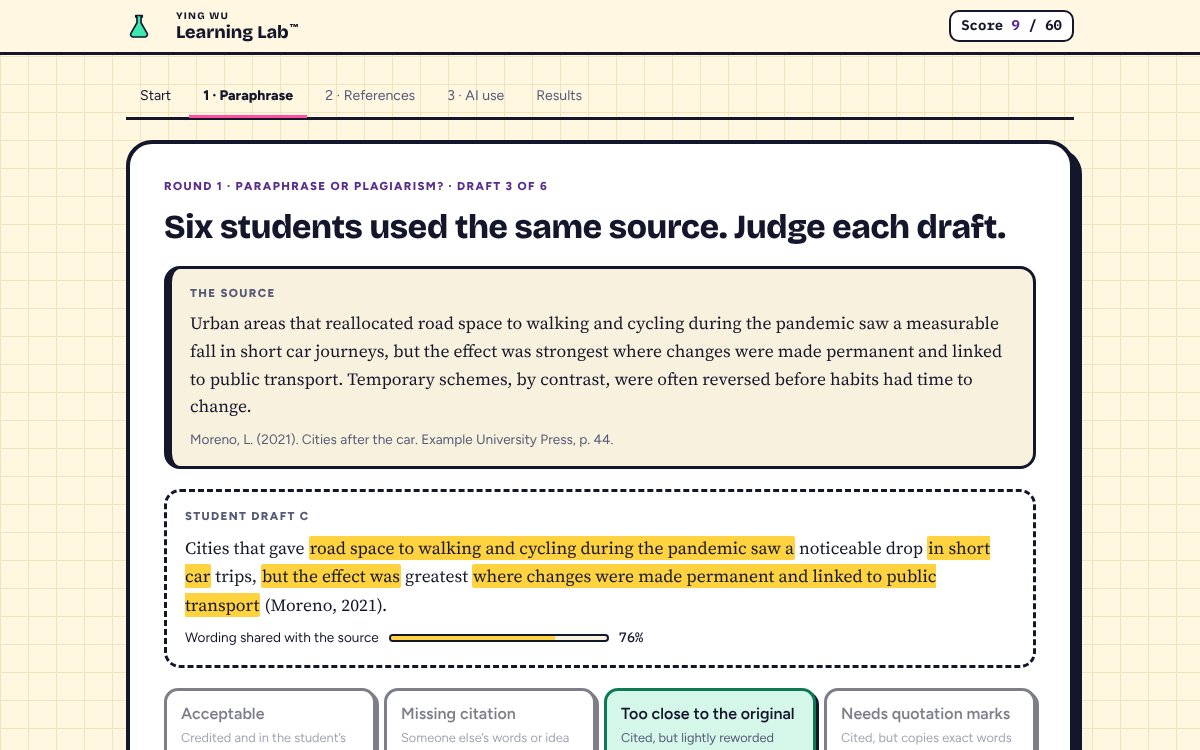
Round 1: the highlighter shows wording shared with the source. 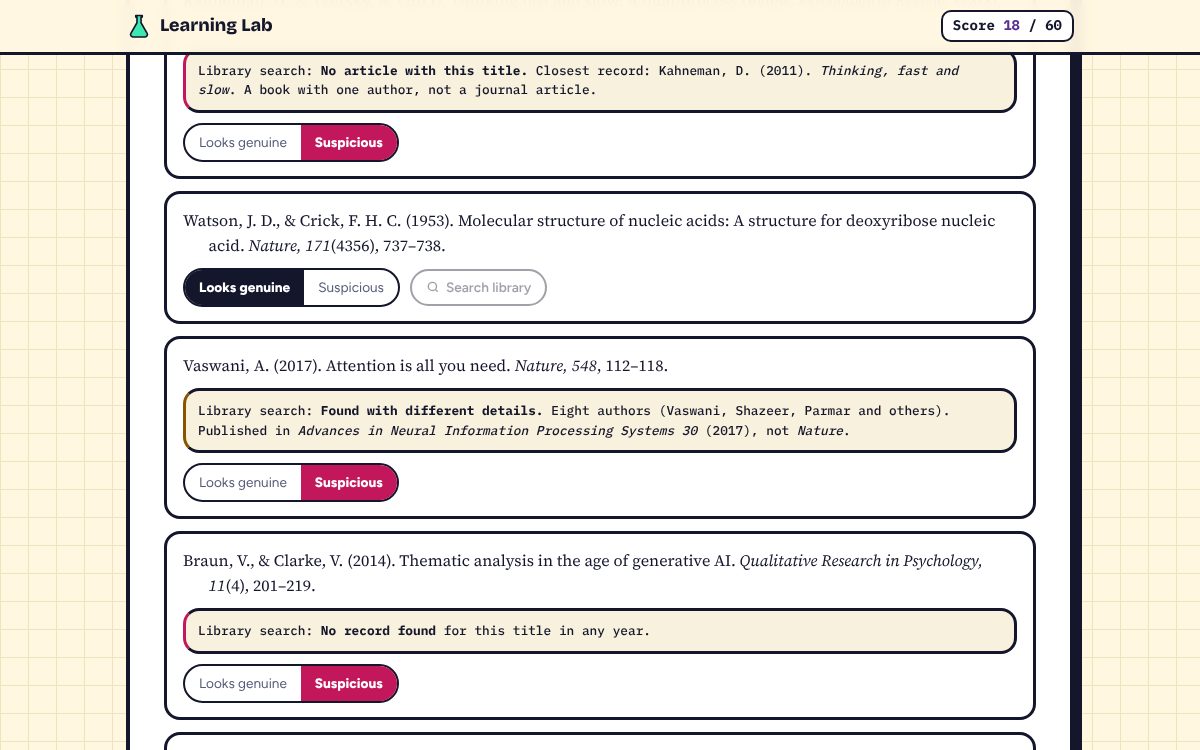
Round 2: three lookups, six calls to make. 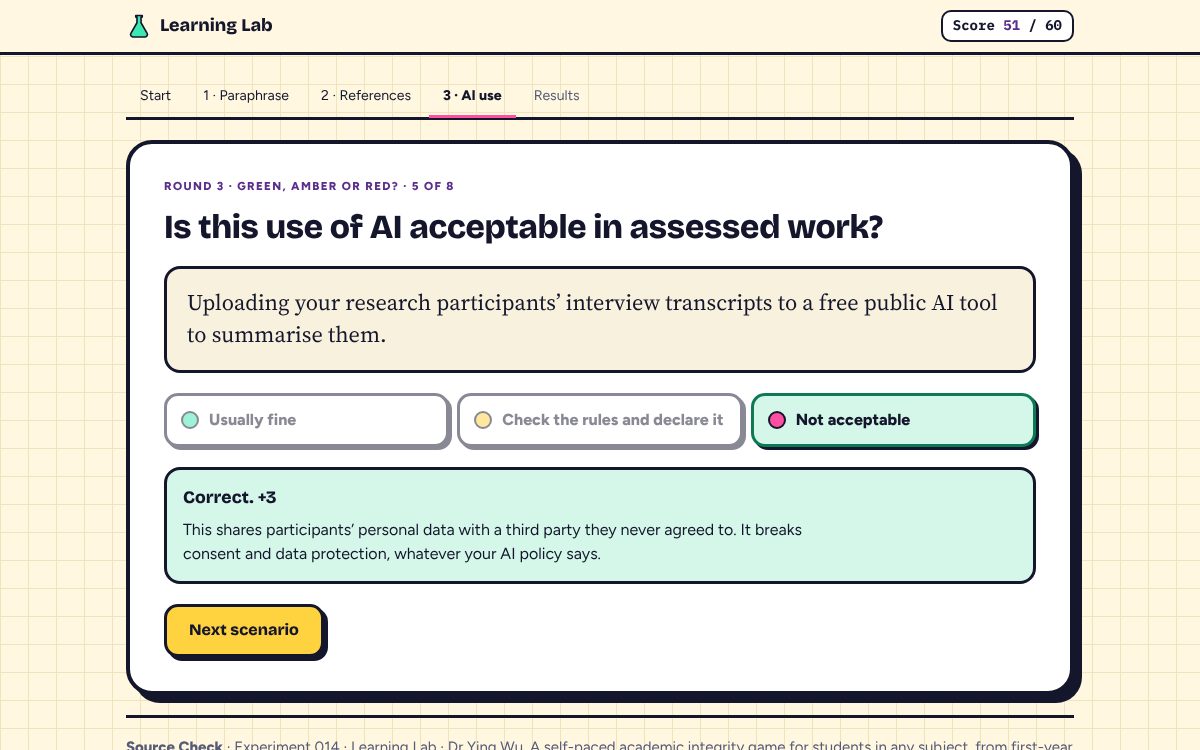
Round 3: green, amber or red. 2 Debrief
6 to 9 min- Ask
- “Draft C cited its source but was still marked down. Is patchwriting as serious as copying without credit?”
- “Why do AI tools produce references that look right but do not exist?”
- “Here is our university’s AI guidance. Where does it put each amber scenario?”
- “Where is the line between help with your writing and someone else writing it?”
- Takeaway
- Credit words and ideas, find and read every source, and check the rules before using AI.
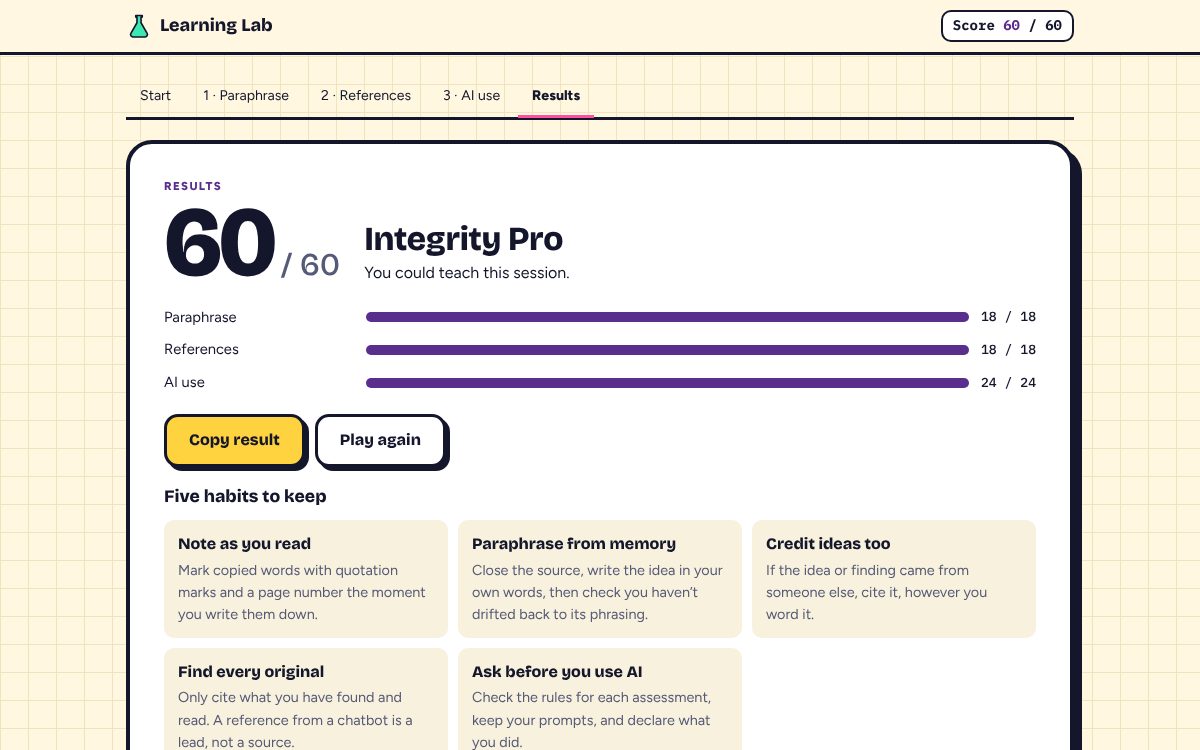
The results: band, per-round bars and five habits to keep.
Adapting Round 3 to your institution
- Round 3 reflects a typical UK university in October 2026. If your policy differs, say so in the debrief: the disagreement is a teaching moment.
- Many universities now use assessment-level categories (for example “AI not permitted”, “AI assistive use”, “AI integral”). Ask students which category each amber scenario would need.
- The transcript scenario is red everywhere: it is a data protection and consent problem, not only an AI policy question.
If something goes wrong
| Problem | What to do |
|---|---|
| A student reloaded the page | The game starts again from the beginning. Each round is short, so replaying is quick, and the second run is usually better. |
| "Copy result" does not copy | Some browsers block the clipboard. The text appears on screen instead: select it and copy by hand. |
| No devices | Put the game on the projector and play it as a whole class: read each item aloud, take a vote by show of hands, then click the room’s answer. |
| No Wi-Fi | Once the page has loaded it runs without a connection. Otherwise, use the answer key on this page as a paper activity. |
| A student argues an amber answer should be green | Good. Check your own policy together. Rules genuinely differ, which is why the answer is amber. |
Cheat card
- Share the link or QR code
- “Read every explanation.”
- 12 to 20 minutes of play
- Draft E: 0% shared wording, still plagiarism
- Show your own AI guidance for Round 3
- “Credit words and ideas; read every source.”
Behind the game
- Howard, R.M. (1995) ‘Plagiarisms, authorships, and the academic death penalty’, College English, 57(7), pp. 788-806.
- Quality Assurance Agency for Higher Education (2020) Academic Integrity Charter. qaa.ac.uk
- Russell Group (2023) Principles on the use of generative AI tools in education. London: Russell Group.
- Real references used in Round 2: Braun and Clarke (2006); Watson and Crick (1953); Vaswani et al. (2017); Hardin (1968). Kahneman (2011) Thinking, fast and slow is the real book behind the fabricated entry.
Moreno (2021) and its passage are invented for the game, and the library records are simulated.