What students learn
1. Judge by the goal, not the clicks
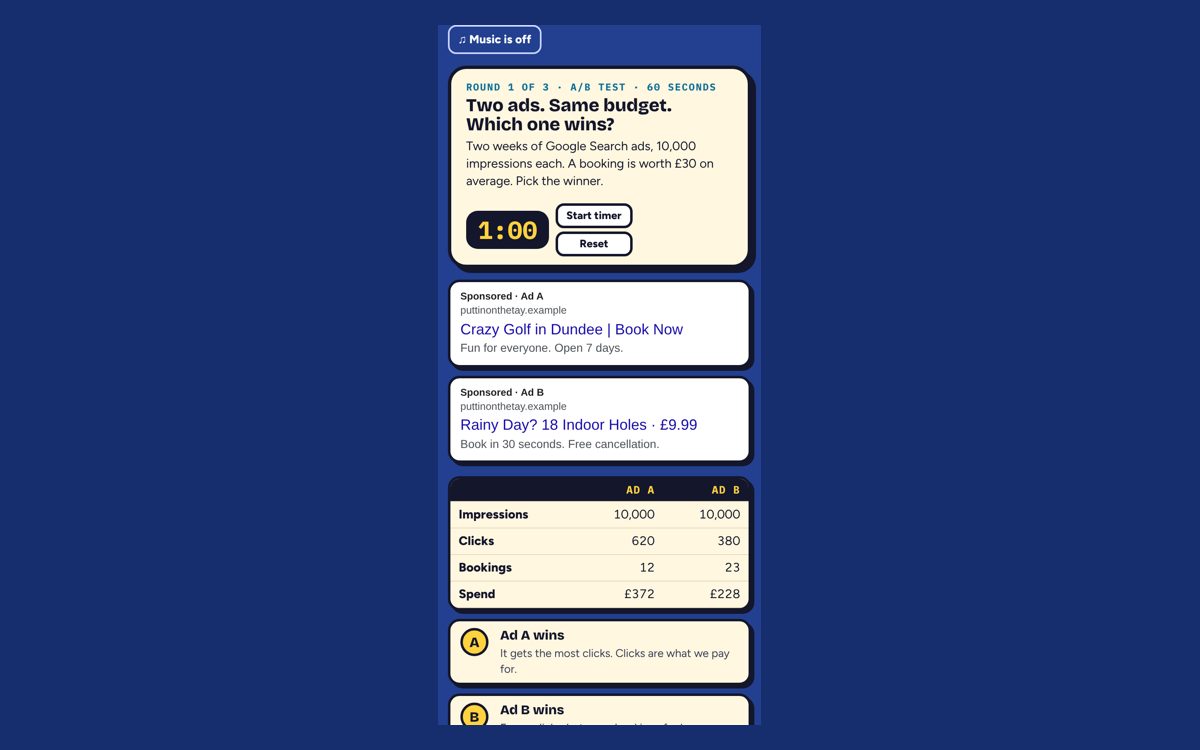
Ad A wins the clicks (6.2% CTR) and loses the money (£31 per booking, ROAS 1.0×). Ad B gets fewer clicks but almost twice the bookings (£9.91 per booking, ROAS 3.0×). CTR measures attention; CPA and ROAS measure business.
2. Read the whole funnel
A strong CTR with a 0.9% conversion rate means the problem is after the click: a slow mobile page, an 11-field form, or tracking that isn't firing. Raising bids pays more to send people into the same leak.
3. Test whether ads add anything
Brand ads can claim credit for bookings that would have come through the free link anyway. A holdout test (ads off for some weeks or regions) measures incrementality. Keep a small defensive budget in case rivals bid on your name.
4. Every number needs a formula and a check
CTR = clicks ÷ impressions. Conversion rate = bookings ÷ clicks. CPA = spend ÷ bookings. ROAS = revenue ÷ spend. Before trusting any of them: is the tracking right, and is there enough data?
Built to fit inside a one-hour lecture. For a longer PPC session use Hungry for Clicks (a whole campaign) or Bid & Rank (a full account recap); for what happens after the click, use Leaky Funnel.
Four golden rules
- One answer per team per round.Each spokesperson calls out a letter (A to D). Tap the team on the right, then its answer. The next team lights up by itself. Tapping the same answer again clears it.
- Answers are on screen, so the room sees them.Small coloured dots show which teams chose each option.
- Points.Best answer 10, good 7, partly right 3, wrong 0. The leaderboard updates after every reveal. Ties on the podium go to round 3, then are shared.
- "Change answers" undoes a reveal.If you tapped a wrong letter, go back, fix it and reveal again. Reloading is safe: the game remembers where you are in this browser tab.
The answers and why
Nothing is random: the answers are fixed, so you can prepare the discussion.
Round 1 · Which ad wins?
B (10): 23 bookings for £228 (CPA £9.91, ROAS 3.0×) beats 12 bookings for £372 (CPA £31.00, ROAS 1.0×). C (3): testing longer is good instinct, but 1,000 clicks and a near doubling of bookings is a clear result. A and D (0): picking on CTR, or never deciding.
Round 2 · Find the leak
C (10): slow mobile page (6.8 s), 11-field form, 78% of clicks on phones: fix the booking page. D (7): checking tracking first is good practice; a 0.9% conversion rate after a site change can be a broken tag. B (3): CTR is already above average. A (0): more bids, same leak.
Round 3 · Is it really working?
B (10): bookings fell only 2% with ads off and organic clicks filled the gap, so the 12× ROAS was mostly borrowed credit. Shrink to a small defensive budget and fund non-brand searches that find new customers. D (3): right that these ads add little, wrong to switch off all search. A and C (0).
Solo rivals
Click Chasers (A, A, C) score 0. Gut Feelers (C, B, A) score 6. Data Detectives (B, D, D) score 20. A player needs more than 20 to win outright; a perfect game is 30.
How long will it take?
Every time in this guide is a range. The low end is a tight run; the top end is what most classes take once teams discuss, decide and react.
In class: about 5 minutes of play; plan 6 to 10Solo: 3 to 5 minutes
What moves you up or down the range
- How strictly you run the clock. Stopping each round at 1:00 keeps you near 6 minutes; letting teams finish talking moves you towards 10.
- Number of teams. More teams means more letters to tap in (about 3 seconds each).
- The maths reveal in round 1. Walking through CTR, CPA and ROAS line by line takes a minute and is the heart of the game.
- Interaction in between. Cheering, reading the real case aloud, a quick question to the team that chose A.
- Your group. Familiarity with the metrics, reading in a second language, and the room layout.
Short on time? Keep to four teams, use the timer and read only the yellow lesson box. Want the richest discussion? Ask a team that chose D in round 2 to argue against the team that chose C.
Step by step
0 Set the scene and form teams
0.5 to 1 min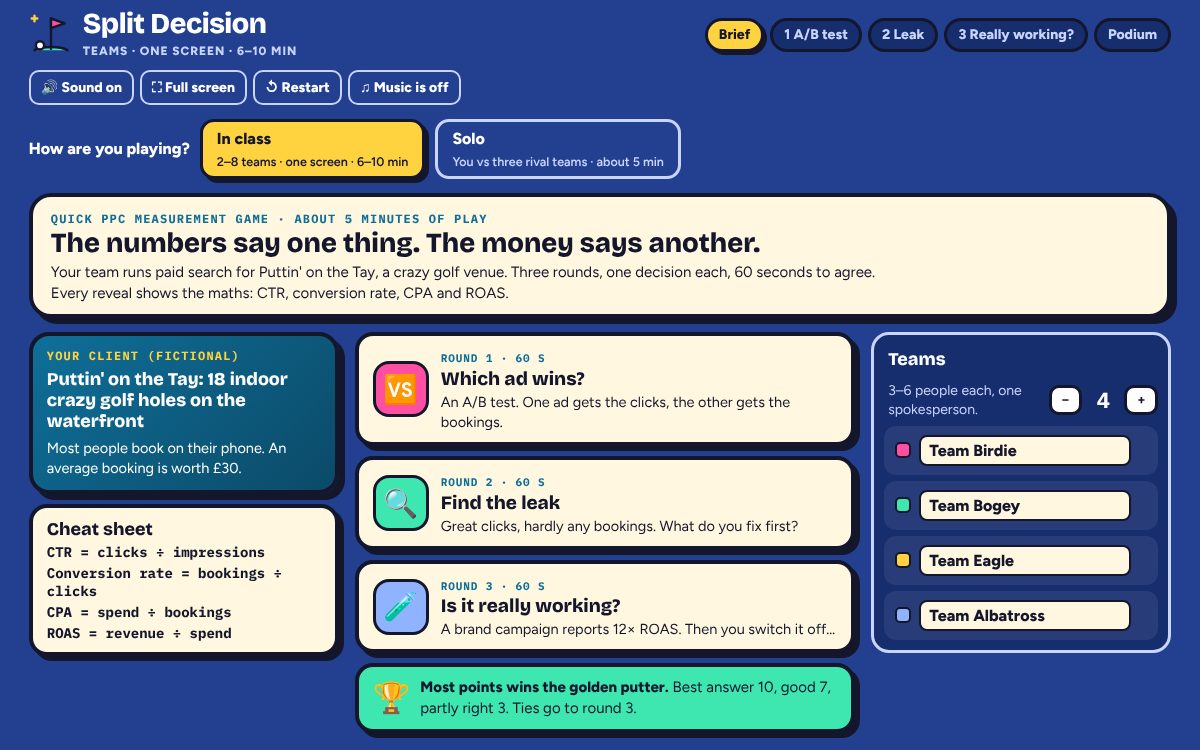
The client, the four formulas, the three rounds and the winning rule on one screen. - Click
- Set the number of teams with − and +; type names if you like.
- Full screen, then Start round 1.
- Say
- "You run the Google Ads for a crazy golf venue. Three decisions, sixty seconds each. Keep an eye on the cheat sheet."
1 Round 1 · Which ad wins?
1.5 to 3 min · timer 1:00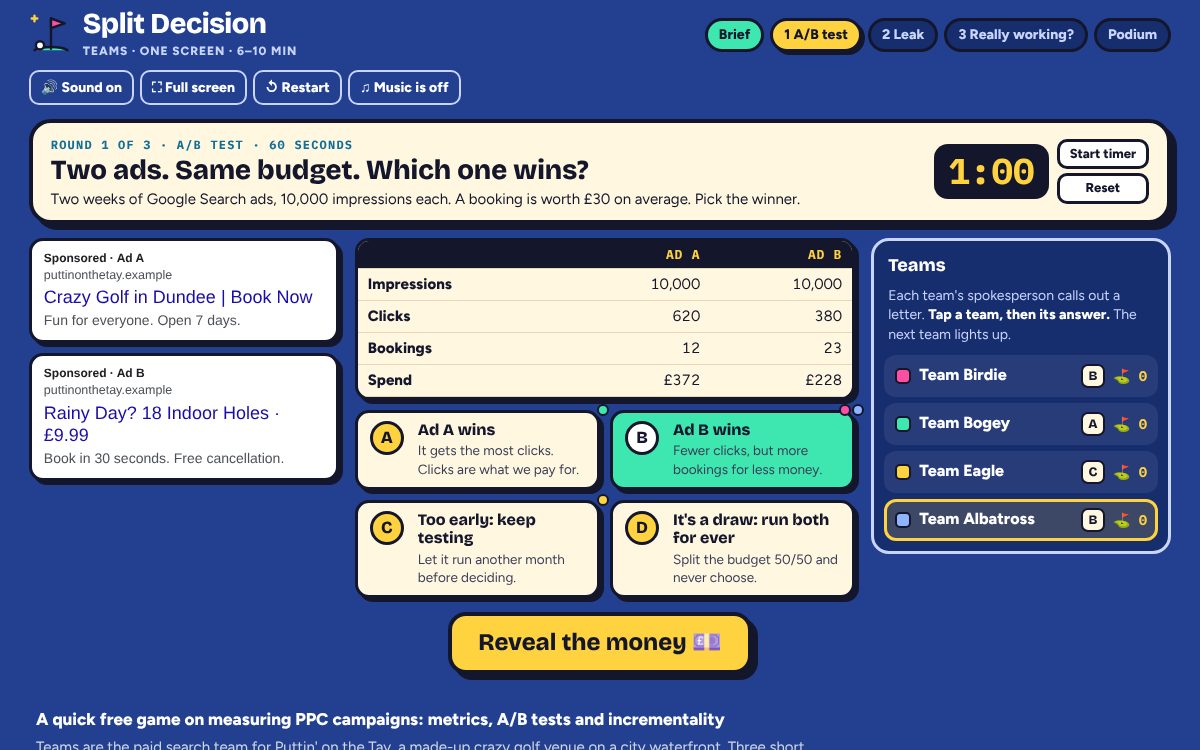
Two ads, the raw numbers and four answers. Teams' letters appear on the right. 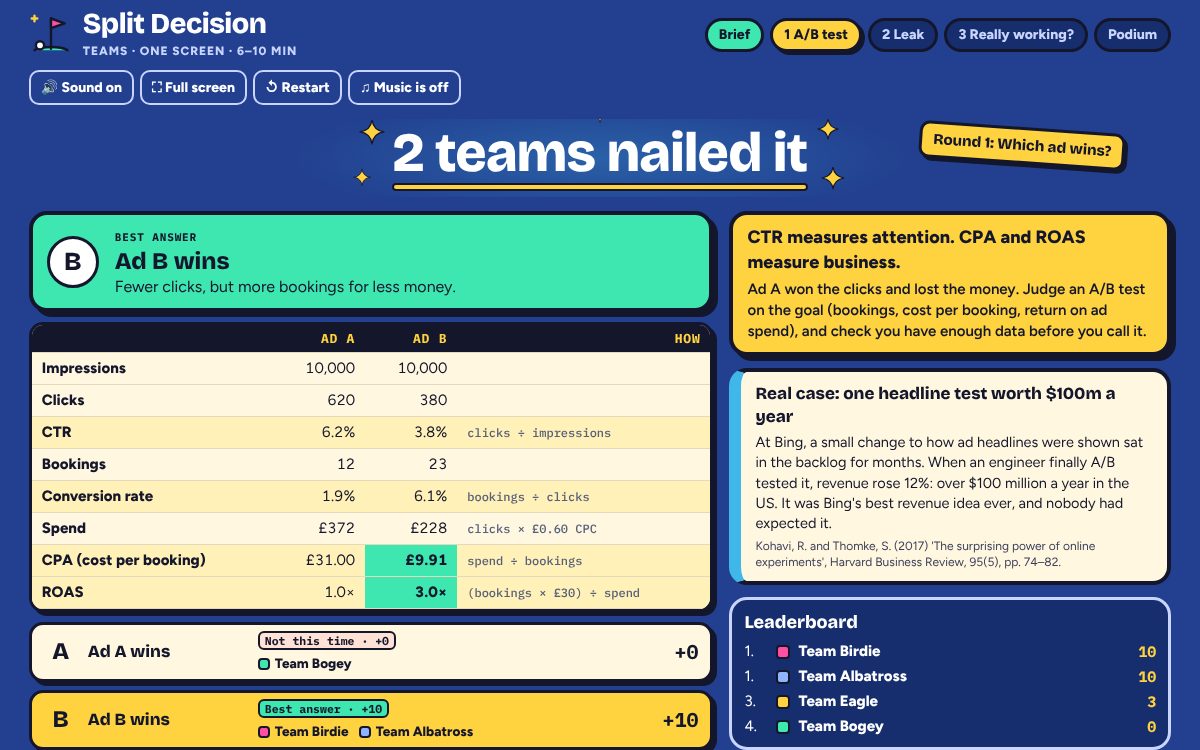
The reveal adds CTR, conversion rate, CPA and ROAS, with the formula for each. - Watch for
- Teams that choose A. Ask: "Which ad would you rather pay for?"
2 Round 2 · Find the leak
1.5 to 2.5 min · timer 1:00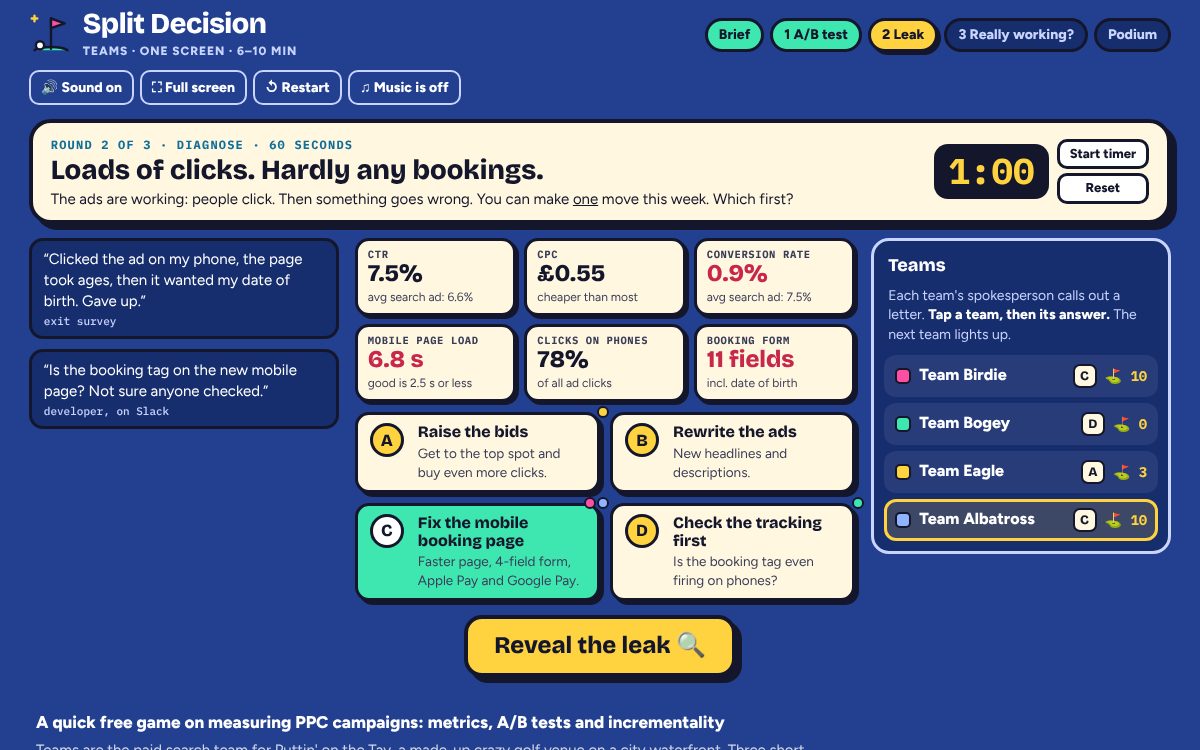
Red tiles are the clues. The developer's message hints at tracking. 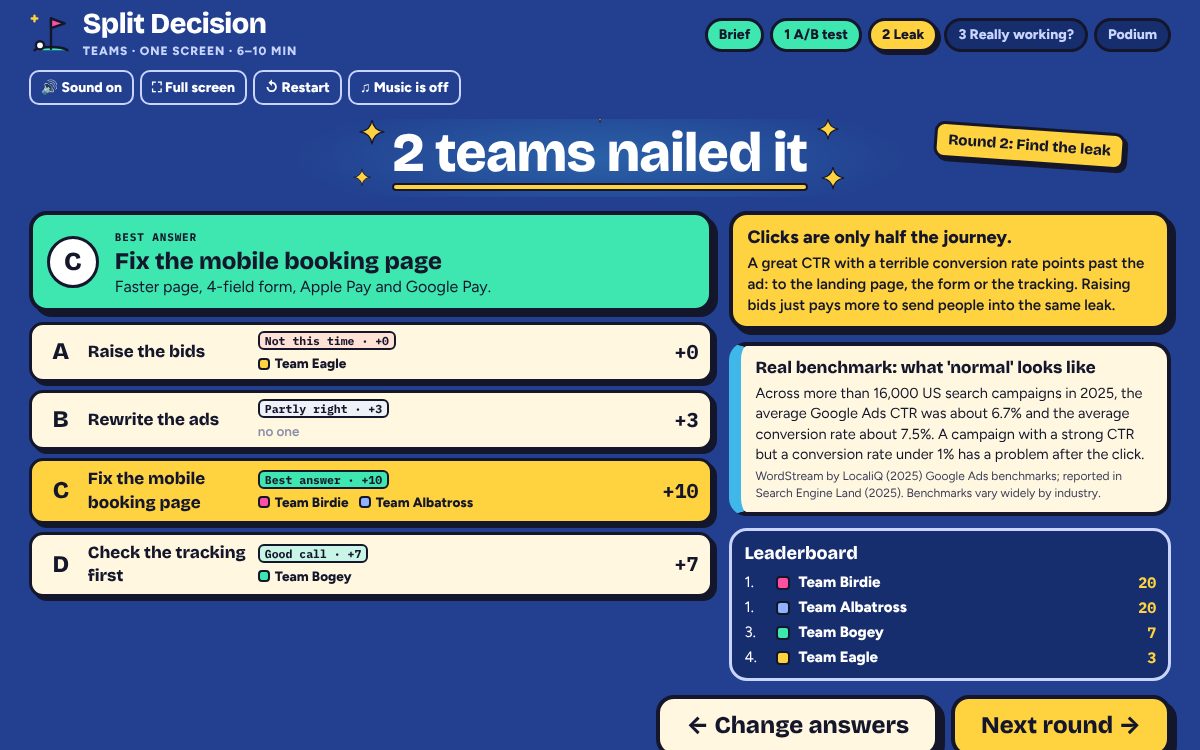
Two good answers: the page (10) and the tracking (7). 3 Round 3 · Is it really working?
1.5 to 2.5 min · timer 1:00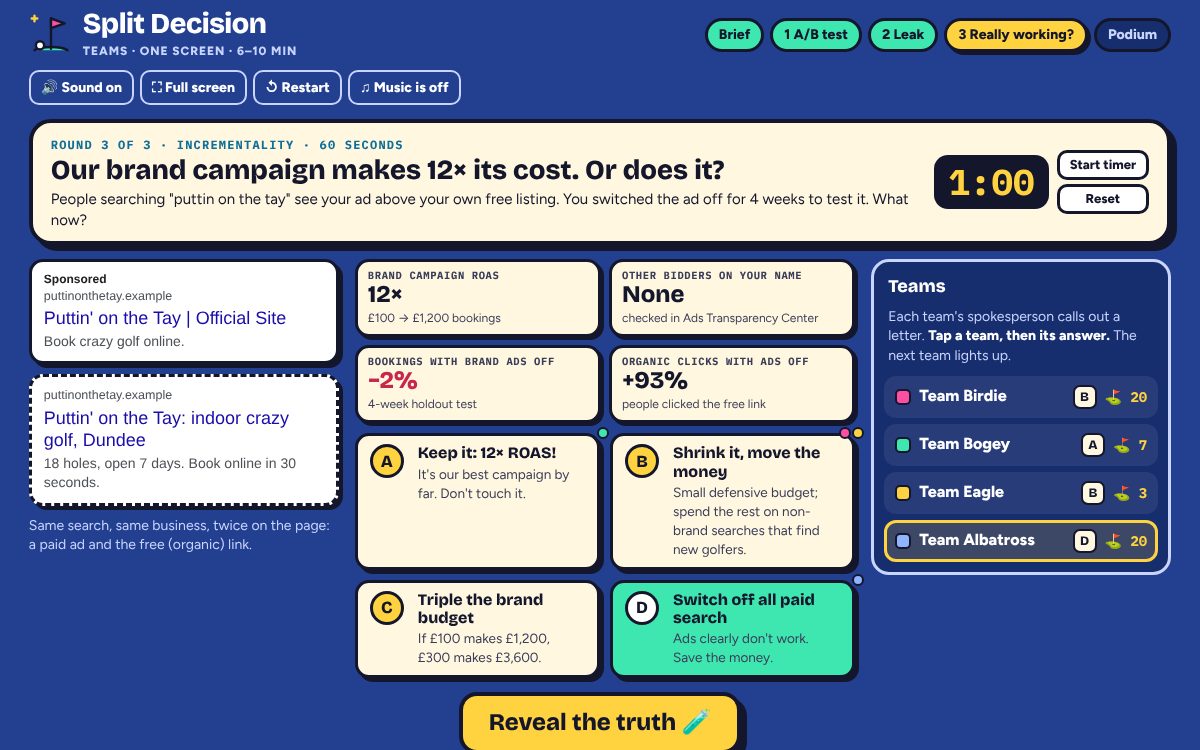
The same business twice on the page, and the holdout test result. 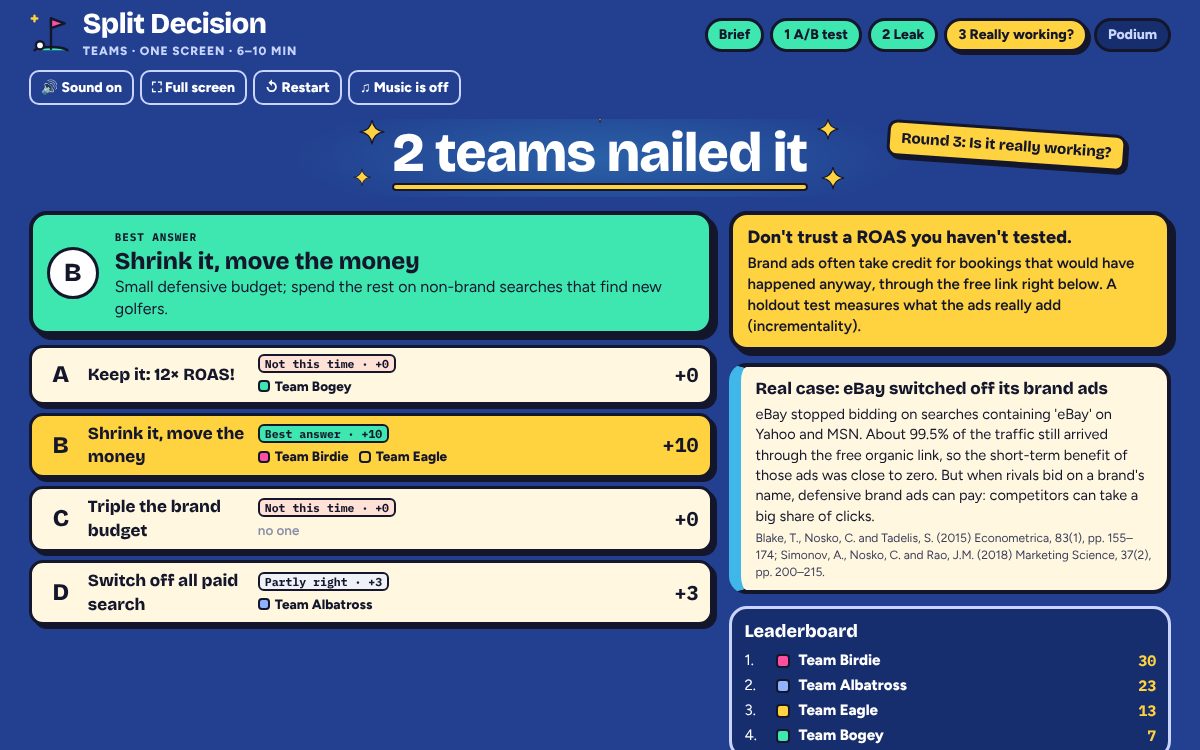
The eBay case, and why brand ads still matter when rivals bid on your name. 4 Podium and one question
1 to 2 min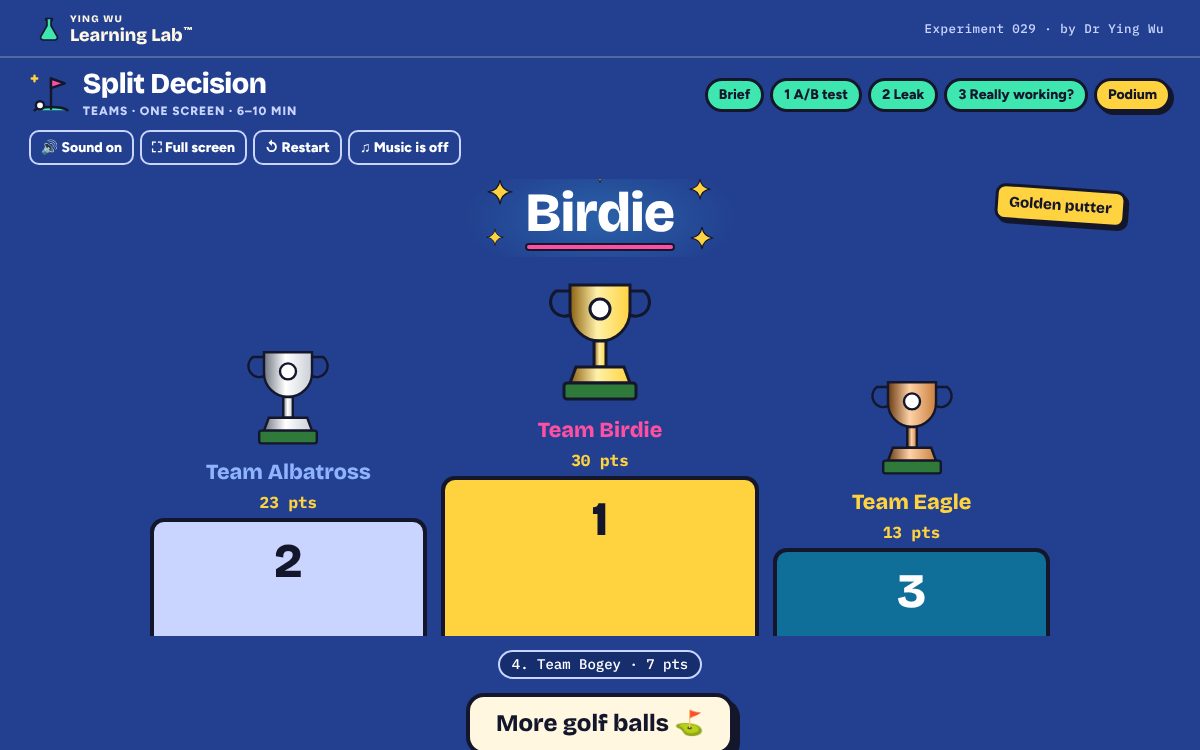
Putter trophies and gently falling golf balls (no flashing or shaking). - Say
- "In your assessment: which one metric would prove your PPC campaign worked for your client, and how would you test it?"
Solo mode
Share lab.yingwu.co.uk/split-decision/#solo for revision. The rivals always make the same choices: Click Chasers love a big CTR, Gut Feelers go with the vibe, and Data Detectives check before acting (but not perfectly). Finishing any game earns the "Split decision" badge; beating all three rivals in solo mode earns "Golden putter".
Debrief questions
- Which one metric proves a PPC campaign worked?The one tied to the business goal: CPA or ROAS for sales, cost per lead for sign-ups, cost per 1,000 people reached for awareness. CTR is a diagnostic, not a goal.
- What would you A/B test first, and how would you call the winner?One change at a time (headline, offer, landing page), the same audience and budget, enough bookings to be confident, judged on the goal metric.
- What would you check before trusting a number?That the conversion tag fires on every device, that GA4 key events and Google Ads conversions are defined the same way, consent mode, and the date range.
Cheat card: the button order
- Set teams, Full screen, Start round 1
- Start timer (1:00); tap each team, then its letter; Reveal the money; Next round
- Start timer (1:00); tap letters; Reveal the leak; Next round
- Start timer (1:00); tap letters; Reveal the truth; To the podium
- Ask one debrief question
Behind the rounds
- Kohavi, R. and Thomke, S. (2017) 'The surprising power of online experiments: getting the most out of A/B and other controlled tests', Harvard Business Review, 95(5), pp. 74–82. hbr.org
- Search Engine Land (2025) Google Ads costs keep rising, but conversion rates improved in 2025 (WordStream by LocaliQ benchmarks: average CTR 6.66%, conversion rate 7.52%). searchengineland.com
- Blake, T., Nosko, C. and Tadelis, S. (2015) 'Consumer heterogeneity and paid search effectiveness: a large-scale field experiment', Econometrica, 83(1), pp. 155–174. doi:10.3982/ECTA12423
- Simonov, A., Nosko, C. and Rao, J.M. (2018) 'Competition and crowd-out for brand keywords in sponsored search', Marketing Science, 37(2), pp. 200–215. doi:10.1287/mksc.2017.1065
- Google Analytics Help: About key events (GA4 renamed "conversions" to "key events" in March 2024). support.google.com
- web.dev (2024) Interaction to Next Paint becomes a Core Web Vital on March 12. web.dev
A simplified classroom model: all figures for Puttin' on the Tay are illustrative teaching devices. The venue is fictional.