Subject bite 01 · Search marketing

Google's next spam update is coming

Jon Earnshaw recorded this two-minute insight for my search marketing students. He explains the three spam rules Google enforces, shows what happened when big newspapers broke one, and says why he expects a crackdown on mass-produced content before Christmas.

2 min 20 videoUK captionsRecorded Oct 20265–10 minute sorting task3 seminar questions
Watch

Two minutes from the front line

Watch with captions on. The charts Jon mentions appear in the video and are explained in full further down.

Jon Earnshaw, Pi DatametricsRecorded October 2026English (UK) captions
Read the transcript

Hello to all of Ying's wonderful search marketing students. We're just having a brief conversation about an algorithm update that I believe is coming in the next two or three weeks, maybe four weeks.

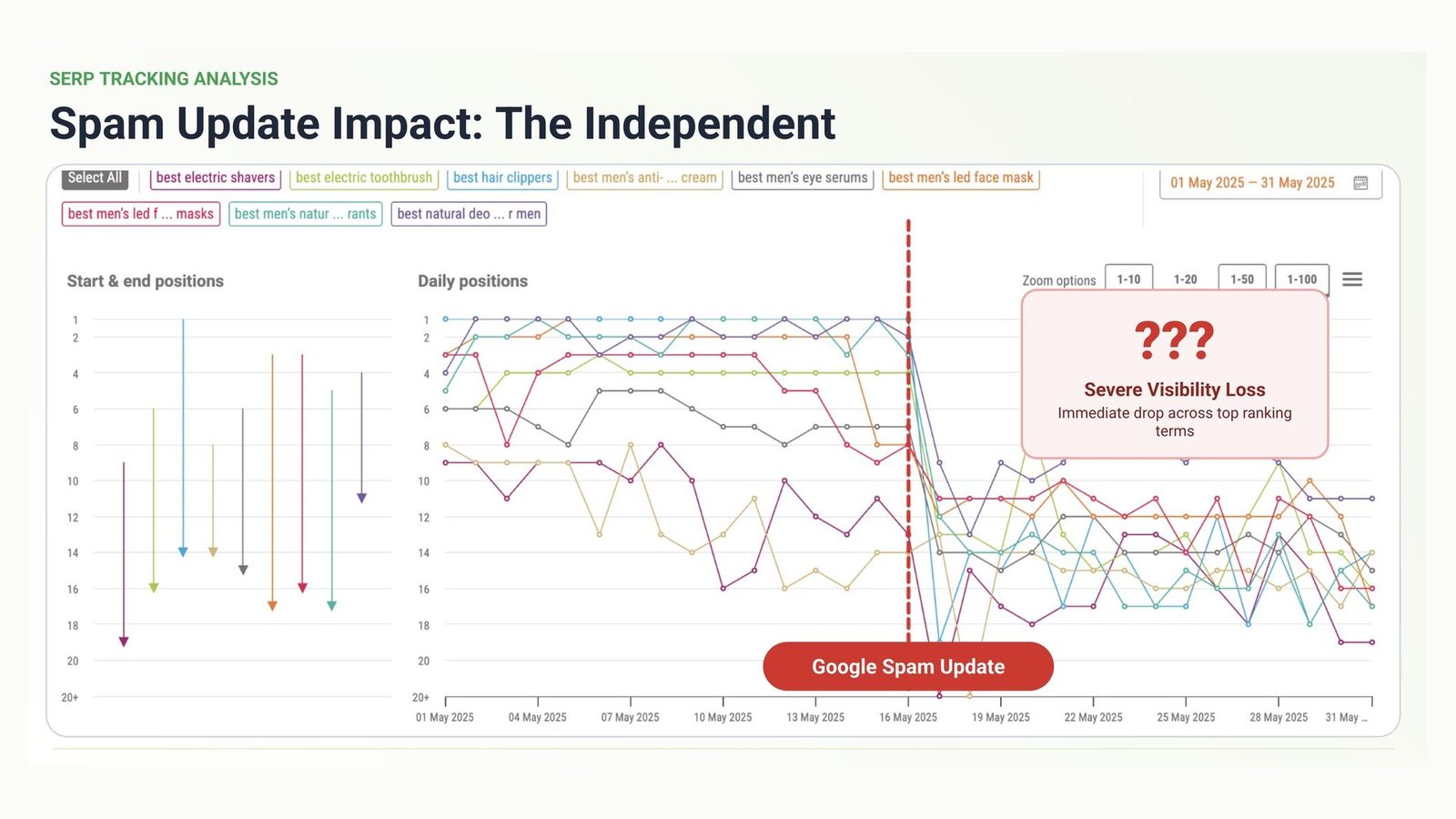
Now, in the post, you'll see that chart. That was the Independent newspaper, and they were hit by one part of last year's spam update. And I wanted to show that chart, really, so you could see how big these spam updates are, and when a big site like the Independent newspaper (it was also the Daily Mail, the Telegraph, and others) they're probably generating 10 to 15 million a year on that content.

Now, the spam update has three parts. Expired domain abuse: when you buy somebody else's domain and you make it your own using all their authority, you can't do that anymore. The second one is scaled content abuse. That's what we're going to see before Christmas. But the third one is site reputation abuse.

So, what businesses were doing, they were looking at websites like the Independent and saying, "Hey, can you put our affiliate content on your site, like best makeup, best moisturiser, best blazer, best everything." And they were relying on the authority of the Independent to give them visibility. It was also gambling and voucher codes. Google came along and in April last year they warned us. Nobody did anything, and in May it hit. And as you can see, the Independent, the Telegraph, all those websites lost all their visibility for every single product that was effectively hijacking their domain.

So, since last year and now, we've had a massive uplift in spam content, AI generated, and people have been taking advice on how to appear in conversational content. And everybody's advice was just make more content, add more content. But then you end up with content, and content is similar, and then more content, and more content. It all says the same thing.

Now, in the next few months, we will all be using agents to do our shopping. And what happens when an agent sees fluffy content like that? It collapses it. It's gone into nothing more than a set of attributes. So that's what's behind this upcoming spam update before Christmas.

Transcript lightly tidied from the captions. Jon's figure is his own estimate of the yearly revenue at stake for each publisher.
In 30 seconds

What Jon is telling you

  • Borrowed authority stops working.Content that ranks only because it sits on someone else's trusted domain gets found and demoted, however big the host.
  • The cost is real money.When Google enforced its site reputation rule, big publishers lost the rankings behind lucrative "best…" affiliate pages almost overnight.
  • More content isn't the answer.Mass-produced, look-alike pages, often written by AI, are the next target. AI shopping agents will boil them down to a few product facts anyway.
The rules

Google's three spam rules, in plain English

Google added these to its spam policies in March 2024. Spam updates are when Google's systems catch up with sites breaking them; serious cases can also get a manual action from a Google reviewer.

1

Expired domain abuse

What it is: buying a domain whose owner let it lapse, then filling it with unrelated content to cash in on the trust and links it built up.

Google's example: casino content on a domain that used to belong to a primary school.

Jon: "When you buy somebody else's domain and you make it your own using all their authority, you can't do that anymore."

2

Scaled content abuse

What it is: publishing lots of pages mainly to rank, not to help anyone. Google says it doesn't matter whether people, AI or both made them; what matters is whether they add value.

Google's examples: AI-generated pages that add nothing; scraped or reworded pages; text that makes little sense but is stuffed with search terms.

Jon: this is the one he expects Google to hit "before Christmas".

3

Site reputation abuse

What it is: a trusted site hosts someone else's content, such as affiliate reviews, gambling or voucher codes, mainly so it can ride on the host's ranking signals. Sometimes called "parasite SEO".

Google's example: a medical site hosting a third party's "best casinos" page that has nothing to do with the rest of the site.

Jon: brands relied "on the authority of the Independent to give them visibility".

How we got here

  1. March 2024

    Google announces the three new spam policies alongside its March 2024 core update, and gives site owners two months' notice of the site reputation rule.

  2. May 2024 onwards

    Google starts enforcing site reputation abuse with manual actions. In November 2024 it tightens the wording: a host being involved with, or overseeing, third-party content doesn't make it acceptable.

  3. May 2025

    Pi Datametrics' tracking shows the Independent's "best…" affiliate pages falling out of the top positions in mid-May (chart 1 below).

  4. 28 to 30 August 2026

    After talks with the European Commission, Google stops applying site reputation penalties for searchers in the European Economic Area. The UK isn't in the EEA, so UK searchers still see them.

  5. 24 September to 8 October 2026

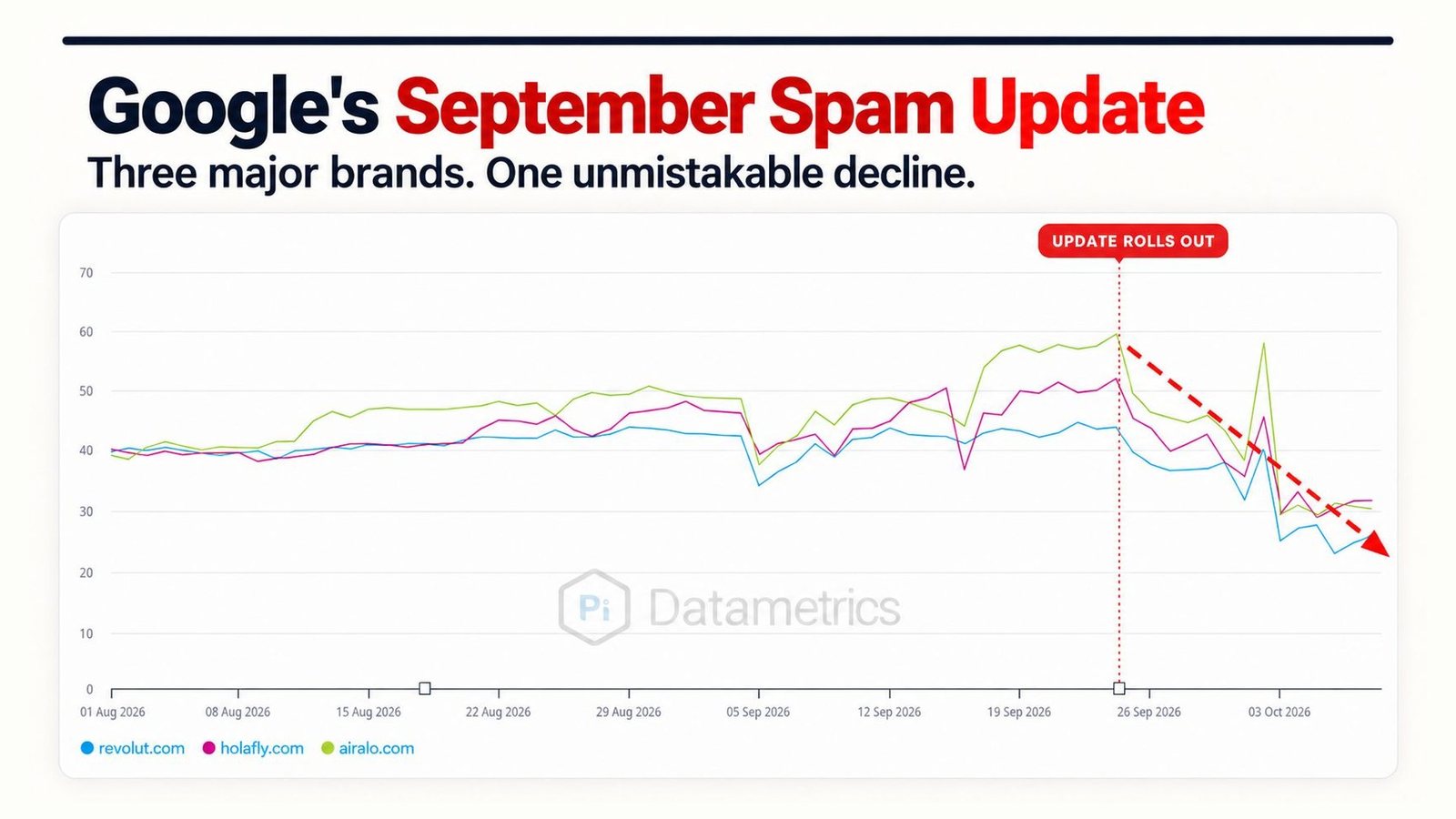
    Google's September 2026 spam update, its fourth spam update of the year, rolls out over almost two weeks (chart 2 below).

Data

Read the charts

Both charts come from Pi Datametrics' daily search tracking. Look closely before you open the answers: reading ranking data properly is a core search marketing skill.

Line chart of daily Google positions in May 2025 for nine 'best…' product searches where Independent pages ranked, such as best electric shavers and best hair clippers. Most sit between positions 1 and 8 until a red dashed line marked Google Spam Update on 16 May, after which they fall to between positions 10 and 20.
Chart 1. Spam update impact on the Independent, 1 to 31 May 2025. Data: Pi Datametrics.

Read the chart

  1. Each coloured line is one search, like "best electric shavers". Where were most lines before 16 May, and where were they afterwards?
  2. The left panel turns each line into one arrow, from its first position of the month to its last. Why might a marketer show a client this view rather than the daily lines?
  3. Falling from position 2 to position 14 means moving from the top of page one to page two. Why does that matter more than the number 12 suggests?
What to look for

Before the update most pages ranked between 1 and 8; after it nearly all sit between 10 and 20, so on page two or lower. Arrows make the scale of the loss readable in seconds. Very few searchers click past page one, so a drop of this size can wipe out most of a page's clicks and the affiliate revenue that came with them.

Line chart of daily search visibility from 1 August to early October 2026 for revolut.com, holafly.com and airalo.com. All three climb from about 40 to between 44 and 60 by late September, then fall to between about 23 and 32 after a red line marked Update rolls out on 24 September.
Chart 2. Google's September 2026 spam update: visibility for three brands, 1 August to early October 2026. Data: Pi Datametrics.

Read the chart

  1. Find the red rollout line. How much did each brand's visibility fall over the next two weeks?
  2. There are sharp dips on about 5 September and 17 September, before the update. What else could cause swings like these?
  3. Does this chart prove these brands broke Google's rules? What more evidence would you want before advising one of them?
What to look for

All three fall by roughly a third to a half within two weeks of the rollout. But day-to-day volatility was already there, and a chart on its own shows timing, not cause. Spam updates can also move sites that have done nothing wrong, as competitors are demoted or promoted around them. Before advising a brand, you'd check which pages and searches lost ground, whether Google Search Console shows a manual action, and whether competitors moved at the same time.

Activity · 5 to 10 minutes

Spam or legit?

Nine situations, based on the kinds of cases in Google's policies. For each one, decide whether it's legitimate or which rule it breaks. Play alone, or put it on the classroom screen and vote with hands up.

Seminar

Three questions to argue about

  1. Jon says AI shopping agents will "collapse" fluffy content into a set of attributes. What should a brand write if it wants to be chosen by an agent, not just ranked by Google?

    Think about product facts, original testing, reviews, prices and stock, and what a person still needs to read.

  2. The Independent's affiliate pages earned money for both the newspaper and its partners. Who carried the risk when Google changed course, and what should a publisher check before renting space on its domain?

    Consider contracts, editorial control, brand trust and how much of the revenue depended on one search engine.

  3. Since August 2026, site reputation penalties no longer apply for searchers in the EEA but still apply in the UK. How would you explain different results in different countries to a client's board?

    Think about reporting by market, regulation (the EU's Digital Markets Act) and which risks a UK brand still faces.

Running it in a 30–45 minute slot

The times below are a tight 30-minute run. Pairs reading the charts and groups reporting back often stretch it to 45 minutes.

TimeWhat happens
0 to 5 minPlay the video with captions on. Ask students to note the three rules as they hear them.
5 to 12 minRead chart 1 together, then chart 2 in pairs. Open "What to look for" only after they've answered.
12 to 18 minSpam or legit? on the big screen. Take a vote on each case before revealing the answer.
18 to 30 minSeminar questions in groups, one question per group, then report back.
Teacher notes: the nine cases and answers
    Prediction on file · Last checked 20 October 2026

    Was Jon right?

    Jon predicts Google will act on scaled content abuse before Christmas 2026. Google confirms updates on its Search Status Dashboard. When the next spam update lands, I'll add what happened here, with fresh ranking data. Until then, students can make their own call: which kinds of sites do you expect to lose out, and why?

    Share on LinkedIn ↗
    Sources

    Read further

    Thank youWith thanks to Jon Earnshaw and Pi Datametrics for recording this insight and sharing their data with my students. The views in the video are Jon's own.