What candidates practise
1. Saying it out loud
Most candidates know their thesis on paper but have rarely explained it aloud under time pressure. The room asks them to speak each answer, starting with the two-minute summary that many vivas open with.
2. Defending their choices
The methodology question changes with the approach the candidate picks: qualitative, quantitative, mixed methods, action research or a systematic review. Contribution, theory and limitations questions push them to justify, not describe.
3. Handling the follow-up
After most questions the external examiner probes: "So what?", "How do you know that is not what you expected to find?" Candidates learn that a follow-up is a normal part of the conversation, not a sign they answered badly.
4. Knowing what to rehearse
After each answer, candidates tick off what a strong answer covers and rate their confidence. The debrief ranks the areas and names the three to work on, with a model structure for each. One click reruns just those three.
It suits candidates from the final year of writing up to the week before the viva, research training programmes and doctoral cohort days. For professional doctorates (DBA, DProf, EdD) the questions shift towards practice: insider research, the influence of the candidate's role, what leaders should do differently, and how the doctorate changed them as a practitioner.
Two examiners, two styles
Dr Ellis, internal examiner
Warm and wants the candidate to shine. Opens the viva, and asks about motivation, theory, ethics, practice, future research and reflection.
Professor Hale, external examiner
Probing and wants the candidate to defend. Asks about contribution, literature, method, findings and limitations, and asks every follow-up.
Both examiners are fictional. Splitting the styles helps candidates practise switching between a friendly question and a challenging one. In a real viva either examiner may do either, and many institutions add an independent chair.
Pick a format
Candidate on their own
Share the link between supervision meetings. Ask the candidate to answer aloud (recording on their phone helps), then bring the copied rehearsal list to the next meeting. That list becomes the agenda.
In a supervision meeting
The candidate drives the room and answers aloud; you listen as the examiner. At each self-check, say which points you heard before they tick, and add one follow-up of your own about their actual thesis. A short run fits a one-hour meeting.
Peer mock vivas
In a cohort session, candidates first rehearse alone, then pair up and play examiner for each other on their weakest areas. This is the 60-minute workshop plan below. It works well for DBA and professional doctorate cohorts.
One screen, whole room
In research training sessions, put the room on the projector with a volunteer's (or a made-up) thesis. Read each question, take two or three answers from the room, then go through the checklist together. Good for first and second-year candidates who have never seen a viva.
Five golden rules
- Nothing is saved.The thesis title, typed answers and ratings stay in the open page and vanish when it closes. Candidates should press "Copy my rehearsal list" on the debrief before leaving. This also means unpublished research never leaves their device, with one exception: in "Speak, see it written" mode the browser's own speech service (Google, Microsoft or Apple) turns the candidate's voice into text. Candidates with sensitive material can use "Say it aloud" or "Type it" instead.
- It is a rehearsal, not a verdict.There is no score and no pass or fail. Confidence is self-rated, and the checklist is ticked by the candidate, so it is only as honest as they are. Say this at the start.
- The questions are typical, not thesis-specific.They cover the themes most vivas touch on and adapt to the candidate's setup, but no tool has read the thesis. Use it alongside a full mock viva with someone who has, never instead of one.
- The setup matters.Doctorate type, approach, claimed contribution, thesis title and sector all change the wording. A wrong choice gives the wrong methodology question, so check candidates pick the approach they actually used.
- Say it, don't just think it."Type it" mode suits a quiet room and gives notes to keep, but the viva itself is spoken. Encourage at least one run aloud. "Speak, see it written" gives both: candidates answer aloud and keep a transcript to edit and copy (Chrome, Edge or Safari). Questions appear as text by default, which suits a shared room; choose "Read questions aloud" to hear each examiner. In both recorded modes the room gives instant feedback on wording: length, pace, filler words, hedging, "we" versus "I", and whether an example was used. It also marks checklist points it "heard". These checks run on the page and look at wording, not the quality of the argument, so the candidate still decides what to tick.
The question bank
The short viva asks the 8 questions marked in the last column, in this order. The full viva asks all 12. Follow-up answers are capped at 90 seconds.
| Area | Asked by | Question | Follow-up | Short |
|---|---|---|---|---|
| Opening | Dr Ellis | Could you summarise your thesis in a few minutes: what you set out to do, how you did it and what you found?Uses the thesis title if one is given. | None | ✓ |
| Motivation | Dr Ellis | What drew you to this topic, and why does it matter now?Professional doctorates: what led you to this topic, and how does it connect to your own professional practice? | Why is this a doctoral-level problem rather than a consultancy question?Professional doctorates: how did you manage being an insider? | |
| Contribution | Prof. Hale | What, precisely, is your original contribution?Worded to match the claim: to practice, to theory, or to both. | So what? Who should do something differently because of your work? | ✓ |
| Literature | Prof. Hale | Which two or three authors or debates is your work most in conversation with, and where do you depart from them? | What important literature did you leave out, and why? | ✓ |
| Theory | Dr Ellis | What theoretical or conceptual framework did you use, and why that one? | What would a different lens have shown you that yours could not? | |
| Methodology | Prof. Hale | Changes with the approach: see the next table. | If you started again tomorrow, what would you change about your method, and why? | ✓ |
| Ethics | Dr Ellis | What were the main ethical issues in your study, and how did you handle them? | Professional doctorates only: how might your seniority or role have shaped what participants were willing to tell you? | |
| Findings | Prof. Hale | Take me to your most important finding. What surprised you? | How do you know that is not simply what you expected to find? | ✓ |
| Limitations | Prof. Hale | What are the main limitations of your study, and how do they affect the claims you can make? | How far can your findings be generalised or transferred beyond your setting? | ✓ |
| Practice | Dr Ellis | What are the practical implications of your work, and for whom?Professional doctorates: what should leaders in your sector do differently on Monday morning because of your research? | How would a practitioner actually use your findings?Professional doctorates: has anything changed in practice as a result of your study, and how would you know? | ✓ |
| Future research | Dr Ellis | Where should research in this area go next, and what would you do with another three years? | None | |
| Reflection | Dr Ellis | Finally, how has doing this doctorate changed you as a researcher?Professional doctorates add "and as a practitioner". | And what would you do differently if you started again? | ✓ |
The five methodology questions
| Approach chosen | Professor Hale asks |
|---|---|
| Qualitative | Why a qualitative design, and how do you know your interpretations are trustworthy? |
| Quantitative | Why this design and sample, and how confident are you that your measures are valid and reliable? |
| Mixed methods | How did your qualitative and quantitative strands actually integrate, rather than sit side by side? |
| Action research or practitioner inquiry | You were both a change agent and a researcher. How did you balance those roles, and keep your inquiry rigorous? |
| Systematic review or conceptual | How did you make your selection and synthesis of sources systematic and transparent? |
Every checklist
These are the points candidates tick after each answer, with the model structure the room suggests. Use them as a listening sheet when you play examiner.
Open the 12 checklists
Opening
- States the problem and why it matters
- Names your research question or aims
- Outlines your approach in a sentence
- Ends with your main contribution
Problem → question → approach → key finding → contribution. Two minutes, no jargon, end on the contribution.
Motivation
- Links your motivation to a genuine gap
- Shows why it matters beyond you
- Acknowledges your position and how you handled it
Start with the practical puzzle, then the gap in what was known, then why you were well placed (and what you did about the risks of that).
Contribution
- States the contribution in one or two sentences
- Distinguishes it from what was already known
- Names who benefits
- Matches the claim to the evidence, with no over-claiming
"Before my study we knew X. My study shows Y. That matters because Z, for these people."
Literature
- Names key authors or debates confidently
- Explains the gap your work fills
- Shows where you agree and where you differ
- Justifies the boundaries of your review
Map it: the conversation, the voices in it, where they disagree, and the seat you take at the table.
Theory
- Names the framework and its core ideas
- Explains why it fits your question
- Shows how it shaped your analysis
- Acknowledges an alternative and its trade-offs
Framework → why it fits → how you used it in analysis → what it hides.
Methodology
Four points that change with the approach. For a qualitative study, for example:
- Names your philosophical position and why it fits the question
- Uses recognised quality criteria, such as credibility, dependability or reflexivity
- Explains how you analysed the data, step by step
- Admits what a qualitative design cannot tell you
Choice → justification against alternatives → how you ensured rigour → honest limits.
Ethics
- Goes beyond consent forms to real dilemmas
- Explains how you protected participants and data
- Shows reflexivity about power and your role
Name one real dilemma, what you did, and what you would watch for next time.
Findings
- Picks one finding and explains it clearly
- Points to the evidence behind it
- Explains what was unexpected and why
- Shows how you guarded against confirmation bias
Finding → evidence (page, data, quote) → why it surprised you → how you tested it.
Limitations
- Names two or three real limitations, not trivial ones
- Links each limitation to what it means for your claims
- Explains what you did to reduce them
- Distinguishes generalisability from transferability, if relevant
Own it calmly: limitation → effect on your claims → what you did → what future work could do.
Practice
- Gives concrete, specific actions
- Names who should act
- Links each action back to your findings
- Is realistic about barriers to change
Two or three concrete actions, each tied to a finding, plus how you would know it worked.
Future research
- Builds directly on your findings or limitations
- Proposes specific, researchable questions
- Shows ambition and realism
Follow the thread: one limitation or surprise → the next question → how you would study it.
Reflection
- Gives a genuine, specific example of growth
- Shows critical self-awareness
- Ends on a confident, forward-looking note
One honest example of how your thinking changed, and what you now do differently because of it.
How the debrief ranks areas: each answer scores its confidence rating (1 to 5) plus up to 2 points for the share of checklist points ticked. The three lowest become "Rehearse these next", and the missed points become "Add next time".
Before the session
- Share lab.yingwu.co.uk/viva/ as a link or QR code.
- Run a short viva yourself with an imaginary thesis. It takes about 20 minutes and shows you where candidates will hesitate.
- Ask candidates to arrive with their thesis title, the approach they used and a rough two-minute summary.
- Plan the space. Answering aloud needs room: spread pairs out, use breakout rooms online, or let candidates use "Type it" mode with headphones for the solo run.
- Check your institution's viva regulations and outcome categories, so you can answer "what happens if…" questions accurately. The room deliberately stays general.
A 60-minute mock viva workshop
For 4 to 30 candidates, each with a phone or laptop. They rehearse alone first, then play examiner for each other.
0 Set the tone
5 min- Say
- "A viva is a conversation about your thesis with people who have read it closely. Most of the questions are predictable, so we will rehearse those today and free up your thinking for the ones that are not. Nobody sees your answers or scores, and there is no pass or fail here."
- Candidates
- Open the room, press "Enter the room" and set the scene: doctorate, thesis title, approach, contribution and sector. Choose Short, 2 minutes and, if the room is busy, Type it.
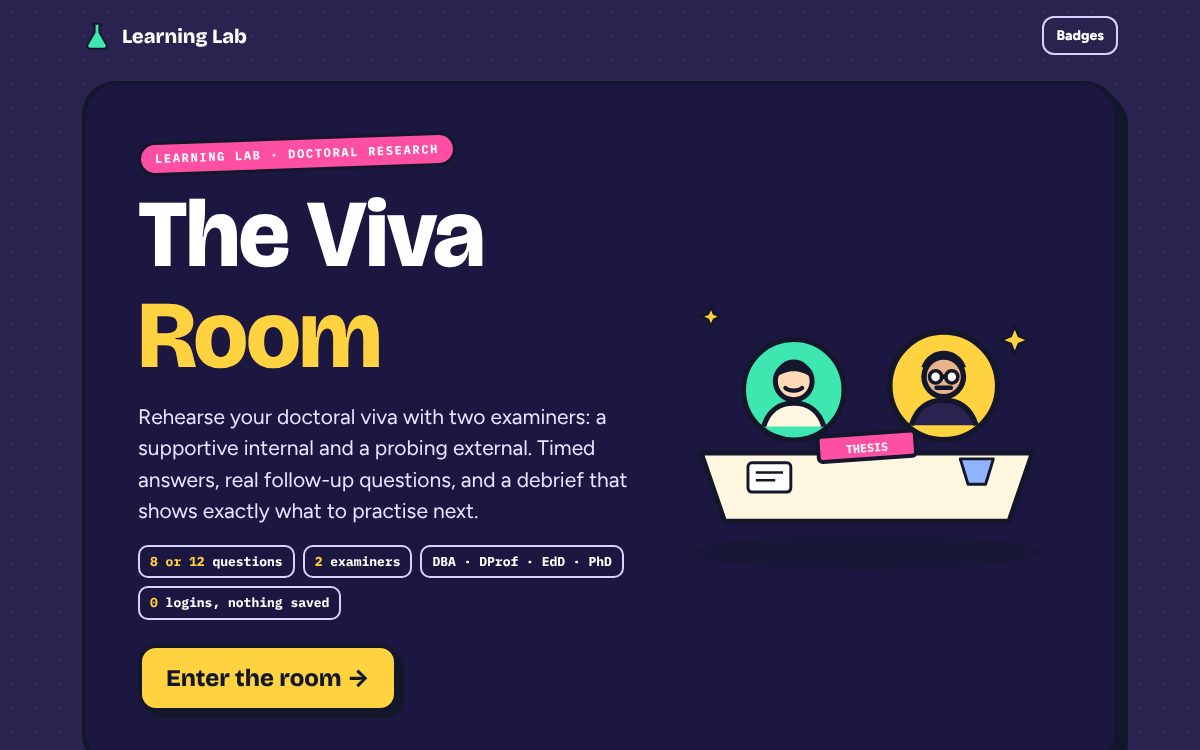
The start screen introduces the two examiners. 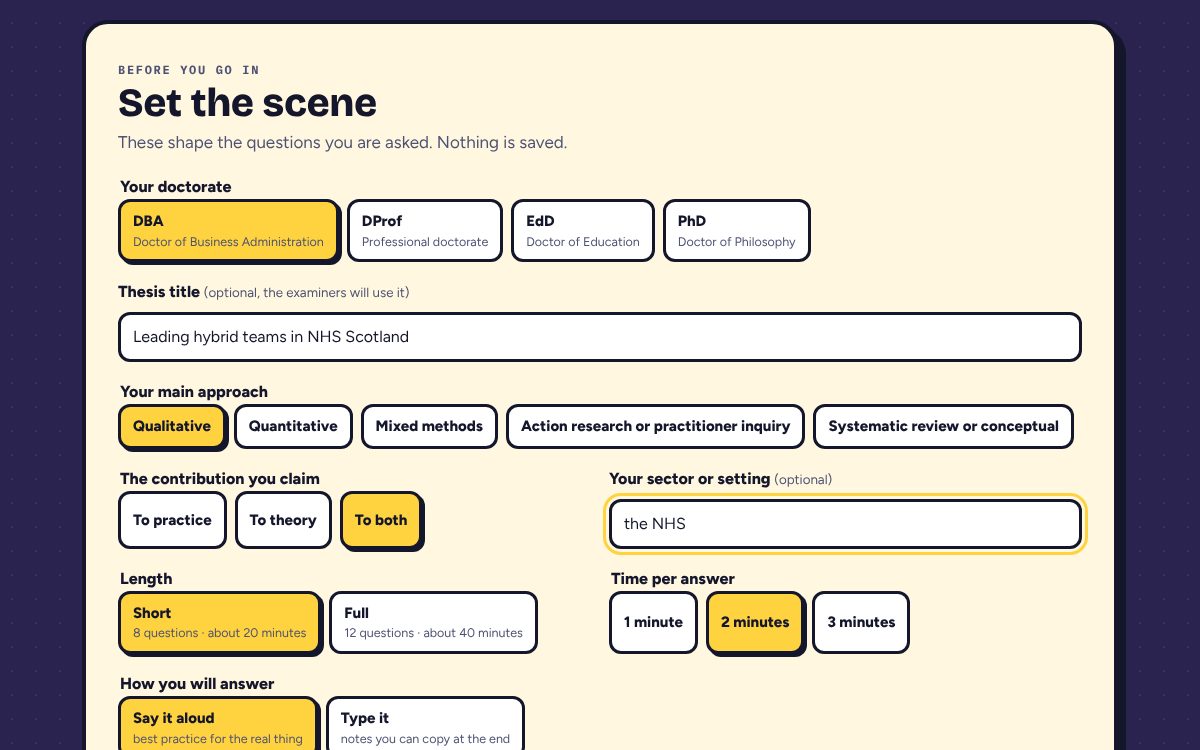
Setting the scene: every choice changes the wording of the questions. 1 Solo run
20 min- Candidates
- Read or listen to the question, then press "Start answering". The timer starts.
- Answer, then press "I have finished". The external examiner usually follows up.
- Tick what the answer covered, read the model structure and rate their confidence.
- After 8 questions, read the debrief and press "Copy my rehearsal list".
- Watch for
- Candidates skimming the checklist. Ask them to tick only what they actually said.
- Anyone stuck on one question for several minutes. The timer is a guide; they can finish and move on.
- Fast finishers: point them to "Rehearse just these 3", aloud this time.
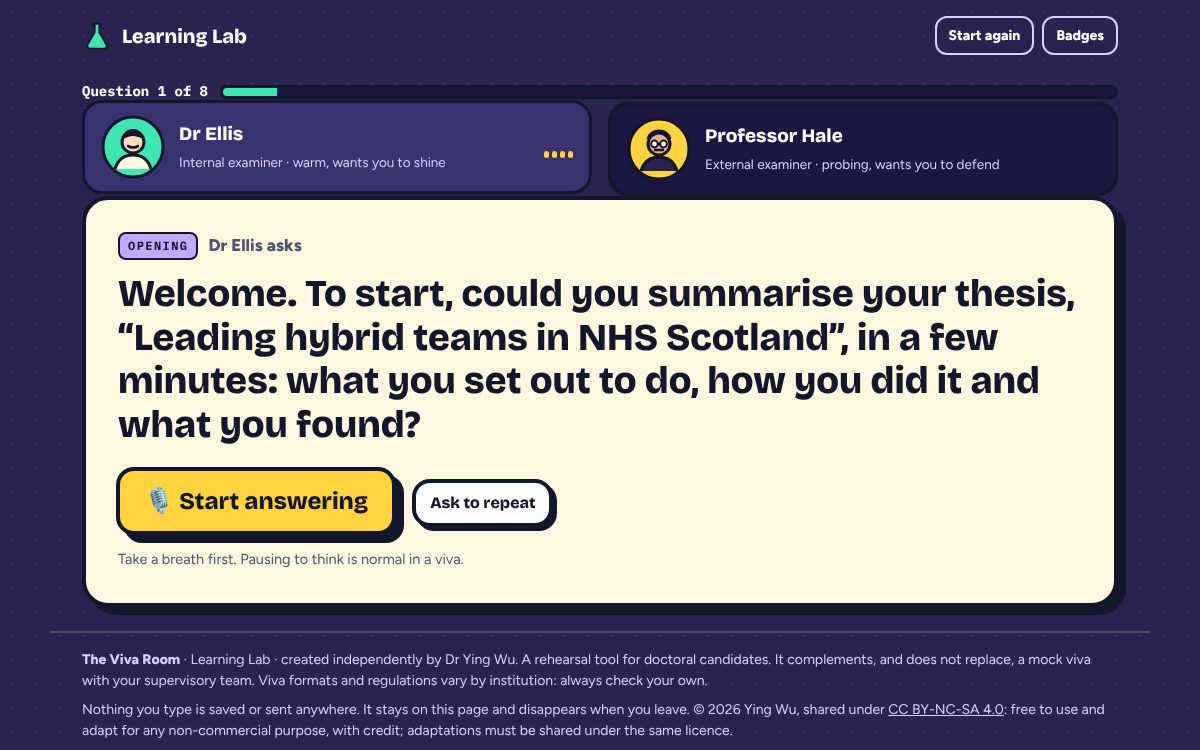
The opening question uses the candidate's own thesis title. 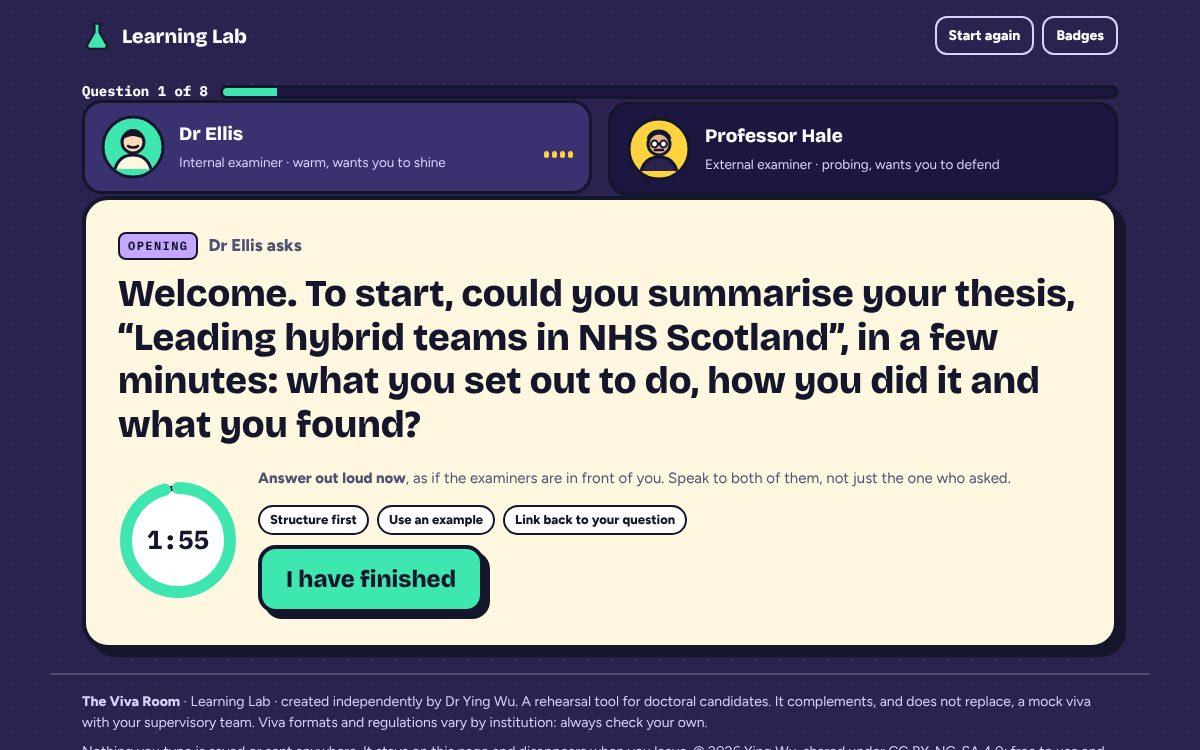
Answering: a countdown ring and three quick reminders. 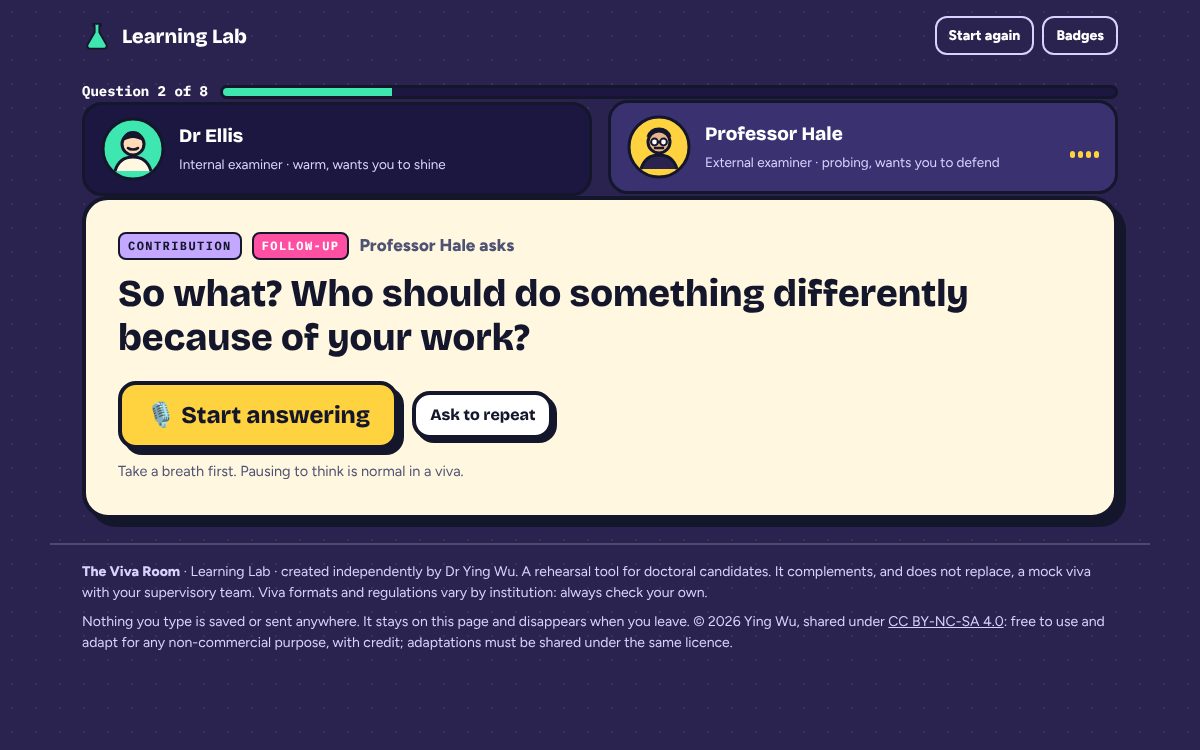
The external examiner follows up after most questions. 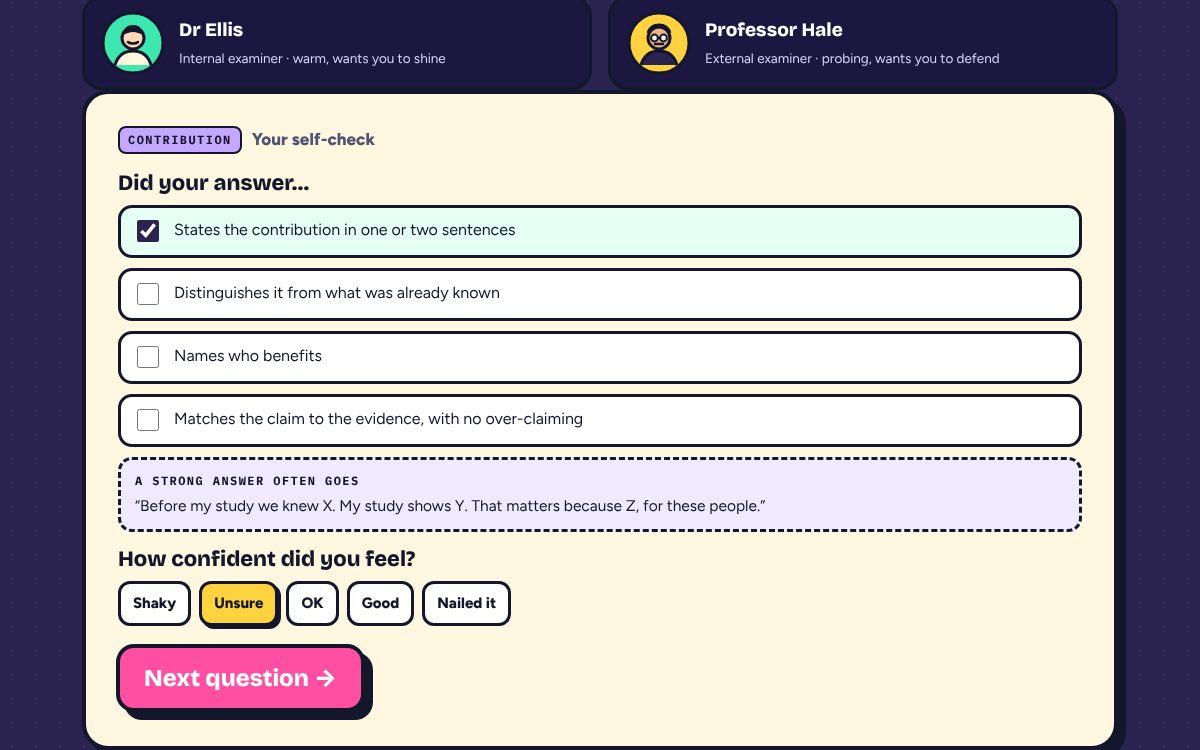
The self-check after each question. 2 Pair mock viva
20 min- Set up
- Pair candidates, ideally from different topics. Each candidate gets 10 minutes as the candidate and 10 as the examiner.
- Candidate
- Presses "Rehearse just these 3", switches to Say it aloud if needed, and hands the device to their partner.
- Examiner
- Reads each question and follow-up aloud, starting the timer for the candidate.
- Listens with the checklist in mind (open the checklists above, or use the self-check screen).
- At the self-check, says which points they heard before the candidate ticks.
- Adds one question of their own: "What did you mean when you said…?"
- Watch for
- Examiners being too kind. Remind them that a probing question is a gift today.
- Candidates reading from notes. Ask them to put the screen face down while they answer.
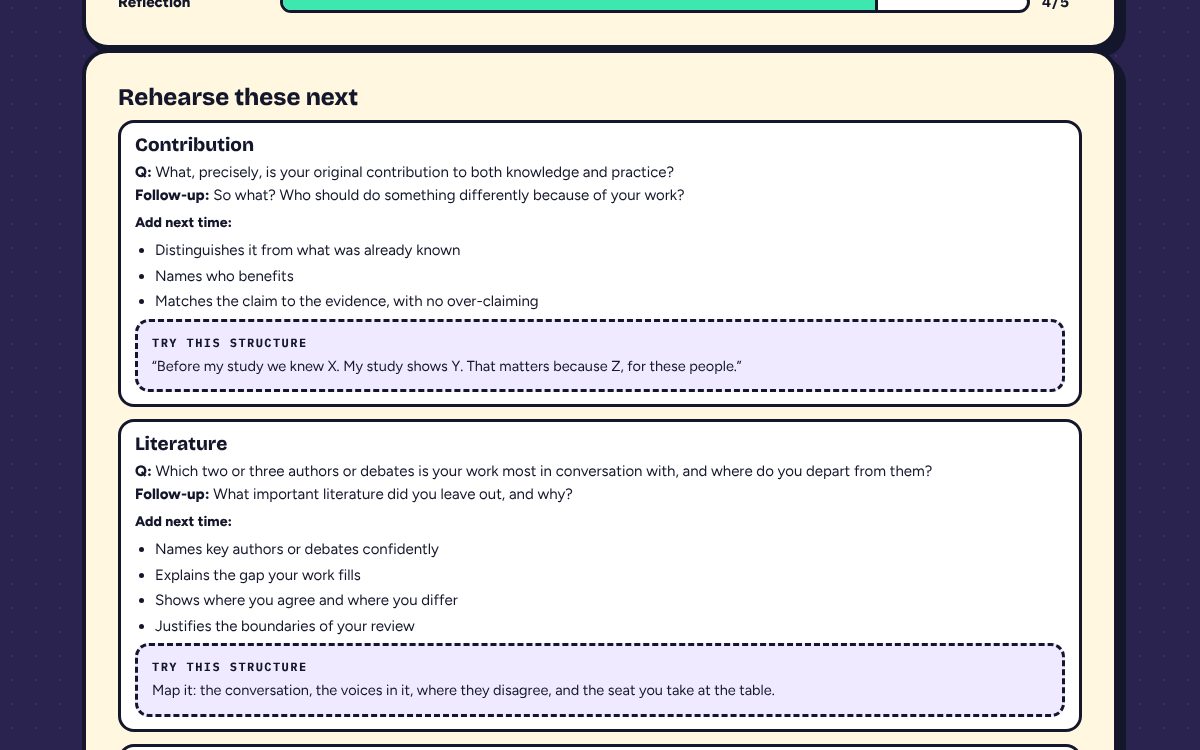
"Rehearse these next" gives each pair its agenda. 3 Debrief
10 min- Ask
- "Which area came up as your weakest? Was it the one you expected?"
- "Say your contribution in one sentence to the person next to you. Did it survive 'So what?'"
- "Which limitation would you raise yourself, before the examiners do?"
- "Professional doctorates: what has changed in your practice because of your study, and what is your evidence?"
- "What will you ask your supervisors to probe in your full mock viva?"
- Takeaway
- Rehearsing the predictable questions aloud frees you to think on your feet for the unpredictable ones.
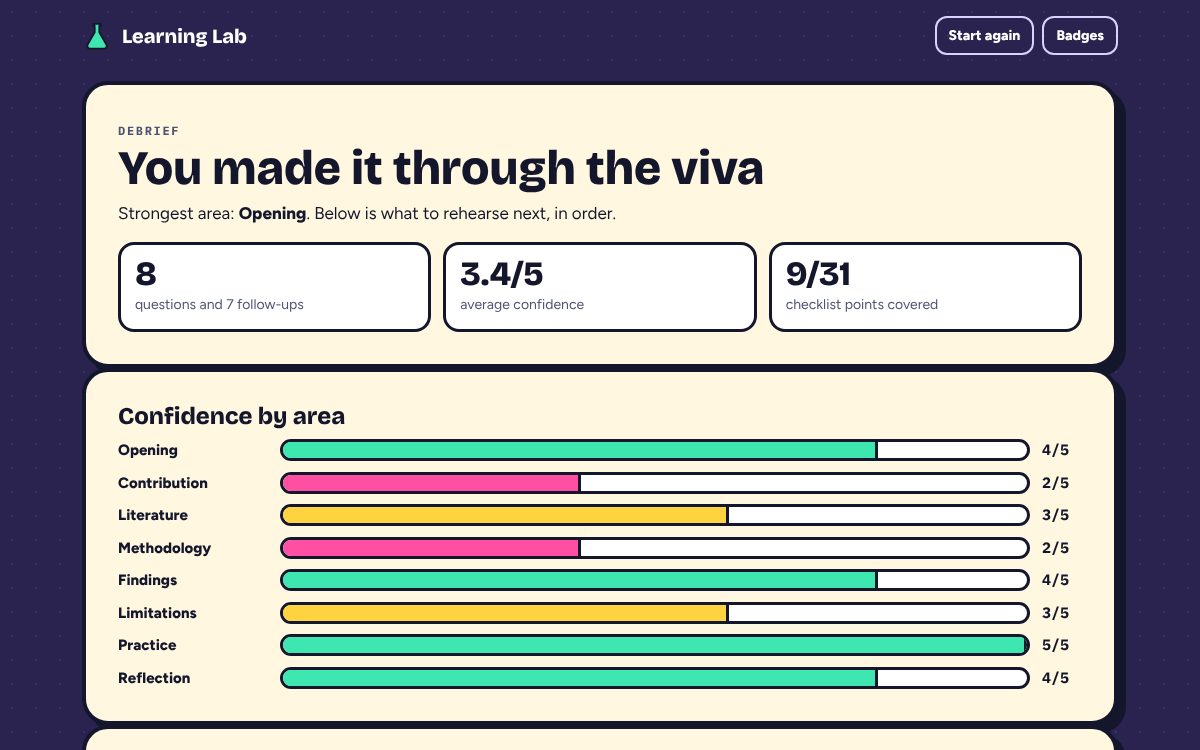
The debrief shows confidence by area at a glance. 4 Close
5 min- Candidates
- Copy their rehearsal list (it includes any typed answers) and send it to their supervisors before the next meeting. Finishing a viva also earns the Viva ready badge on their device, if they want to share it.
- Say
- "Run it again the week before your viva, aloud, and once more with just your three weakest areas."
If something goes wrong
| Problem | What to do |
|---|---|
| A candidate closed or reloaded the page | The run is gone: nothing is stored. The browser warns before leaving mid-viva. A short run takes 20 minutes, or the candidate can choose fewer areas next time with "Rehearse just these 3". |
| The timer ran out mid-answer | Nothing is cut off. The button changes to "Time is up: finish answer". Real vivas have no per-question time limit; the timer trains concise answers. |
| "Copy my rehearsal list" does not copy | Some browsers block the clipboard. A message says so; take a screenshot of the debrief instead. |
| The room is too noisy to answer aloud | Use "Type it" for the solo run, then answer aloud in pairs, spread out or in breakout rooms. |
| The questions do not fit the thesis | Check the approach chosen in setup. For conceptual or theoretical theses, choose "Systematic review or conceptual". Then add thesis-specific questions yourself: that is the supervisor's part. |
| A candidate's confidence drops | Remind them it is a rehearsal, not a verdict, and that low ratings show where to practise. A second run of their three weakest areas usually goes noticeably better. |
| "Is my viva going to be like this?" | Formats vary: some vivas are online, some have an independent chair, and some systems hold a public defence. Point candidates to their institution's regulations. |
Cheat card
- Share lab.yingwu.co.uk/viva/
- "A conversation, not a test. Nobody sees your answers."
- Setup: Short, 2 minutes, their real approach
- 20 min solo run, then copy the rehearsal list
- Pairs: "Rehearse just these 3", aloud, partner as examiner
- Debrief: weakest area, one-sentence contribution, next step
DBA, DProf and EdD candidates often research their own organisations and are asked how that shaped their study. The room asks those questions too, alongside the themes every doctorate shares. Open the Viva Room →
Behind the room
- Mullins, G. and Kiley, M. (2002) '"It's a PhD, not a Nobel Prize": how experienced examiners assess research theses', Studies in Higher Education, 27(4), pp. 369-386.
- Murray, R. (2015) How to survive your viva: defending a thesis in an oral examination. 3rd edn. Maidenhead: Open University Press.
- Quality Assurance Agency for Higher Education (2020) Characteristics statement: doctoral degree. Gloucester: QAA. qaa.ac.uk
- Tinkler, P. and Jackson, C. (2004) The doctoral examination process: a handbook for students, examiners and supervisors. Maidenhead: Open University Press.
- Trafford, V. and Leshem, S. (2008) Stepping stones to achieving your doctorate. Maidenhead: Open University Press.
- Wellington, J. (2010) 'Supporting students' preparation for the viva: their pre-conceptions and implications for practice', Teaching in Higher Education, 15(1), pp. 71-84.
The questions reflect themes commonly raised in doctoral vivas and discussed in this literature. They are not taken from any institution's regulations. Viva formats, outcomes and timescales vary by institution.