What students learn
1. Say, do, prove
The greenwashing matrix (Delmas and Burbano, 2011) separates what a firm says from what it does. Students place brands in four quadrants: greenwashing, vocal green, silent green and silent brown.
2. Name the sin
TerraChoice's seven sins of greenwashing (2010) give students a vocabulary for why a claim misleads: hidden trade-off, no proof, vagueness, false labels, irrelevance, lesser of two evils and fibbing.
3. Evidence starts with measurement
Students sort emissions sources into Scope 1, 2 and 3 (GHG Protocol), so they can ask which scopes a "low-carbon" claim actually covers.
4. Write a better claim
In the last round students become the marketer and pick the rewrite that meets every principle of the CMA Green Claims Code (2021).
Good for sustainability marketing, marketing communications, brand management, CSR and responsible leadership classes, at undergraduate, postgraduate or MBA level. All brands in the cases are fictional, and the rules are described as at October 2026 as a teaching summary, not legal advice.
Pick a format
Before class
Post the link and ask students to play and bring their rank and "the case that surprised me". Open the session with those cases. The end screen writes the post for them.
In class, on phones
Students play on their own phones for 8 minutes, then you debrief the cases most of the room missed. This is the plan in the step-by-step section below.
In class, one screen
No devices? Put the game on the projector, read each case aloud and take a vote by show of hands, or with letters A to G on paper. Click the room's answer and read the verdict together.
Online and cross-border
It works asynchronously, so it suits online cohorts. In GRL4ST, students from different countries post their rank and reply to a classmate from another country.
Five golden rules
- A reload starts the game again.Progress lives only in the open page. The best score on each device is remembered, but a half-finished game is not.
- There is no back button.Once an answer is clicked, the verdict appears and the points are banked. That is deliberate: the verdict is where the learning happens.
- Nothing leaves the device.The optional name box stays on the student's own screen. There are no accounts, and the game sends no answers anywhere.
- Keyboard works.Keys A to G pick an answer and Enter moves on, which helps on the projector.
- The bonus file is separate.Fast finishers can open 9 more cases from the start or end screen. They are scored on their own and do not change the main rank.
The four rounds
| Round | Task | Framework | Main cases | Bonus cases |
|---|---|---|---|---|
| 1 | Spot the greenwash: place each brand in the matrix, using what it says and the evidence of what it does | Delmas and Burbano (2011) | 3 | 2 |
| 2 | Name the sin: match each claim to one of the seven sins | TerraChoice (2010) | 3 | 4 |
| 3 | Prove it: sort emissions sources for Thread & Co, a fictional clothing brand, into Scope 1, 2 or 3 | GHG Protocol (WRI and WBCSD, 2004; 2011) | 3 | 2 |
| 4 | Fix the claim: choose the rewrite that meets every principle of the Green Claims Code | CMA (2021) | 3 | 1 |
+5 bonus points for every correct answer in a row after the first
Main game maximum: 175 points (12 cases)
Ranks: Trainee Detective · Junior Detective 80+ · Senior Detective 125+ · Chief Inspector 160+
Every answer shows a verdict that explains the idea, so a wrong answer still teaches. Ask students to read the verdict even when they are right. Some verdicts, mostly in the bonus file, also flag current rules: the EU ban on offset-based "neutral" product claims from 27 September 2026 (Directive (EU) 2024/825), and the CMA's power since 6 April 2025 to fine firms directly for breaches of UK consumer law.
Every case, with the answer
Collapsed so students looking over your shoulder don't see them. Open before the debrief.
Main game: 12 cases
| Case | The claim or item | Answer | Why, in one line |
|---|---|---|---|
| 1.1 PureBloom | "100% eco-friendly. Kind to the planet." | Greenwashing | Loud claim, empty evidence file: virgin plastic, no life-cycle assessment, no data. |
| 1.2 Brightfold | "Our boxes contain 80% recycled fibre. See how we measure it." | Vocal green | Specific, scoped and independently evidenced. |
| 1.3 Calder Tools | Says nothing about sustainability | Silent green | Strong, assured performance but no communication: possible greenhushing. |
| 2.1 SoftLeaf | "Made from sustainably harvested forests." | Hidden trade-off | Green on the wood source, silent on bleaching, water and energy. |
| 2.2 NatureWash | "All-natural and eco-friendly." | Vagueness | So broad it is likely to be misunderstood. |
| 2.3 Coastline | "Bottle made with 50% ocean plastic." | No proof | The evidence is withheld as "commercially confidential". |
| 3.1 Thread & Co | Diesel burned in its own delivery vans | Scope 1 | Fuel burned in vehicles the company owns or controls. |
| 3.2 Thread & Co | Grid electricity for its shops | Scope 2 | Purchased electricity. |
| 3.3 Thread & Co | Growing and processing suppliers' cotton | Scope 3 | Upstream purchased goods: usually most of a clothing brand's footprint. |
| 4.1 Stride | "Eco-friendly trainers." | B: the recycled-polyester upper, with the method | Specific, scoped (upper, not sole) and evidenced. |
| 4.2 Morrow | "Greener than ever!" | C: 30% lower footprint per kilo than the 2023 blend, verified | A fair comparison with a baseline, a boundary and verification. |
| 4.3 Sip | "100% recyclable cup." | B: recyclable only at specialist points | Does not hide how the cup can actually be recycled. |
Bonus file: 9 more cases
| Case | The claim or item | Answer | Why, in one line |
|---|---|---|---|
| Rapid Haul | Says nothing; emissions rising, no targets | Silent brown | Poor performance and no communication. Not greenwashing, but exposed. |
| GlowMart | "Carbon neutral delivery on every order." | Greenwashing | Neutrality rests only on offsets; van emissions have not fallen. |
| FreshAir | "CFC-free!" | Irrelevance | True, but CFCs have been phased out for decades. |
| Verda | "Certified Green ✓" (its own seal) | Worshipping false labels | A self-made badge that looks independent. |
| Leafline | "Made with organic tobacco." | Lesser of two evils | Distracts from the far bigger impacts of the product. |
| Kelvin | "Top energy-efficiency rating, independently certified." | Fibbing | Never tested or certified: simply false. |
| Thread & Co | Refrigerant leaking from its shops' air conditioning | Scope 1 | Leaks from equipment it owns or controls. |
| Thread & Co | Customers washing and drying the clothes | Scope 3 | Downstream use of sold products. |
| Lumen Air | "Fly carbon neutral with Lumen Air." | B: the verified fuel saving, impact stated, offsets kept separate | Truthful about what changed and what remains. |
The subtler cases make the best debrief starters: Calder Tools (silence proves nothing either way), telling a hidden trade-off from vagueness, and refrigerant leaks as Scope 1 in the bonus file.
Before the lesson
- Share lab.yingwu.co.uk/greenwash-detective/ as a link or QR code in your slides or virtual learning environment.
- Play it once yourself, so you know where students will hesitate. It takes about 6 minutes.
- Decide where students will post their result: a discussion board, a padlet or the chat. The end screen's "Copy my result" text is written for this.
- If students will be in a room together, ask them to turn the sound off (top-right button) or bring headphones.
- Open the answer key above, ready for the debrief.
Step by step
About 20 minutes, with students on their own phones or laptops.
0 Set it up
2 min- Say
- "Brands make green claims every day. Some are credible and some are not. You are the detective: for every case, compare what the brand says with what it does and what it can prove. Read every verdict, even when you get it right."
- Students
- Open the game and, if they like, type a first name or team name. It stays on their own screen.
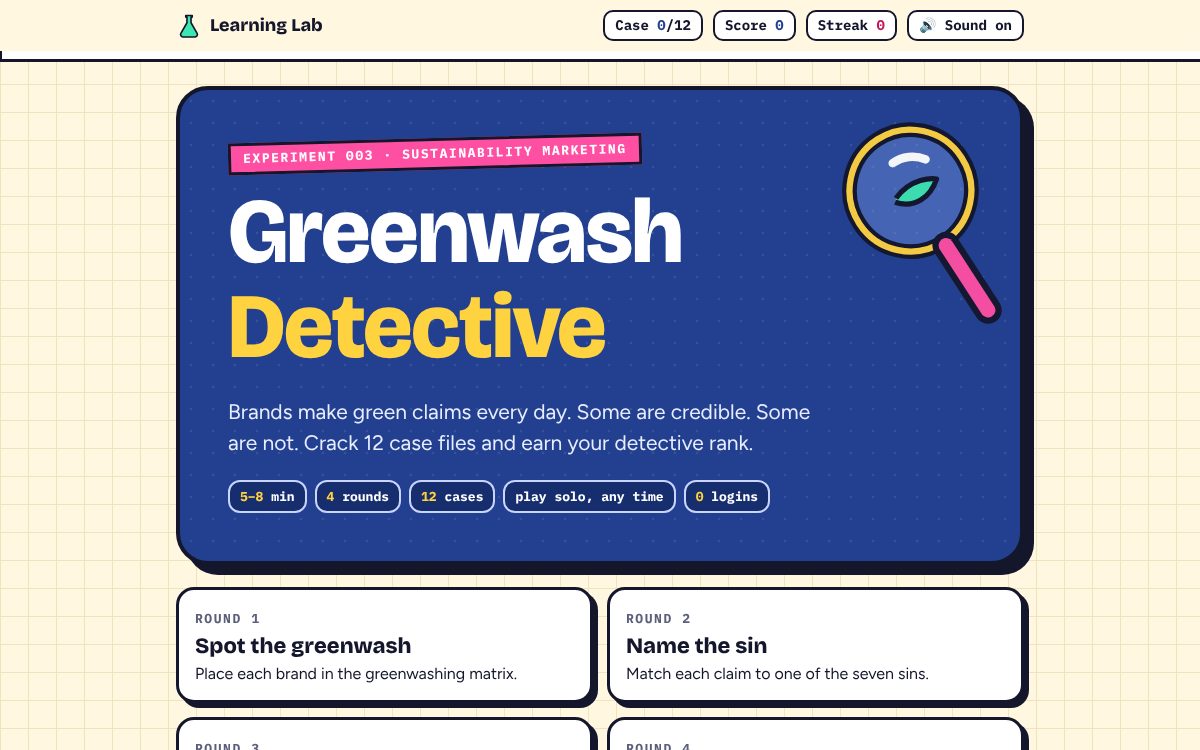
The start screen explains the four rounds and the scoring. 1 Play the main game
8 min- Students
- Round 1: read the claim and the evidence folder, then place the brand in the matrix.
- Round 2: match each claim to a sin. All seven sins are listed as answers.
- Round 3: sort Thread & Co's emissions into Scope 1, 2 or 3.
- Round 4: pick the rewrite that meets every principle of the Green Claims Code.
- Watch for
- Students racing through and skipping verdicts. The streak bonus rewards accuracy, not speed.
- Fast finishers: point them to the bonus case file.
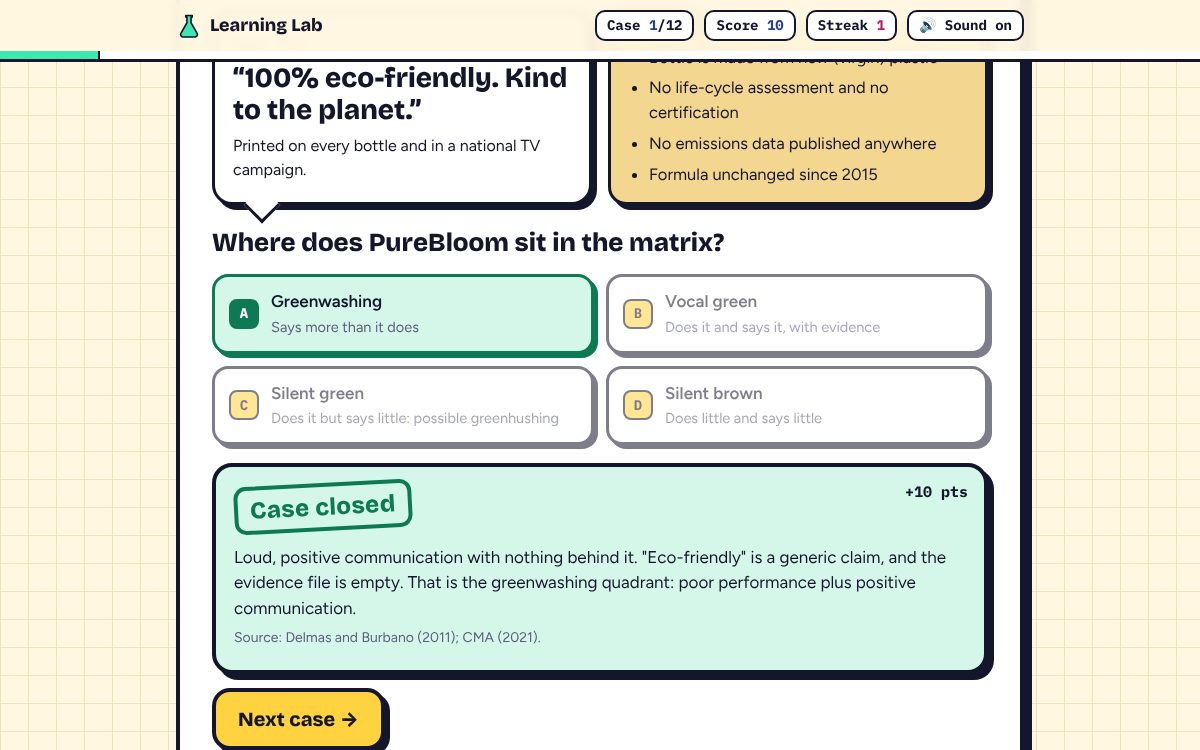
Round 1: the claim, the evidence and the verdict. 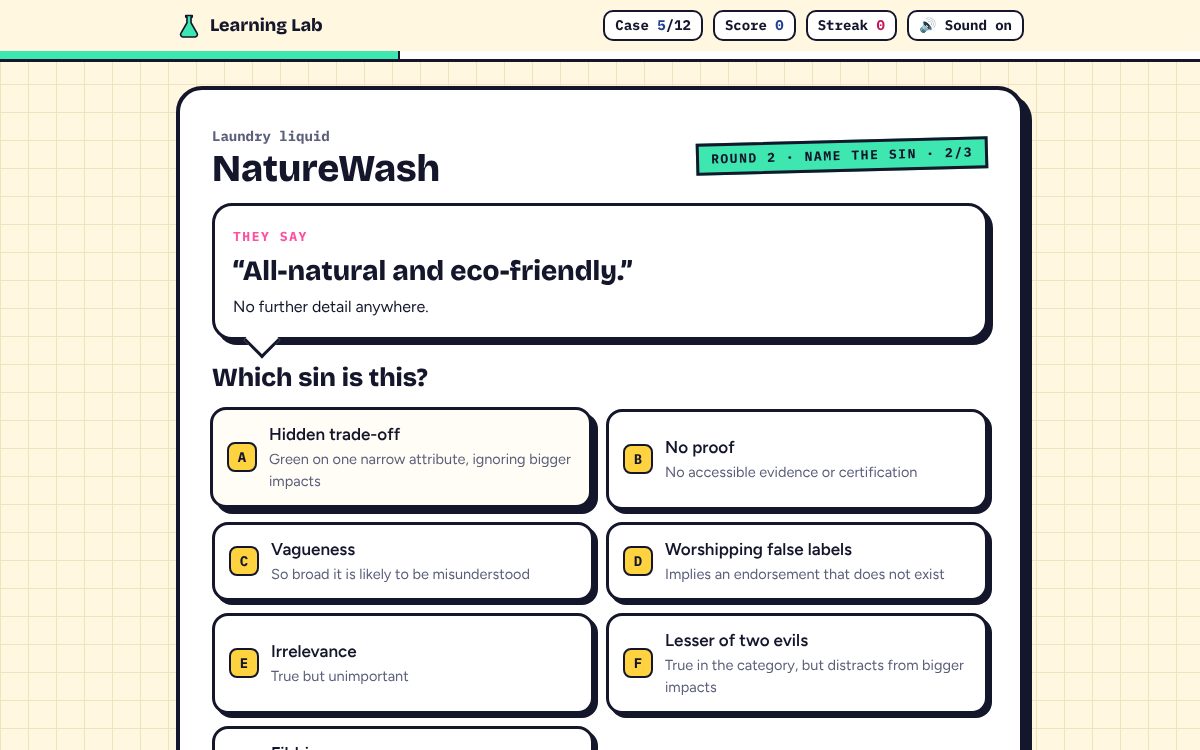
Round 2: all seven sins are on screen, with a one-line definition each. 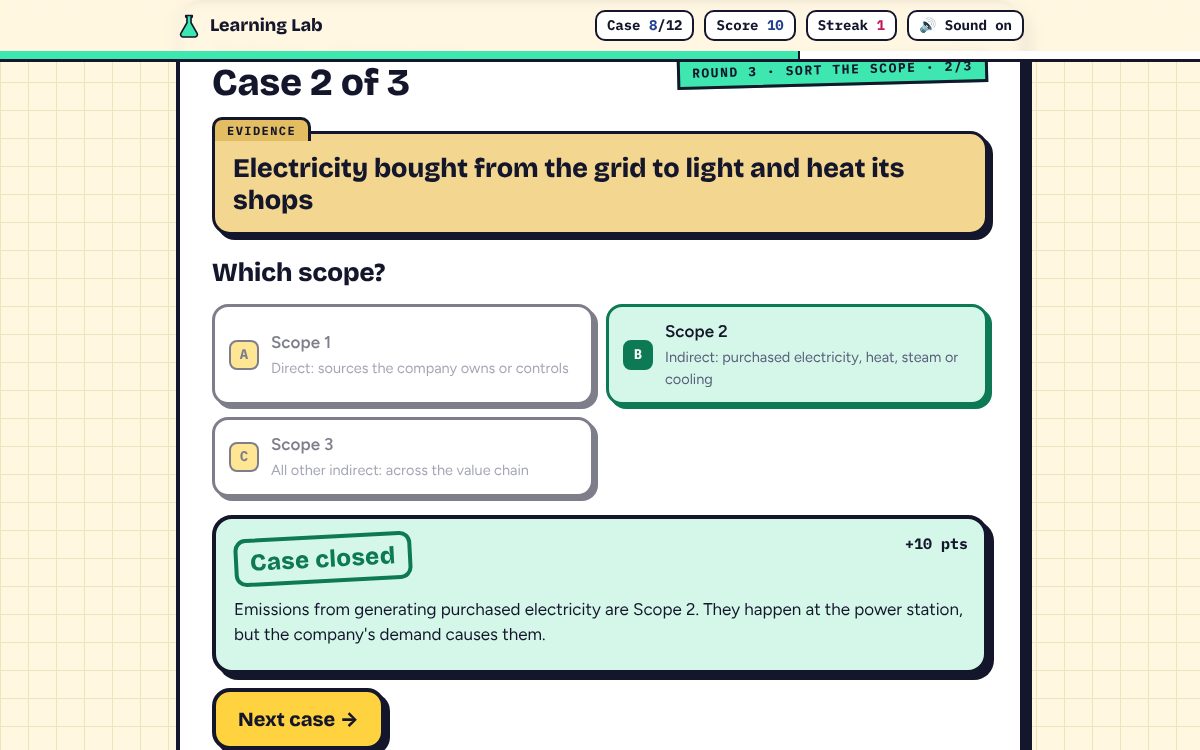
Round 3: one emissions source at a time. 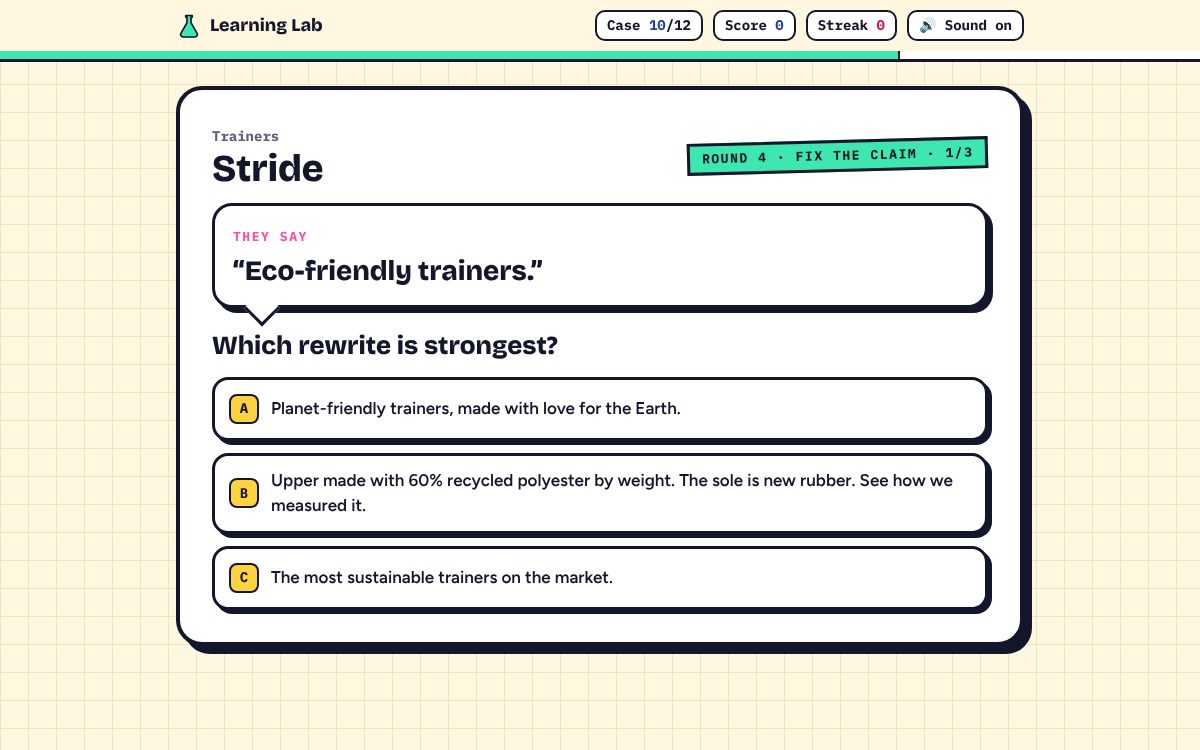
Round 4: students choose the strongest rewrite. 2 Ranks and sharing
3 min- Students
- The end screen shows their rank, score per round and the cases they missed, with the reasoning. "Copy my result" copies a short post with two sentences to finish: the case that surprised them, and one thing they will check before trusting a green claim.
- Say
- "Hands up: Chief Inspectors? Senior Detectives? Which round cost you the most points?"
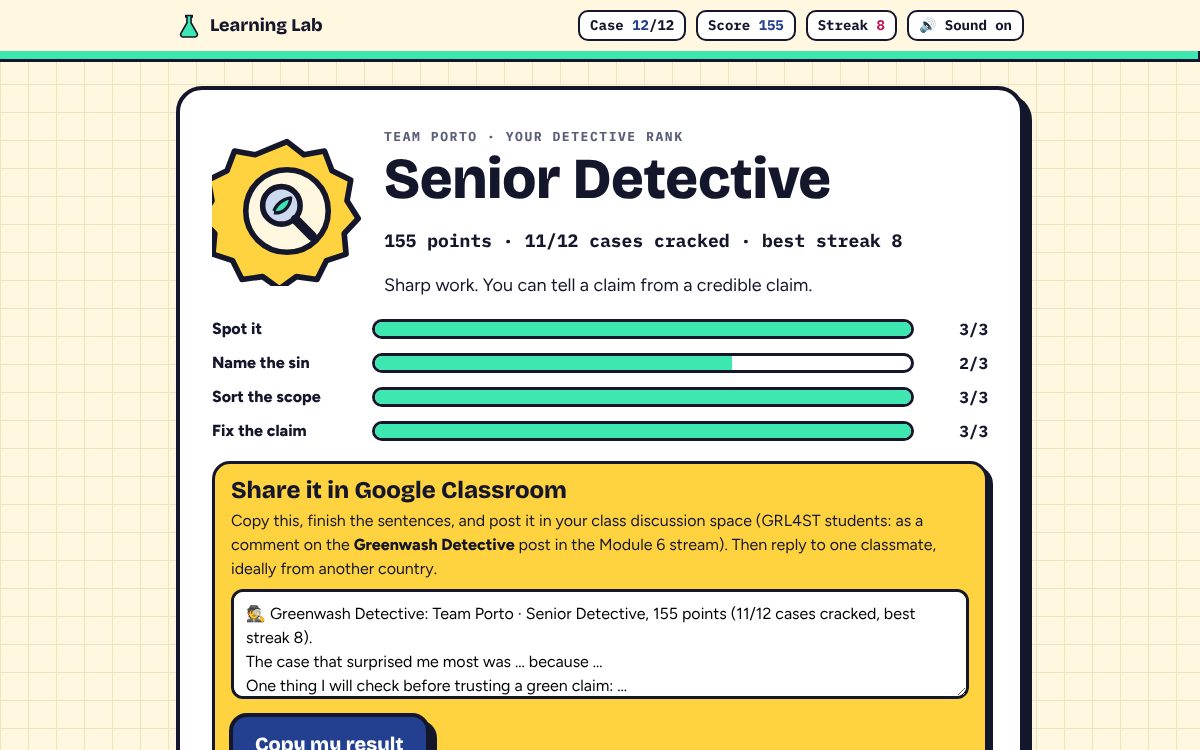
The end screen: rank, per-round results and a ready-made post. 3 Debrief
7 min- Ask
- "Calder Tools says nothing about sustainability, yet performs well. Is staying silent a safe strategy? What does a firm lose by greenhushing?"
- "If a 'carbon neutral' claim rests only on buying offset credits (GlowMart, in the bonus file), why are regulators moving against claims like this?"
- "For a clothing brand, most emissions sit in Scope 3. What does that mean for a claim like 'our clothes are low-carbon'?"
- "Take a real green claim from a brand you buy. Which sin, if any, does it commit, and how would you rewrite it?"
- Takeaway
- What an organisation says should match what it does and what it can prove.
If something goes wrong
| Problem | What to do |
|---|---|
| A student reloaded the page | The game starts again. At 5 to 8 minutes, replaying is quick, and the second run is usually better. |
| "Copy my result" does not copy | Some browsers block the clipboard. The text is selected instead: press Ctrl+C (Mac: Cmd+C). |
| Sound in a quiet room | The top-right button turns sound off, and the setting is remembered on that device. |
| No devices | Use the one-screen format: read each case aloud, vote, click the room's answer. |
| No Wi-Fi | Once the page has loaded it runs without a connection. Otherwise, use the answer key above as a paper quiz. |
| A student disputes an answer | Good: ask them to argue it from the evidence folder. Some cases sit close to a boundary, which is the point of the debrief. |
Cheat card
- Share the link or QR code
- "Compare what they say, do and can prove. Read every verdict."
- 8 minutes of play; bonus file for fast finishers
- Hands up by rank; which round cost the most?
- Open the answer key, debrief the most-missed cases
- One question: "Which sin does a real claim you have seen commit?"
Greenwash Detective is a support resource in Globally Responsible Leadership for Sustainable Transformation (GRL4ST), a course that brings together students from six institutions in five countries. Read about the course →
Behind the game
- Competition and Markets Authority (2021) Green claims code: making environmental claims. gov.uk
- Delmas, M.A. and Burbano, V.C. (2011) 'The drivers of greenwashing', California Management Review, 54(1), pp. 64-87.
- Directive (EU) 2024/825 of the European Parliament and of the Council of 28 February 2024 as regards empowering consumers for the green transition. eur-lex.europa.eu
- TerraChoice (2010) The sins of greenwashing: home and family edition. Ottawa: TerraChoice Group.
- WRI and WBCSD (2004) The Greenhouse Gas Protocol: a corporate accounting and reporting standard, revised edn. Washington, DC: World Resources Institute.
- WRI and WBCSD (2011) Corporate value chain (Scope 3) accounting and reporting standard. Washington, DC: World Resources Institute.
All brands, products and figures in the cases are fictional. Rules are described as at October 2026: a teaching summary, not legal advice.