What students learn
1. Intent beats volume
"chocolate" has 50,000 searches and eats the budget with browsers. The brand name and the long-tail "buy vegan dark chocolate online" have few searches but bring buyers. Broad match without negatives pays for "chocolate cake recipe"; a "–vegan" negative switches off your own product.
2. Pay for what the goal needs
For an awareness brief, buying clicks (CPC) or using Search, which only reaches people already looking, reaches few people. CPM or CPV on a visual platform reaches many. The same £500 reaches 5,000 or 70,000 people.
3. Smart bidding needs good data
Conversion-based bidding wins, until tracking breaks. Quality fixes (landing page, ad copy, assets) lower cost per click and lift sales; raising bids instead only makes clicks dearer.
4. PPC is a tap, SEO is a tree
Paid traffic arrives the day you pay and stops the day you stop. Organic traffic builds slowly and keeps coming. Most brands need both.
Built for search marketing and digital marketing classes. It is the quick, whole-campaign game; for depth, pair it with Match Point (match types, the search terms report and negatives over three weeks), Bid & Rank (a whole PPC account and its metrics), Ad Auction Live (how Ad Rank and the auction work) and Rank Rescue (SEO). Nibbo and every number are fictional.
Five golden rules
- Reloading is safe.The game remembers where you are in this browser tab. Closing the tab clears it.
- Picks can change until you reveal.After a reveal, "Change picks" takes you back to that round if a team was entered wrongly.
- Two keywords, one match type, one negative in round 1.Tapping a third keyword drops the first one. If nobody taps a match type it stays on exact; the negative stays on "none".
- Each round is scored on its own.Round winners get 10 points, then 7, 5, 4, 3, 2, 1, 1. Points add up; ties on the podium go to round 3 profit.
- The chaos card is random.It is drawn when you lock round 3, after every team has chosen, so nobody can play to it.
The model
Round 1 clicks = searches × match reach × click-through rate; junk clicks = clicks × match junk share × (1 − negative cut)
Orders = (clicks − junk) × conversion rate × match quality; if spend goes over £500, everything scales down to fit
Round 1 score = orders × £10 − spend (+ £50 earned media for the misspelling)
Round 2 score = people aged 18–34 reached = £500 ÷ price per 1,000 × 1,000 × platform's 18–34 share (× 1.3 for video views)
Round 3: CPC = strategy CPC × fix; conversion rate = strategy rate × fix; then the chaos card; score = orders × £10 − spend
Round 1: six keywords (pick two)
| Card | Searches a week | Click-through | CPC | Conversion | Note |
|---|---|---|---|---|---|
| A. chocolate | 50,000 | 2% | £0.60 | 1% | Huge, vague: eats the budget |
| B. vegan chocolate | 8,000 | 5% | £0.80 | 10% | The category |
| C. buy vegan dark chocolate online | 1,500 | 8% | £1.00 | 16% | Long-tail, ready to buy |
| D. chocolate gift box | 10,000 | 4% | £1.20 | 6% | Busy and pricey |
| E. nibbo chocolate | 300 | 30% | £0.20 | 20% | Brand: cheap, high intent |
| F. choclate | 4,000 | 3% | £0.10 | 1.5% | Misspelling stunt: +£50 buzz |
| Match type | Reach | Junk share of clicks | Conversion quality |
|---|---|---|---|
| Exact | ×1 | 0% | ×1 |
| Phrase | ×1.8 | 25% | ×0.9 |
| Broad | ×3.5 | 50% | ×0.75 |
Negatives: –recipe removes half the junk, –free removes 30%, and –vegan is the trap: it removes nothing useful and blocks keywords B and C completely.
Round 2: platform and pay model
| Platform | Share aged 18–34 | CPM | CPC (per 1,000 reached) | CPV (per 1,000 reached) | Best reach |
|---|---|---|---|---|---|
| Google Search | 40% | – | £40 | – | 5,000 (any choice becomes CPC) |
| Instagram & Facebook | 55% | £6 | £15 | £9 | 45,833 (CPM) |
| TikTok | 70% | £5 | £18 | £7 | 70,000 (CPM) |
| YouTube | 50% | £7 | £25 | £8 | 40,625 (CPV) |
Round 3: bidding strategy and one fix
| Strategy | CPC | Conversion | Spends | Smart? |
|---|---|---|---|---|
| Manual CPC | £0.80 | 7% | £500 | No |
| Maximise clicks | £0.65 | 5% | £500 | No |
| Maximise conversions | £0.95 | 10% | £500 | Yes |
| Target ROAS 300% | £0.90 | 11% | £400 | Yes |
| Fix | CPC | Conversion | Quality Score component |
|---|---|---|---|
| Faster mobile landing page | ×0.90 | ×1.25 | Landing page experience |
| Ad copy matches the keyword | ×0.85 | ×1.05 | Ad relevance |
| Sitelink & price assets | ×0.92 | ×1.10 | Expected click-through rate |
| Skip the fix, raise bids 15% | ×1.15 | ×1 | None: same ad, dearer |
| Chaos card | What happens | Who is protected |
|---|---|---|
| Bot attack | 15% of clicks are fake | Smart bidding: only 5% lost |
| Tracking broke | Smart bidding falls to a 7% conversion rate, minus 10% | Manual and Maximise clicks don't notice |
| A rival bids on your keywords | CPC +20% | Matching ad copy: only +10% |
| An AI Overview appears | 30% fewer clicks (and less spend) | Sitelink & price assets: only 20% fewer |
Design assumptions and simplifications
The same list appears in the game under "How this game simplifies reality".
- Every number is invented for teaching.Searches, click-through rates, prices and conversion rates are round, plausible figures chosen so that good decisions win clearly. Real figures vary by market, season and account.
- Match types are three dials.Real matching is decided by Google's systems in real time and also uses your landing pages, other keywords and data, so real broad match can do better or worse than this.
- Search ads are sold per click.A CPM or CPV plan on Google Search becomes CPC, as in real Search campaigns. CPM and CPV prices for social and video are illustrative, and pay models vary by platform and objective.
- Bidding strategies are four fixed profiles.Real smart bidding learns over time and needs enough conversion data. Enhanced CPC is not offered: Google retired it for Search and Display campaigns from the week of 31 March 2025.
- Quality fixes are multipliers.They echo the three Quality Score components (expected click-through rate, ad relevance, landing page experience). Quality Score itself is a diagnostic, not an auction input.
- Chaos cards are stylised.Invalid clicks, broken tracking, new competitors and AI Overviews are all real; the percentages are for the game. Google filters invalid clicks out of billing and credits some back; ads can appear above, below or inside AI Overviews.
- The "switch the ads off" chart is illustrative,not data. The shape is the point.
- Nibbo is fictional.Any resemblance to a real company is accidental.
Results you can predict
Every result is fixed by the picks; only the chaos card is random. Teams don't affect each other's money, only each other's rank.
Round 1 (profit after ads)
| Picks | Profit | Why |
|---|---|---|
| C + E, phrase, –recipe | £279 | Best in the game: long-tail plus brand, with the junk cut |
| B + E, exact | £242 | Category plus brand, no waste |
| C + E, exact | £234 | Safe, but small |
| E + F, exact | £218 | Brand carries it; the misspelling adds buzz, few sales |
| B + C, exact | £152 | Good intent, pricier clicks |
| B + C, phrase, –recipe | £30 | Phrase reach brings junk the negative only half removes |
| B + C, –vegan | £0 | The trap: no ads shown at all |
| B + C, broad, –recipe | −£122 | Broad junk outweighs the sales |
| A + E, exact | −£273 | "chocolate" spends the whole budget by day 6 |
| A + D, broad, none | −£441 | The worst: broad, busy and no negatives |
Round 2 (18–34s reached)
TikTok CPM 70,000 · TikTok CPV 65,000 · Meta CPM 45,833 · YouTube CPV 40,625 · Meta CPV 39,722 · YouTube CPM 35,714 · TikTok CPC 19,444 · Meta CPC 18,333 · YouTube CPC 10,000 · Google Search (any) 5,000. The gap between CPC and CPM on the same platform is the lesson: paying per click for an awareness goal buys clicks, not eyeballs.
Round 3 (profit after ads, by chaos card)
| Strategy + fix | No card | Bots | Tracking | Rival | AI Overview |
|---|---|---|---|---|---|
| Target ROAS + page | £279 | £245 | −£11 | £166 | £195 |
| Max conversions + page | £231 | £194 | −£39 | £109 | £162 |
| Target ROAS + copy | £204 | £174 | −£54 | £149 | £143 |
| Max conversions + assets | £129 | £98 | −£104 | £24 | £103 |
| Manual CPC + page | £108 | £16 | £108 | £6 | £75 |
| Manual CPC + copy | £40 | −£41 | £40 | −£9 | £28 |
| Max clicks + page | £34 | −£46 | £34 | −£55 | £24 |
| Target ROAS + raise bids | £25 | £4 | −£157 | −£46 | £18 |
| Max clicks + raise bids | −£166 | −£216 | −£166 | −£221 | −£116 |
When "Tracking broke" comes up, the manual bidder with a good landing page wins the round, which is the point of that card. Raising bids instead of fixing quality loses money with every strategy except Target ROAS, and even then it barely breaks even.
The screenshots below come from one four-team game: Truffle (B + E exact; TikTok CPM; Target ROAS + page), Fudge (C + E phrase –recipe; Google; Max clicks + raise bids), Praline (A + E exact; YouTube CPV; Max conversions + assets) and Ganache (B + C –vegan; Meta CPC; Manual + copy), with the AI Overview card. Final: Truffle 27, Praline 18, Fudge 18 (Praline ahead on round 3 profit), Ganache 15.
How long will it take?
Every time in this guide is a range. The low end is a tight run; the top end is what most classes take once teams discuss, decide and react to the results.
In class: 15 to 25 minutesSolo: at the player's own pace
What moves you up or down the range
- How strictly you run the clock. Stopping each round when the timer ends keeps you near the low end; letting teams finish talking moves you to the top.
- Number and size of teams. More teams means more picks to enter and more results to read out; bigger teams take longer to agree.
- How much discussion you want. Quick calls, or asking each team to explain its choice before the reveal.
- Getting started. Forming teams, explaining the rules and first-time players all take a few minutes.
- Interaction in between. Questions, cheering at the results, the chaos card or a tech hiccup.
- The debrief. One question, or a full discussion of what the game showed.
- Your group. Familiarity with the topic, reading in a second language, and the room layout.
Short on time? Use the timers, keep to four teams or fewer, and take one debrief question. Want the richest discussion? Plan for the top of the range.
Step by step
15 to 25 minutes with one debrief question. Short of time? Skip round 2: press Reveal the reach without entering any picks (every team scores the same), then Next round (10 to 15 minutes).
0 Set the scene and form teams
1 to 2 min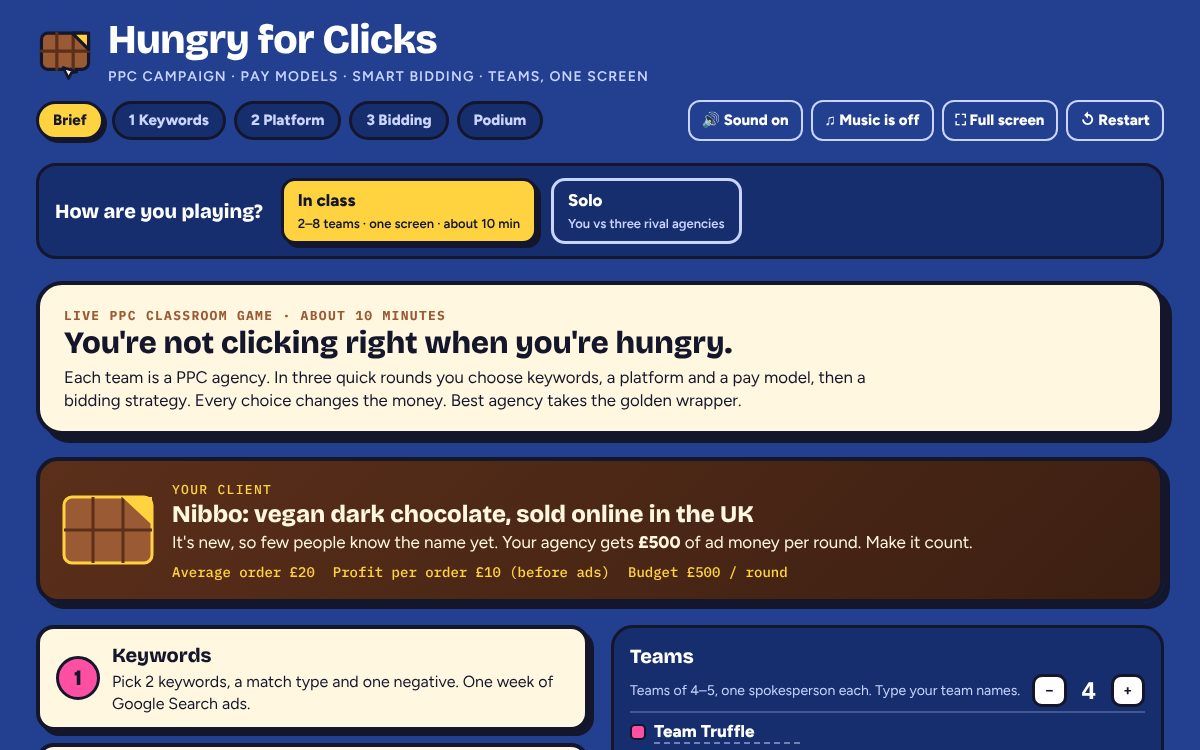
The brief, the client and the winning rule on one screen. - Click
- Set the number of teams with − and +; type team names if you like.
- Full screen, then Start round 1.
- Say
- "Each team is a PPC agency. Your client sells vegan dark chocolate online and nobody knows the name yet. You get £500 a round. Every click costs money; only buyers make money. Most points after three rounds takes the golden wrapper."
1 Round 1: keywords, match type, negative
3 to 6 min · timer 2:00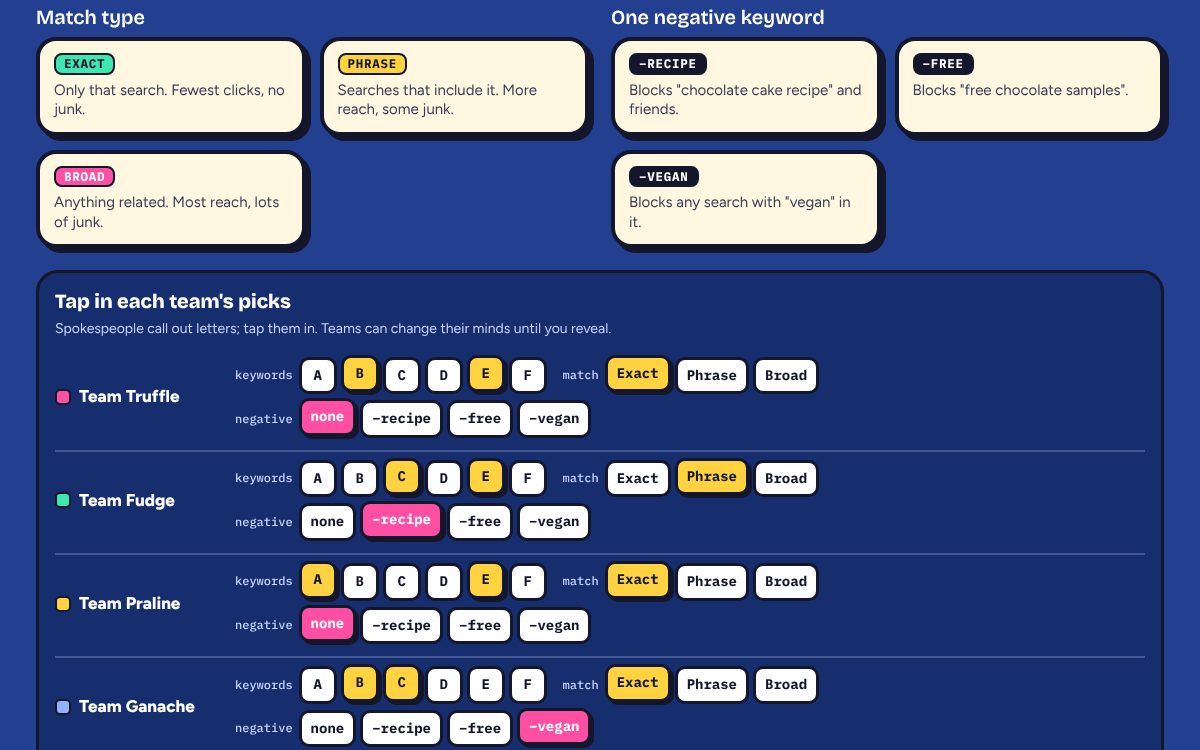
Six keywords, three match types and three negatives. 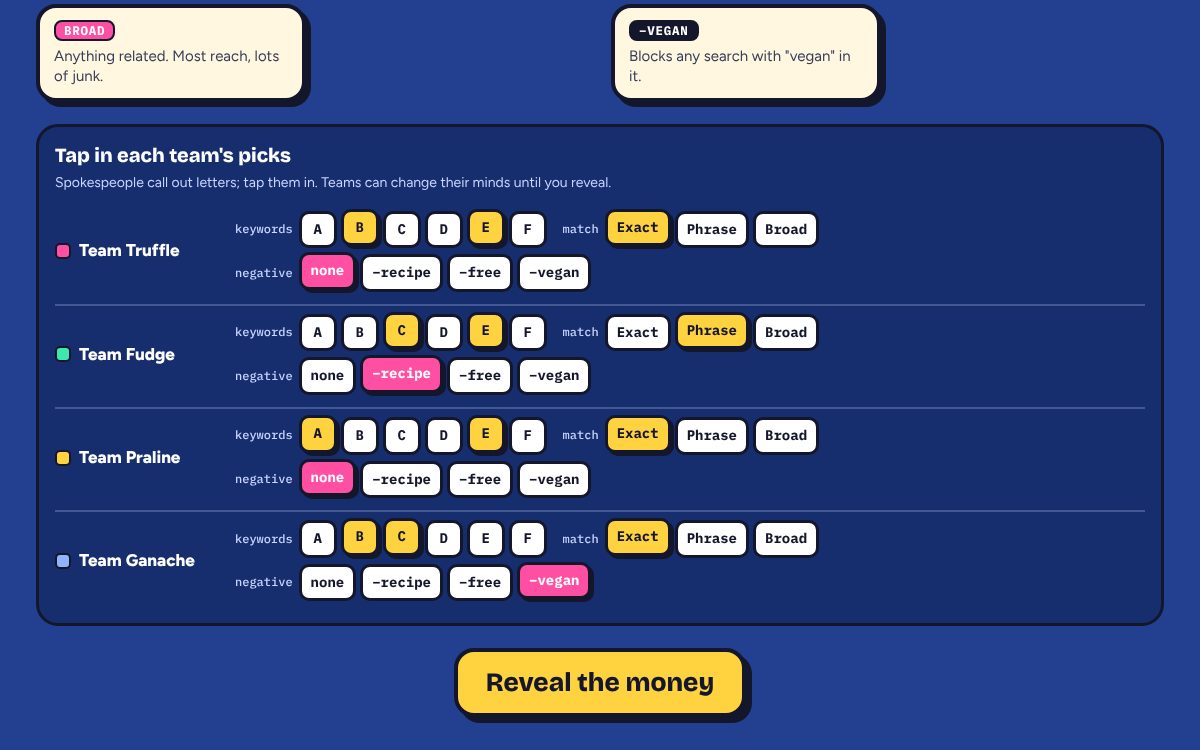
Tap each team's picks as spokespeople call them out. - Click
- Start timer, tap in picks, read them back, then Reveal the money.
- Watch for
- Someone picks "chocolate" (A) for its volume. Don't comment; the bar will.
- "–vegan" sounds tidy. Ask the team that picked it why their ad never showed.
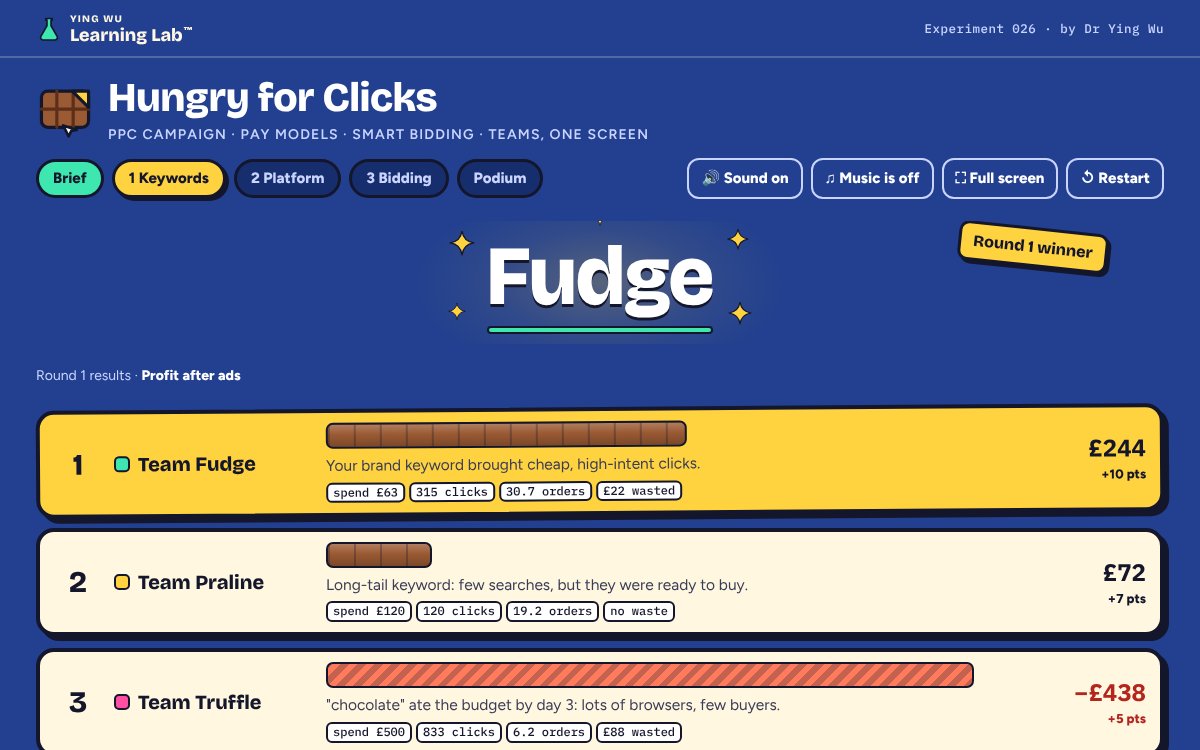
The winner’s name shines with gold stars; each team gets a one-line reason. 2 Round 2: platform and pay model
2 to 4 min · timer 1:30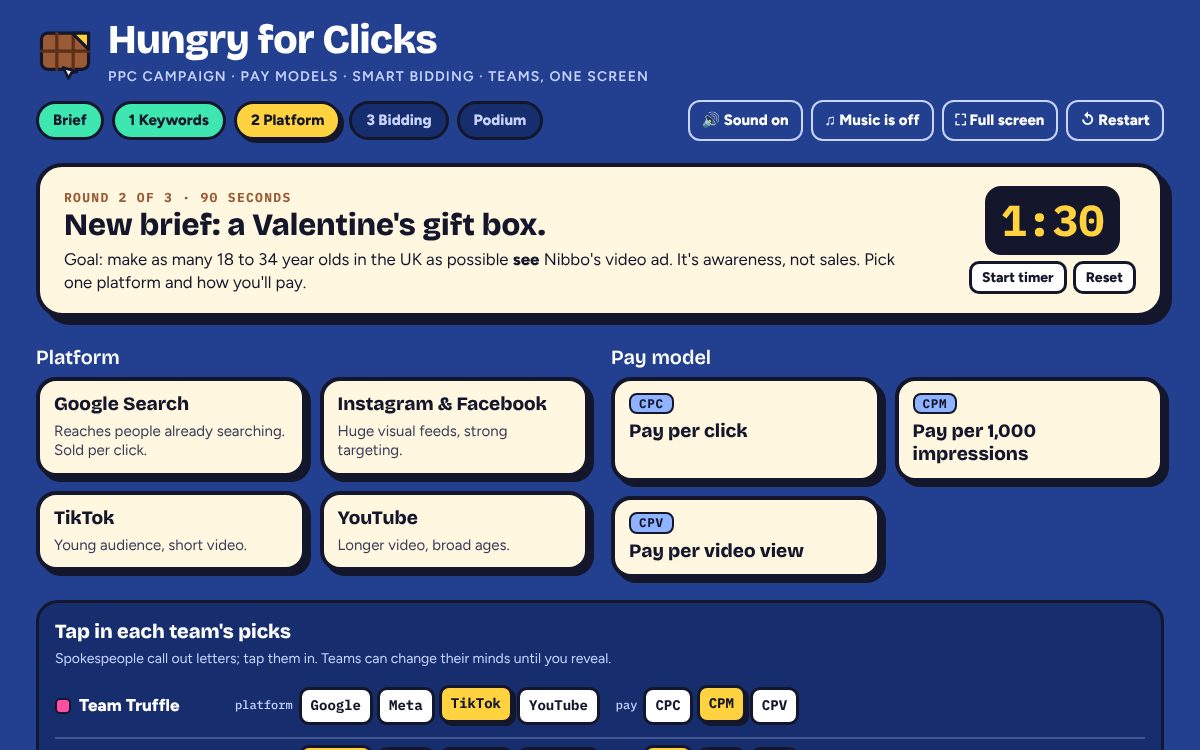
Now the goal is to be seen, not to sell. - Say
- "New brief. Valentine's is coming and the goal is for as many 18 to 34 year olds as possible to see the video ad. Which platform, and how do you want to pay?"
- Watch for
- Teams that loved round 1 often stay on Google Search. The result explains why Search is small for awareness.
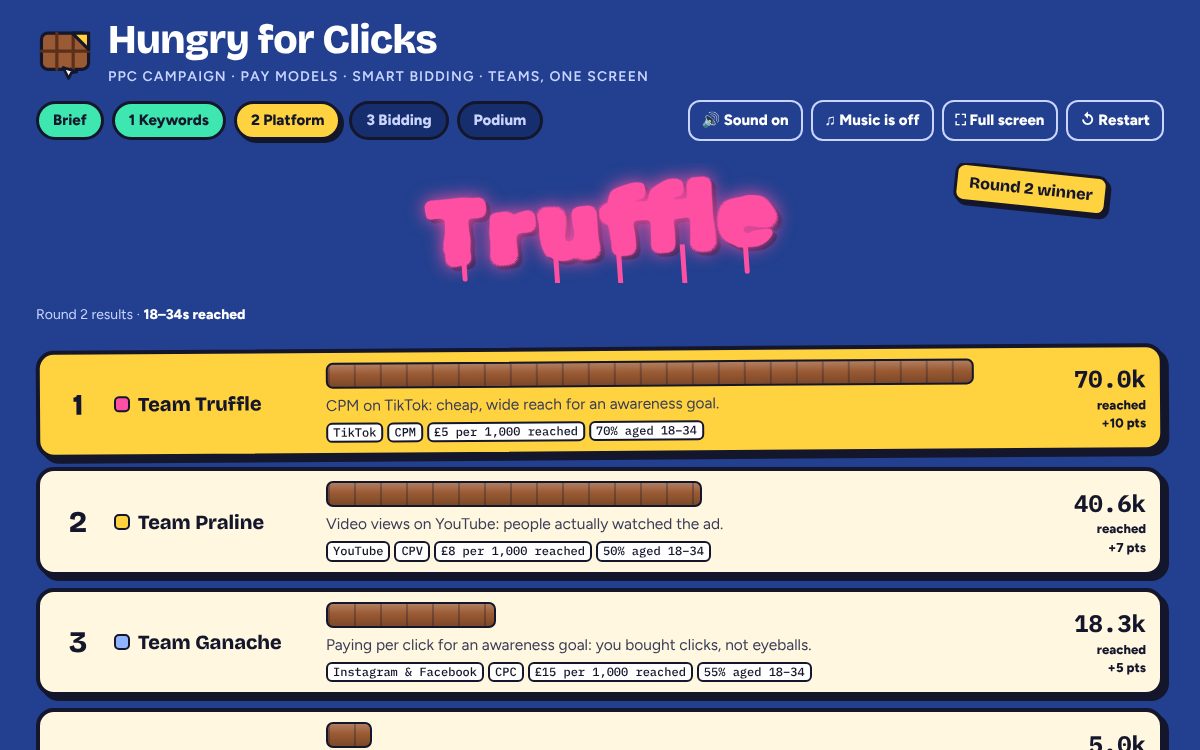
The same £500 reaches 5,000 or 70,000 people. 3 Round 3: bid smart, then chaos
2.5 to 5 min · timer 1:30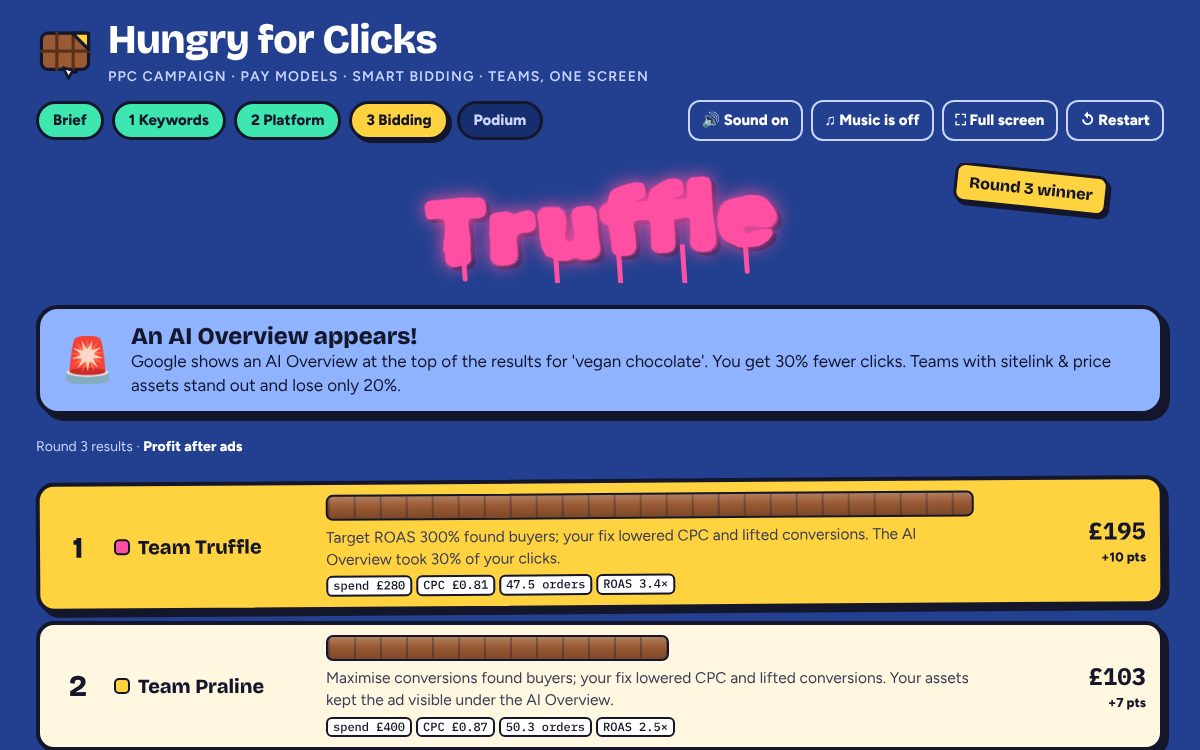
The chaos card is drawn after everyone has chosen. - Click
- Lock picks and draw a chaos card. Read the card aloud before scrolling to the results.
- Watch for
- Teams that picked "raise bids 15%" are surprised it loses. Ask: "What did you pay more for?"
4 Podium, then switch the ads off
1.5 to 3 min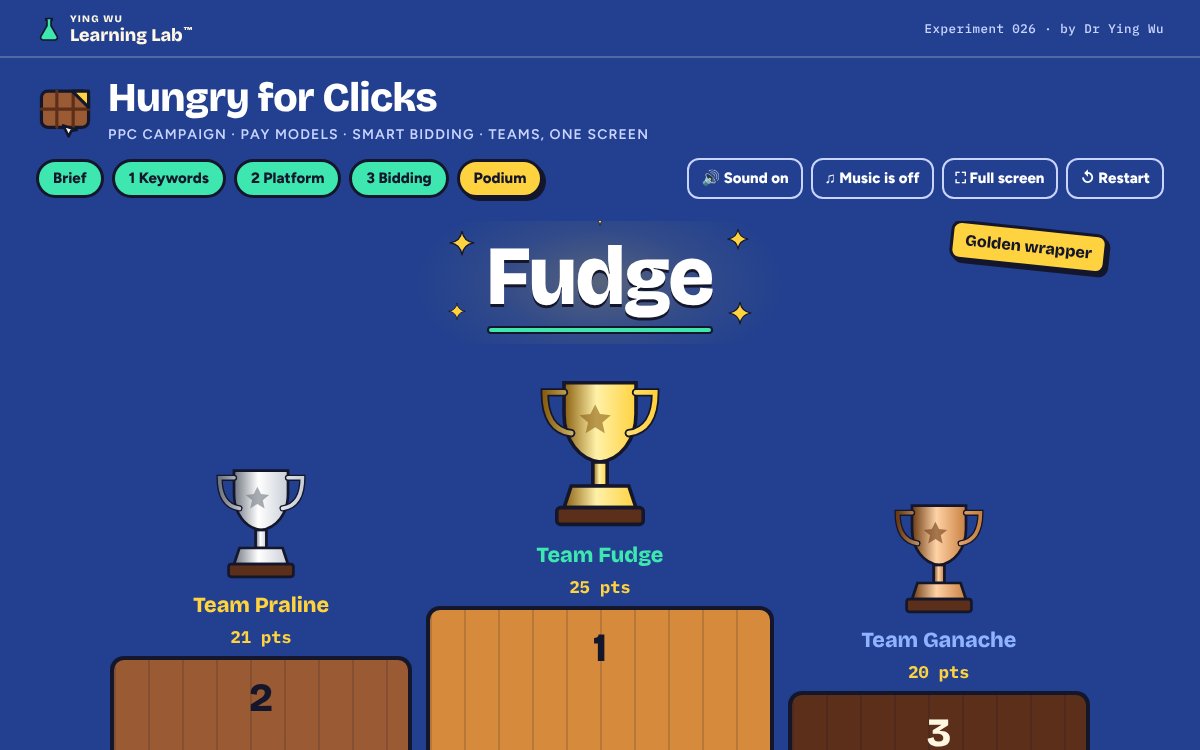
Melting chocolate, a fanfare, trophies and chocolate rain. 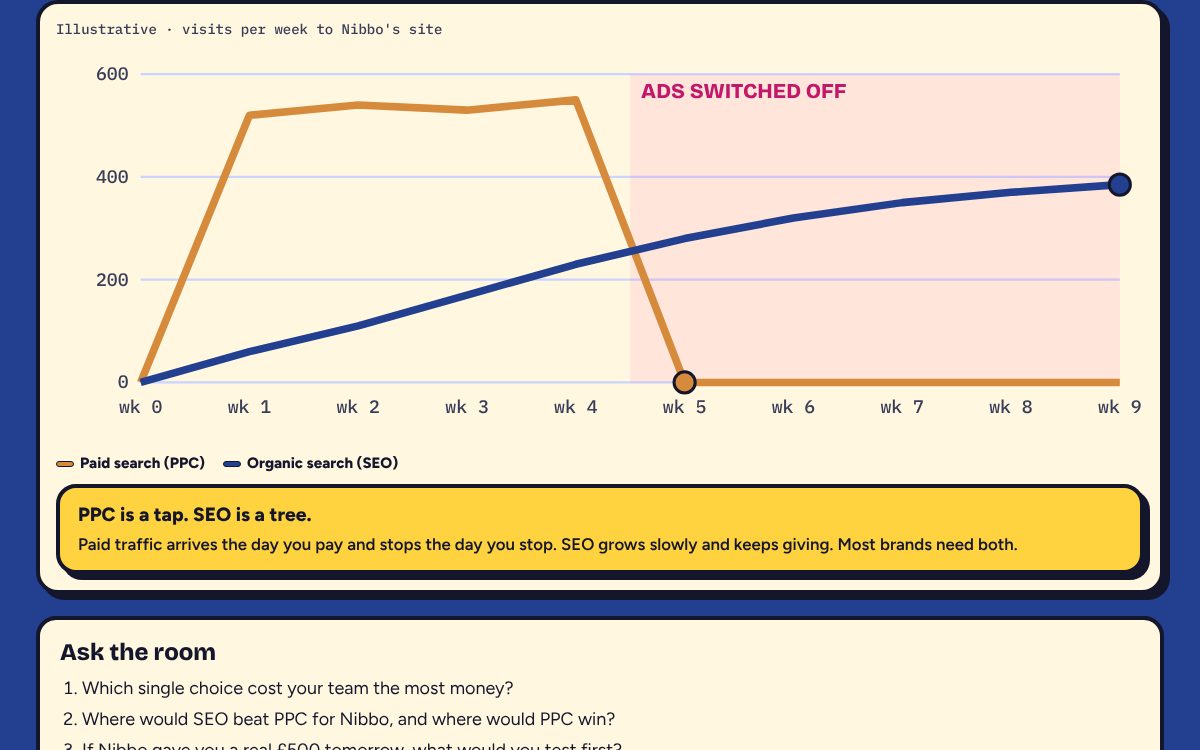
"Now switch the ads off…": PPC is a tap, SEO is a tree. - Say
- "Everything you just did stops the day the money stops. That's the difference from SEO, which you met in the last lecture."
Solo mode
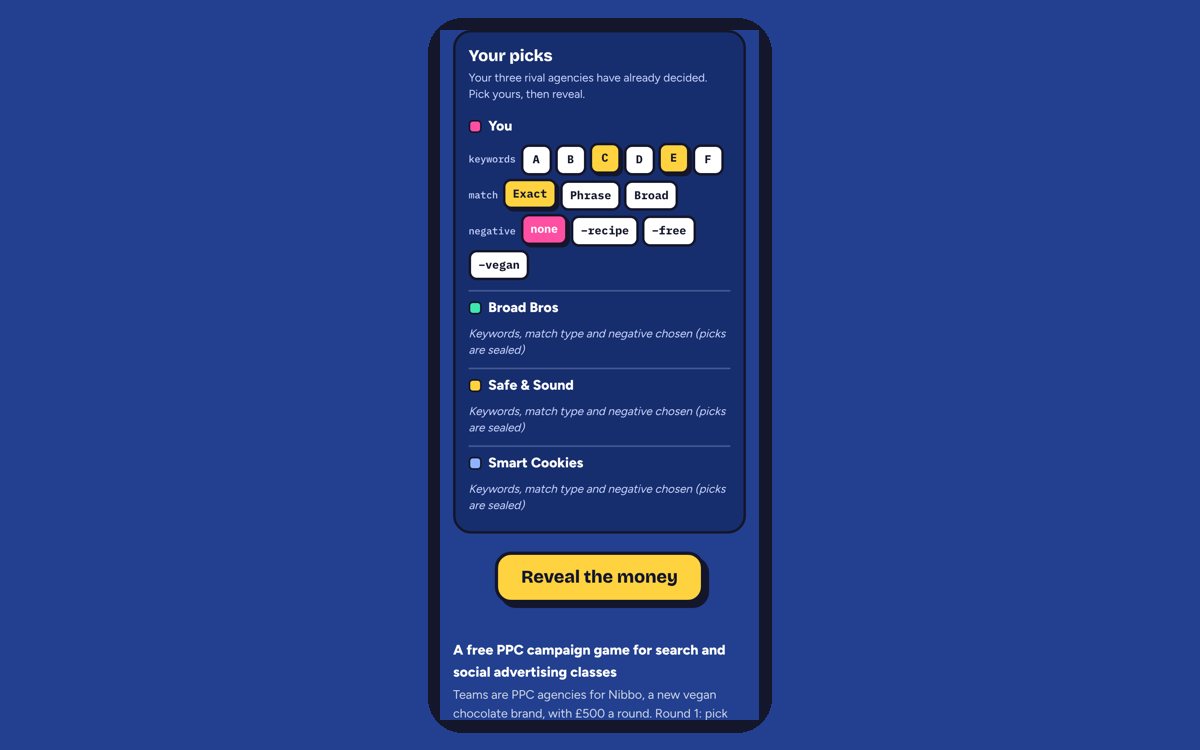
Share lab.yingwu.co.uk/hungry-for-clicks/#solo for homework or revision. The rivals always make the same choices: Broad Bros go big and hope, Safe & Sound play it safe, and Smart Cookies read the brief but aren't perfect. Finishing any game earns the "Hungry for clicks" badge; beating all three rivals in solo mode earns "Golden wrapper".
Debrief questions
- Which single choice cost your team the most? Usually "chocolate" in round 1 (volume without intent), paying per click in round 2 (the wrong price for an awareness goal), or raising bids in round 3 (paying more for the same quality). Ask teams to name the choice and the metric that showed it.
- Where would SEO beat PPC for Nibbo, and where would PPC win? SEO wins for steady, long-term traffic on informational searches ("is dark chocolate vegan?") and once the brand is known. PPC wins for launches, seasonal pushes such as Valentine's, testing which keywords sell, and appearing for competitive commercial searches straight away. Most brands use both.
- If Nibbo gave you a real £500 tomorrow, what would you test first? Good answers set up conversion tracking first, start with brand and high-intent keywords, add negatives from the search terms report, fix the landing page, and only move to smart bidding once there is conversion data.
- Why did smart bidding lose when tracking broke? Smart bidding optimises towards the conversions it can see. If the tag stops firing it learns from wrong data. Check tracking before handing bidding to the algorithm.
- What do AI Overviews change? Fewer clicks for everyone on some searches, and new places for ads (above, below or inside AI Overviews). Richer ads, assets and strong landing pages matter more.
Cheat card: the button order
- Set teams, Full screen, Start round 1
- Start timer (2:00), tap picks, Reveal the money
- Next round, Start timer (1:30), tap platform and pay, Reveal the reach
- Next round, Start timer (1:30), tap strategy and fix, Lock picks and draw a chaos card
- Read the chaos card aloud; To the podium
- Now switch the ads off…; ask one debrief question
Behind the rules
- Google Ads Help (n.d.) About keyword matching options. support.google.com
- Google Ads Help (n.d.) About negative keywords. support.google.com
- Google Ads Help (n.d.) About automated bidding. support.google.com
- Google Ads Help (n.d.) Enhanced CPC (ECPC): Definition. support.google.com
- Google Ads Help (n.d.) About Quality Score for Search campaigns. support.google.com
- Google Ads Help (n.d.) About Ad Rank. support.google.com
- Google Ads Help (n.d.) Invalid clicks: Definition. support.google.com
- Google Ads Help (n.d.) About ads and AI Overviews. support.google.com
A simplified classroom model: searches, prices and conversion rates are illustrative teaching devices. Nibbo is fictional.