What students learn
1. Match types trade reach for control
Broad finds the most searches, including valuable ones nobody thought of and worthless ones nobody wants. Exact is precise but small. Phrase sits between, and word order matters.
2. Keywords are not searches
The search terms report shows what people actually typed. Job seekers, DIYers and trade buyers all search for "plumber"; their clicks cost the same and book nothing.
3. Negatives are literal
"–jobs" blocks job seekers; "–job" blocks nothing, because negative keywords don't stretch to plurals or close variants. "–emergency" switches off your best customers.
4. Relevance pays twice
A specific ad earns more clicks for less; a landing page that matches the search turns more clicks into jobs. The quality diagnostics mirror Google's three Quality Score components.
Built for search marketing and digital marketing classes, and designed to follow Ad Auction Live (how the auction and Ad Rank work) and sit beside Rank Rescue (SEO). Every rule is based on Google Ads Help and the UK advertising code; the firms and numbers are fictional.
Five golden rules
- Reloading is safe.The game remembers where you are in this browser tab. Closing the tab clears it.
- There is no back button.Once you press Run the week, that week's picks are locked in.
- Up to three cards in weeks 1 and 2.In week 3, one ad (A, B or C) and one landing page (D, E or F). If a team forgets one, the game uses the standard ad or the homepage and warns you first.
- Keywords stay for the whole game.Week 2 adds negatives on top; week 3 keeps both.
- Competition matters.Click prices rise when more teams target the same search, so results depend a little on what the other teams choose.
The model
Cost per click = base price × (0.7 + 0.15 × number of firms targeting that search) × ad price multiplier × page price multiplier
Jobs = clicks × booking rate × ad booking multiplier × page booking multiplier
Profit = jobs × profit per job − clicks × cost per click
Each search counts once per firm, however many of its keywords match
Week 3 cold snap: "burst pipe repair" and "frozen pipes help" × 6
"Wasted" = spend on searches that almost never book (booking rate under 1%)
The searches (per week)
| Search | Searches | Intent | Booking rate | Profit per job | Base cost per click |
|---|---|---|---|---|---|
| emergency plumber glasgow | 120 | Ready to book | 20% | £180 | £6.50 |
| glasgow emergency plumber | 40 | Ready to book | 20% | £180 | £6.50 |
| emergency plumber near me | 200 | Ready to book | 18% | £180 | £6.00 |
| 24 hour plumber | 90 | Ready to book | 15% | £180 | £5.50 |
| burst pipe repair | 60 (360 in week 3) | Ready to book | 22% | £180 | £5.00 |
| frozen pipes help | 30 (180 in week 3) | Ready to book | 15% | £180 | £4.50 |
| plumber glasgow | 300 | Ready to book | 8% | £120 | £4.00 |
| cheap plumber glasgow | 70 | Price shopper | 10% | £90 | £3.50 |
| blocked toilet glasgow | 80 | Ready to book | 15% | £120 | £4.00 |
| boiler repair glasgow | 150 | Ready to book | 10% | £150 | £6.00 |
| glasgow emergency plumber jobs | 60 | Job seeker | 0% | – | £2.00 |
| plumber jobs glasgow | 400 | Job seeker | 0% | – | £2.00 |
| plumbing apprenticeship | 300 | Job seeker | 0% | – | £1.80 |
| plumber salary uk | 500 | Job seeker | 0% | – | £1.50 |
| boiler repair course | 120 | Job seeker | 0% | – | £2.00 |
| how to fix a dripping tap | 900 | DIY | 0.3% | £120 | £1.20 |
| how to unblock a toilet | 700 | DIY | 0.3% | £120 | £1.20 |
| plumbers merchant glasgow | 250 | Trade supplier | 0% | – | £1.80 |
Week 1: keywords (up to three)
| Card | Match type | Searches it reaches in the game |
|---|---|---|
| A. emergency plumber | Broad | both "emergency plumber glasgow" orders, near me, 24 hour plumber, burst pipe repair, frozen pipes help, glasgow emergency plumber jobs |
| B. "emergency plumber" | Phrase | both "emergency plumber glasgow" orders, near me, glasgow emergency plumber jobs |
| C. [emergency plumber glasgow] | Exact | emergency plumber glasgow, glasgow emergency plumber |
| D. plumber | Broad | every search except "boiler repair course" |
| E. "boiler repair" | Phrase | boiler repair glasgow, boiler repair course |
| F. [burst pipe repair] | Exact | burst pipe repair |
| G. "plumber glasgow" | Phrase | emergency plumber glasgow, plumber glasgow, cheap plumber glasgow |
| H. blocked toilet | Broad | blocked toilet glasgow, how to unblock a toilet |
Week 2: negatives (up to three)
| Card | Blocks | Verdict |
|---|---|---|
| A. –jobs | both "jobs" searches | Good move |
| B. –job | nothing (no plurals or close variants) | Trap |
| C. –"how to" | both DIY searches | Good move |
| D. –salary –apprenticeship –course | salary, apprenticeship, boiler repair course | Good move |
| E. –emergency | all four "emergency" searches | Trap: blocks your best customers |
| F. –cheap | cheap plumber glasgow | Judgement call (still slightly profitable) |
| G. –merchant | plumbers merchant glasgow | Good move, if you reached it |
Week 3: one ad and one landing page
| Card | Clicks | Cost per click | Bookings | Diagnostics shown |
|---|---|---|---|---|
| A. Generic "Plumbing Services" ad | ×1 | ×1 | ×1 | CTR average · relevance average |
| B. "Emergency Plumber Glasgow, 24/7" ad | ×1.3 | ÷1.15 | ×1 | CTR above · relevance above |
| C. "#1 Best… Guaranteed Cheapest" ad | ×1.15 | ×1 | ×0.8 | CTR average · relevance average |
| D. Homepage | – | ×1 | ×1 | Landing page average |
| E. Emergency page with tap-to-call | – | ÷1.1 | ×1.5 | Landing page above |
| F. Twelve-field contact form | – | ×1 | ×0.6 | Landing page below |
Design assumptions and simplifications
The same list appears in the game under "How this game simplifies reality".
- Fictional firms and figures.Search volumes, click prices, booking rates and job values are invented to make the trade-offs clear. "Profit" is job profit minus ad costs.
- Which searches each keyword reaches is a teaching judgement.It follows Google's definitions: broad reaches related searches, phrase reaches searches that include the keyword's meaning, exact reaches searches with the same meaning. Real matching is decided in real time and also uses landing pages, other keywords and recent searches, so real results can differ, especially for broad match.
- One search, one keyword.When several of a firm's keywords match a search, Google uses one. Every firm that matches a search gets the same 6% click-through rate on a standard ad.
- Competition raises prices, simply.Real auctions set prices from bids and ad quality (see Ad Auction Live).
- Quality is three multipliers.In real auctions Google uses real-time estimates of expected click-through rate, ad relevance and landing page experience. The 1 to 10 Quality Score is a diagnostic, not an auction input.
- No bids, budgets or Smart Bidding.Google recommends Smart Bidding with broad match; here everyone pays the going rate so the focus stays on keywords.
- Search Network only.No location targeting, ad schedules, AI Max or Performance Max.
- UK advertising rules, simplified.Not legal advice.
Results you can predict
These four paths, played together in one game, always land here. Change the other teams and click prices change a little.
| Path | Week 1 · Week 2 · Week 3 | Week 1 | Week 2 | Week 3 | Total |
|---|---|---|---|---|---|
| Broad and smart | A D F · A C D · B E | £877 | £1,112 | £4,231 | £6,219 |
| Tight phrase and exact | B C F · A · B E | £681 | £710 | £2,808 | £4,199 |
| Broad and careless | D · B E · A D | £877 | £351 | £1,149 | £2,377 |
| Exact only | C F · none · B F | £384 | £393 | £697 | £1,474 |
The careless broad team looks as good as the smart one in week 1, then falls away: its "–job" blocks nothing and its "–emergency" blocks its best searches. The exact-only team wastes nothing and still finishes last, because it never reaches "near me", "24 hour" or the frost. Playing alone with no competitors on the same searches, the best possible total is about £6,500 (broad "emergency plumber" and "plumber", the three good negatives, then ad B and page E).
Step by step
About 15 minutes with one debrief question; allow 18 for the full debrief.
0 Set the scene and form teams
1.5 min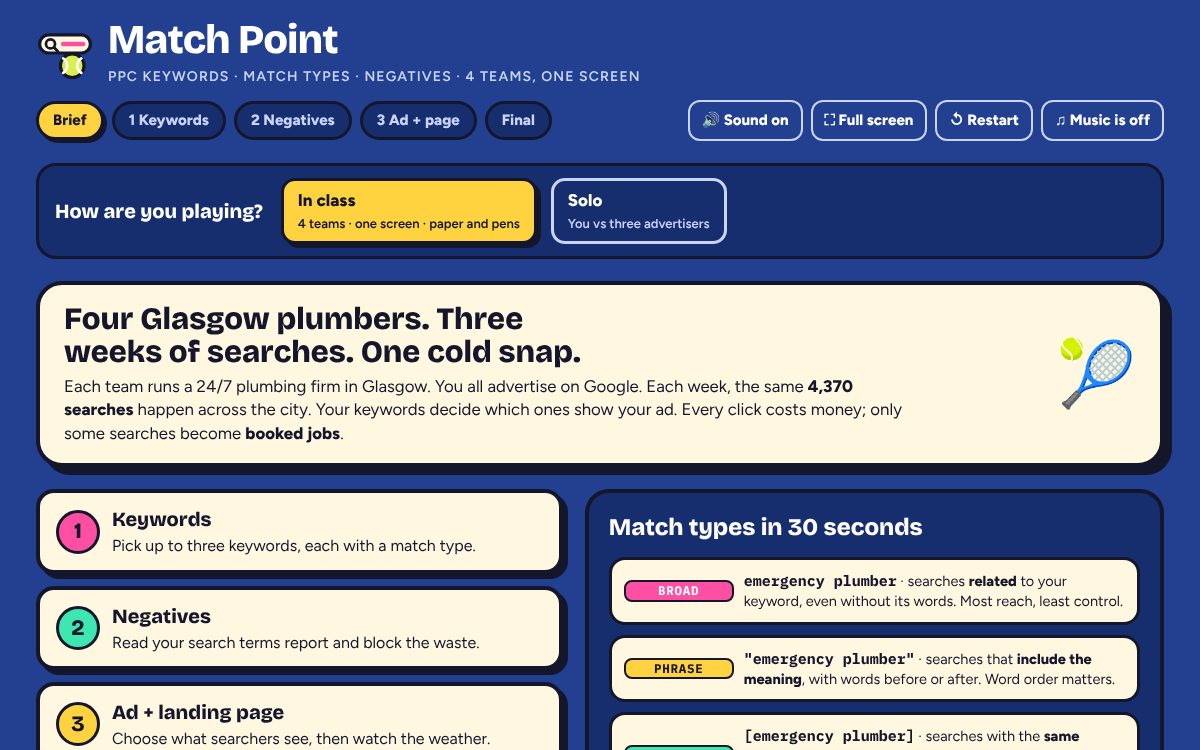
The brief and a 30-second match type cheat sheet. - Say
- "You each run a 24/7 plumbing firm in Glasgow. The same searches happen every week. Your keywords decide which ones show your ad. Every click costs money; only some clicks become jobs. Most profit after three weeks wins."
1 Week 1: keywords
4 min · timer 2:30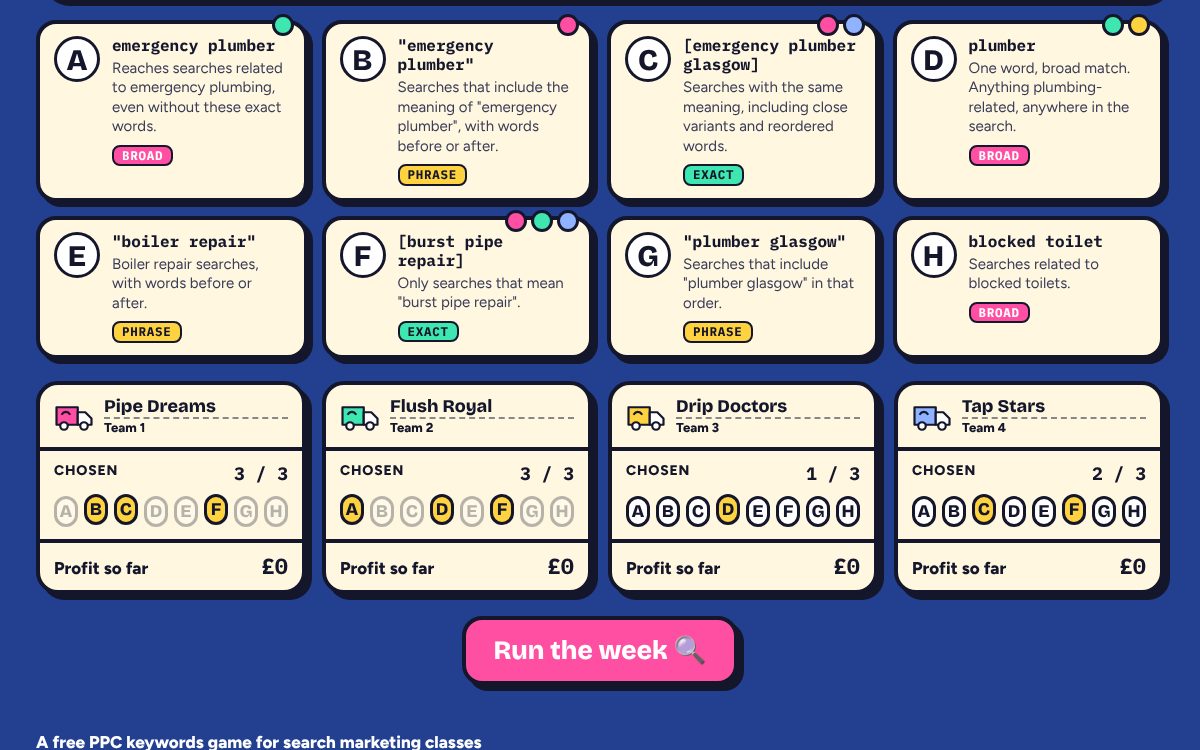
Teams choose up to three keyword cards. The colour shows the match type. - Click
- Full screen, then Start.
- Tap each team's letters, read them back, then Run the week. The search terms report fills in row by row.
- Watch for
- Someone always picks "plumber" (D) for reach. Don't comment; the report will.
- Ask: "Why didn't 'glasgow emergency plumber' match 'plumber glasgow'?" (word order in phrase match).
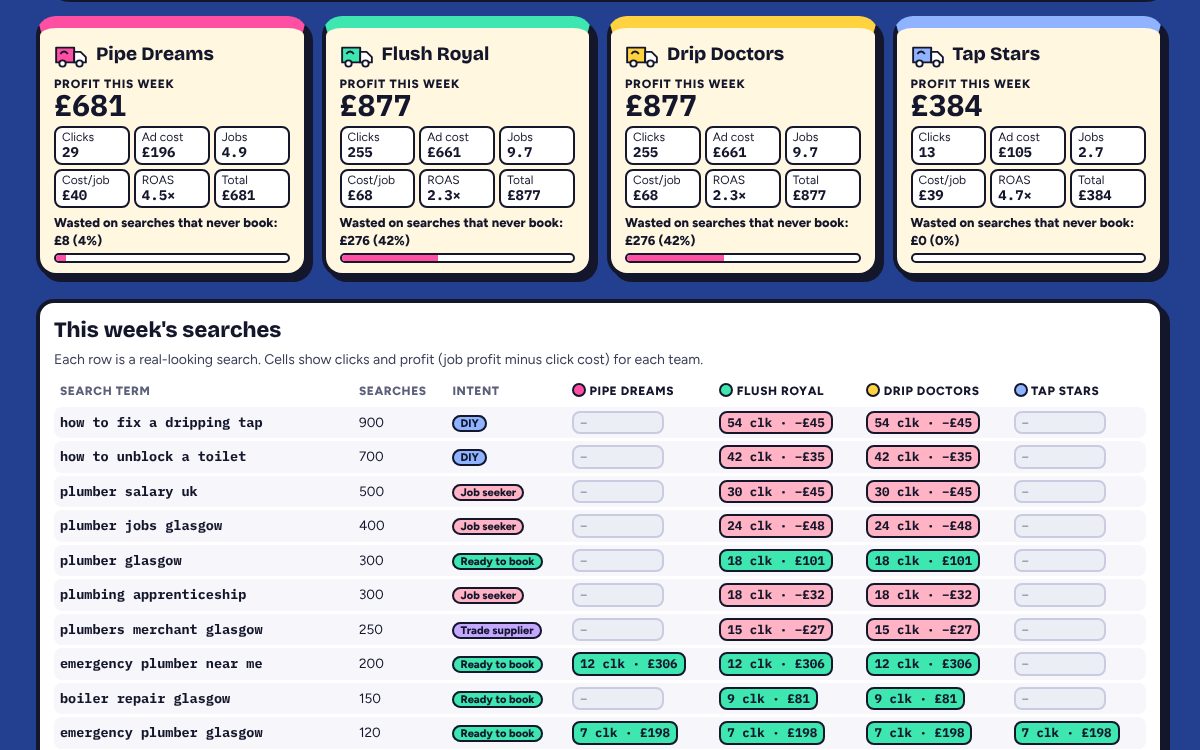
The summary cards; scroll down for the full search terms report and the verdicts. 2 Week 2: read the report, add negatives
4 min · timer 2:30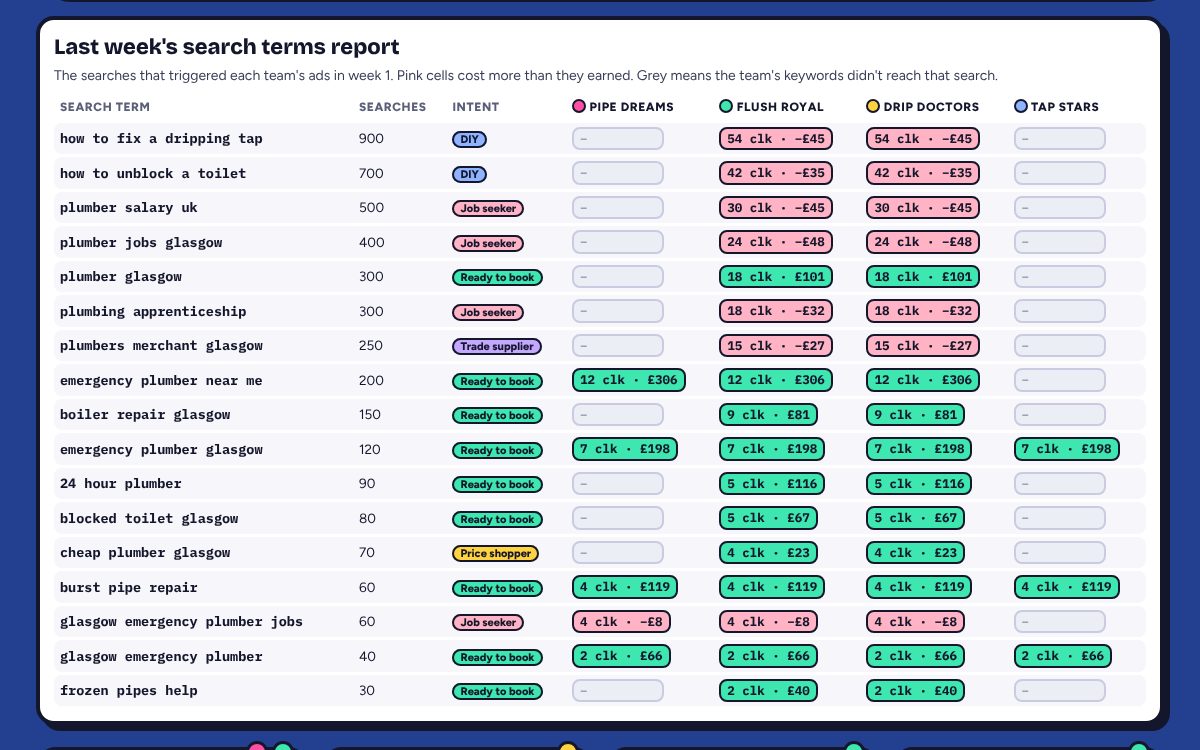
The report is shown above the negative cards, the way practitioners actually work. - Say
- "Find the pink cells. Who is clicking your ads and never booking? Now choose up to three negatives. Careful: they only block exactly what they say."
- Watch for
- "–job" is the most common trap. When the black "blocked" cells don't appear for that team, ask the room why.
3 Week 3: ad, landing page and the frost
3 min · timer 2:30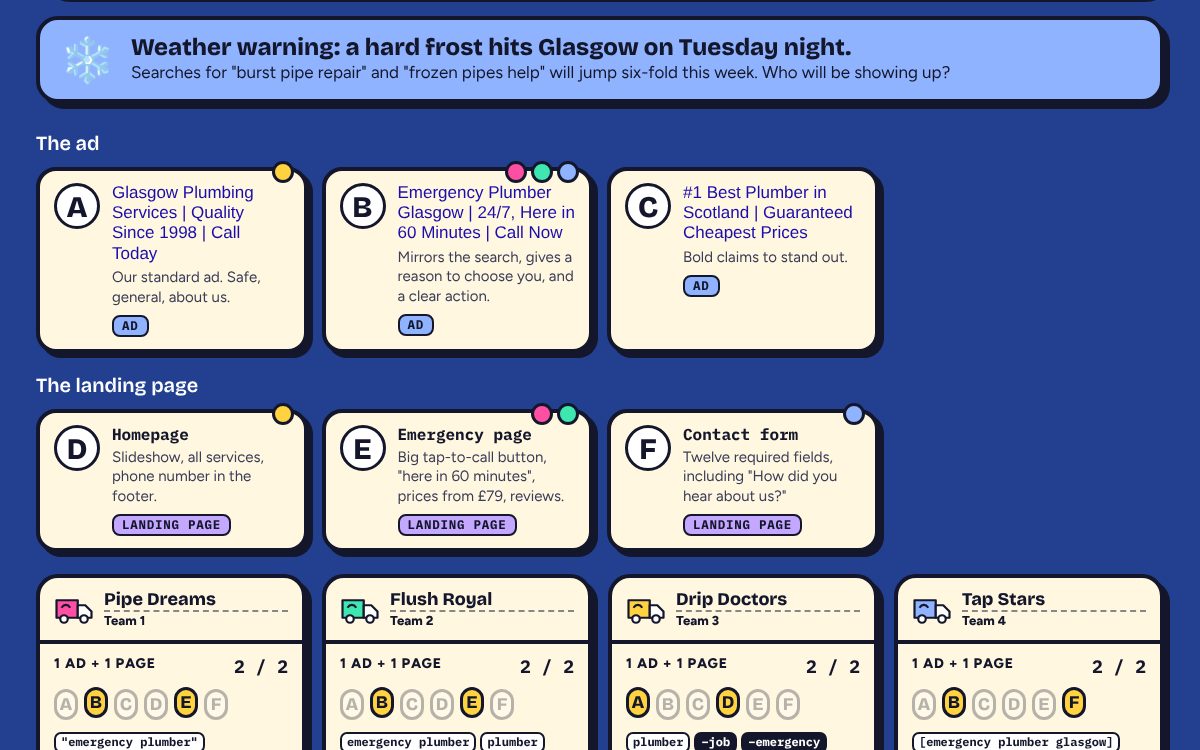
The weather warning arrives with the ad and landing page choice. 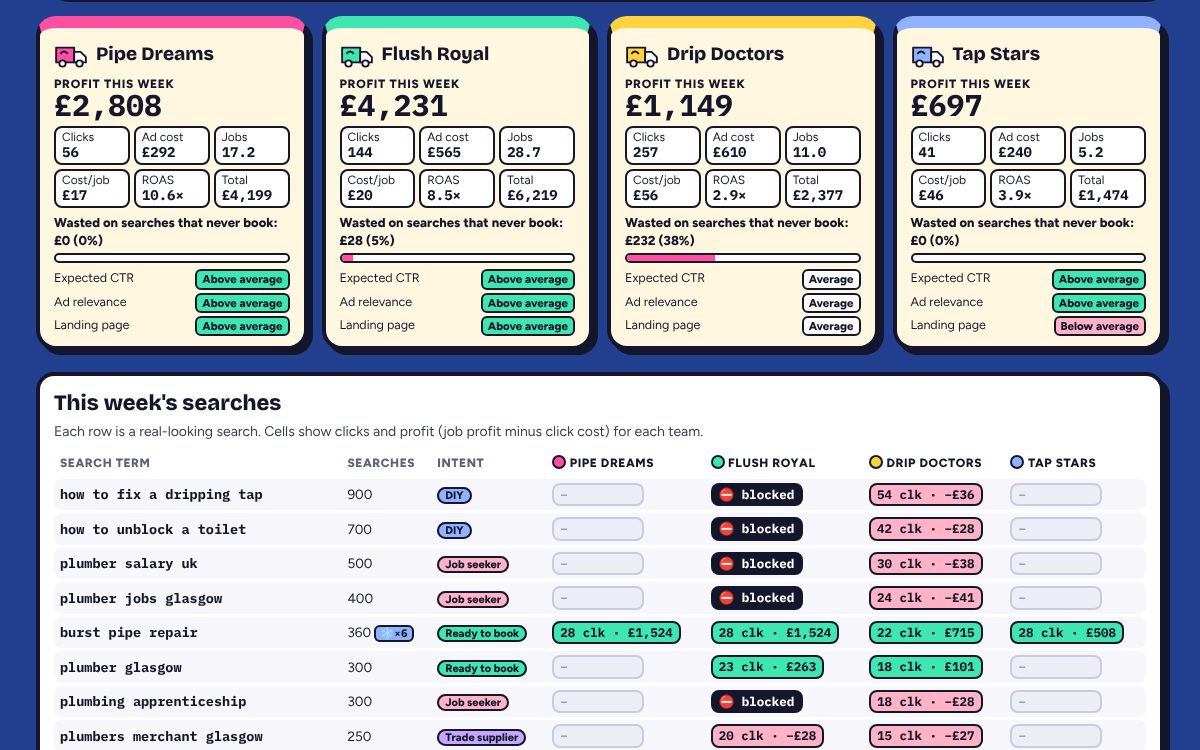
Quality diagnostics appear in week 3, mirroring Google's three Quality Score components. - Watch for
- Teams with broad "emergency plumber" or "plumber", or exact "burst pipe repair", catch the frost. Teams with only "emergency plumber glasgow" see the ❄️ rows go by without them.
4 Final results and debrief
1 to 4 min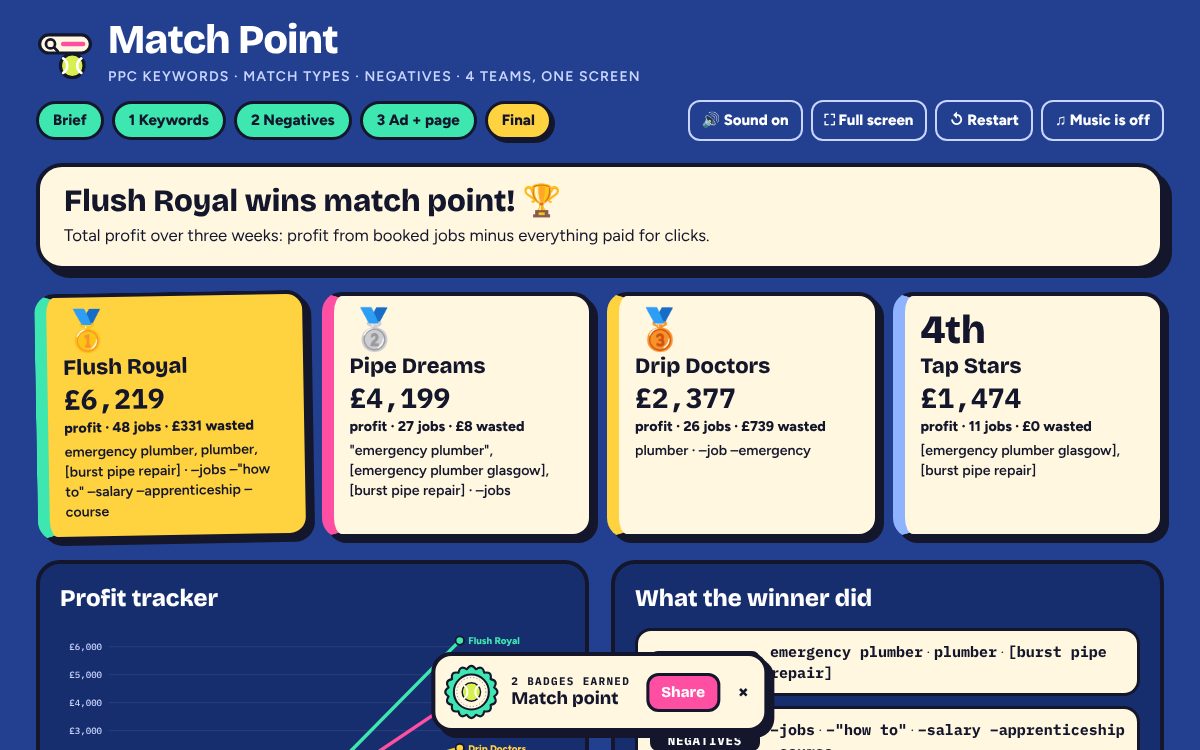
The podium lists each team's keywords and negatives, so the room can compare strategies. 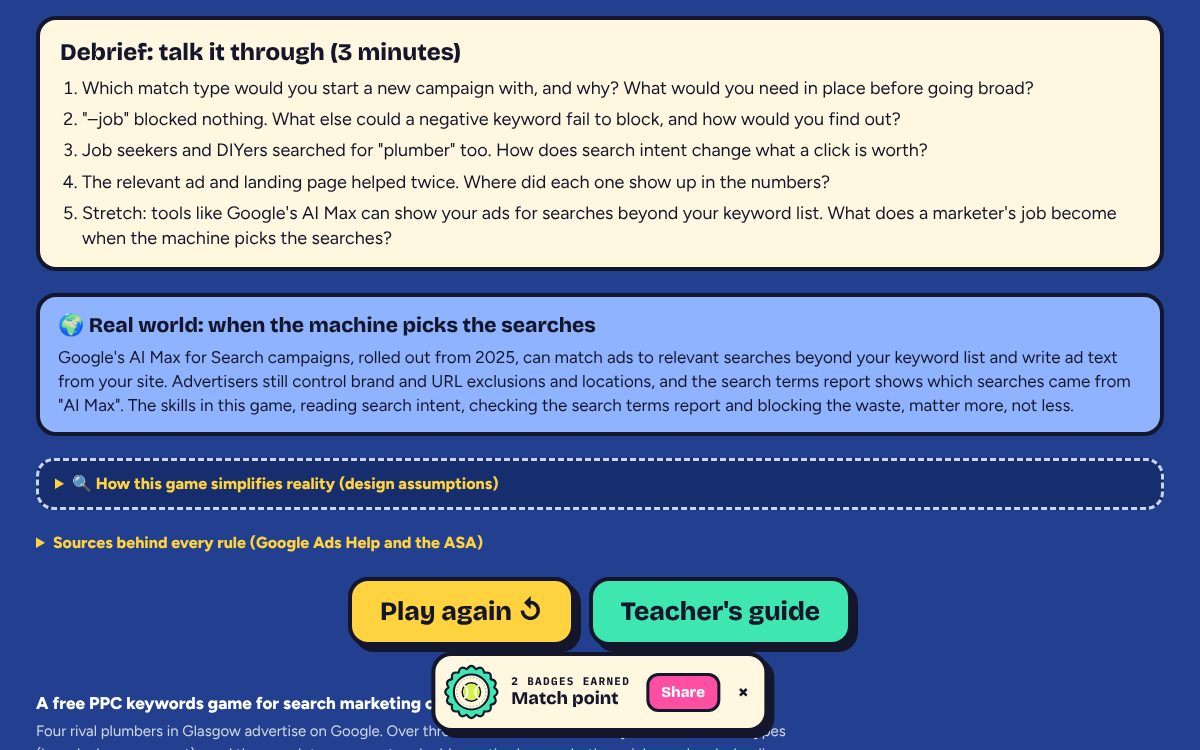
Pick one question, or all five.
Solo mode
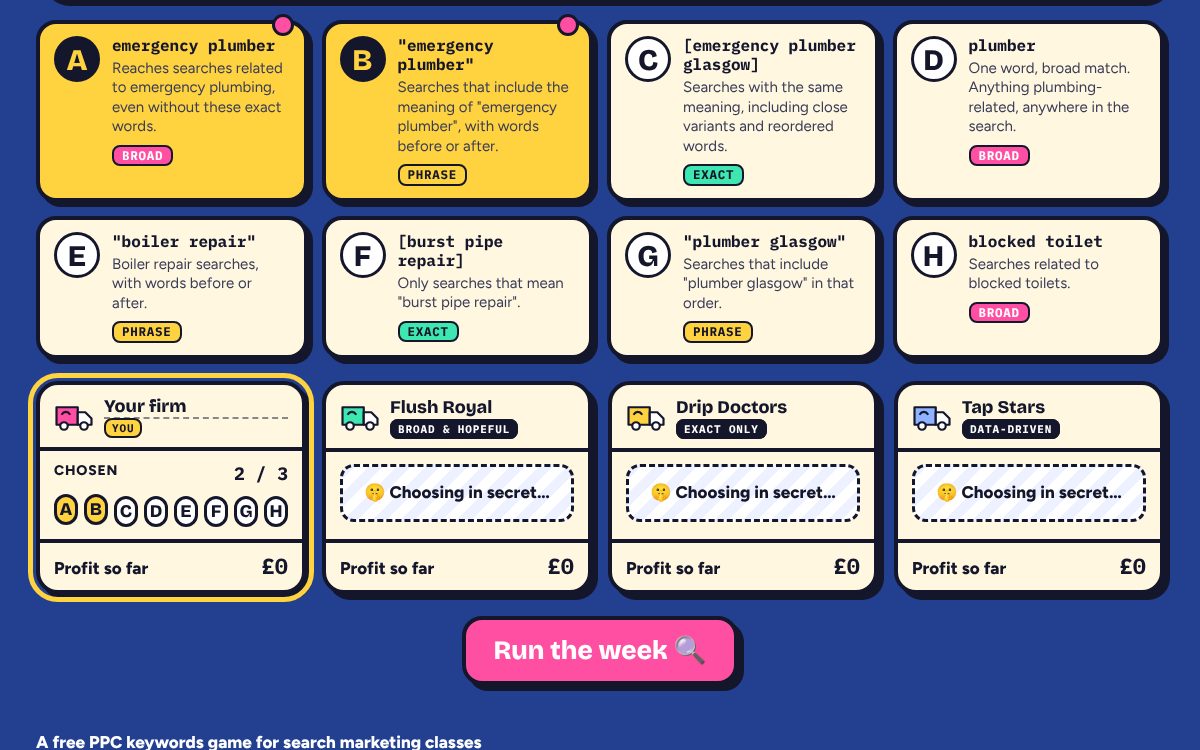
Share lab.yingwu.co.uk/match-point/#solo for homework or revision. Three rivals choose in secret: Broad & hopeful goes wide and is careless with negatives, Exact only plays it safe and small, and Data-driven is sensible but not perfect. Their choices have some randomness. Winning the most profit in solo mode earns the "Sharp shooter" badge; finishing any game earns "Match point".
Debrief questions
- Which match type first? There is no single answer. Many practitioners start with phrase and exact for control while data is thin; Google recommends broad match with Smart Bidding, which needs reliable conversion tracking. Before going broad you need conversion data, a negative keyword list, a sensible budget and a habit of checking the search terms report.
- What else can a negative miss? Plurals and singulars, synonyms ("vacancies", "careers", "hiring") and close variants are not covered, so each needs adding. Only the first 16 words of a search are checked. The way to find gaps is the search terms report, reviewed regularly.
- How does intent change a click's value? A click is worth the chance it books a job times the profit on that job. A job seeker's click costs the same as a homeowner's but is worth nothing. The same word ("plumber") hides very different goals.
- Where did the ad and page show up? The better ad raised clicks and lowered cost per click; the better landing page raised jobs per click, so cost per job fell and ROAS rose. The quality diagnostics moved from "Average" to "Above average".
- When the machine picks the searches? The job shifts from listing keywords to steering the system: feeding it good conversion data, landing pages and assets; setting guardrails (negatives, brand and URL exclusions, locations); reading the search terms report, including searches labelled "AI Max"; and judging business value the algorithm can't see.
Cheat card: the button order
- Start week 1, Full screen, Start (2:30)
- Tap each team's keyword letters, read them back, Run the week
- Point at the pink cells in the report; Next
- Week 2: Start, negative letters, Run the week; look for black "blocked" cells
- Week 3: read the frost warning; Start, one ad + one page each, Run the week
- See the final results; ask one debrief question
Behind the rules
- Advertising Standards Authority (n.d.) Misleading advertising (CAP Code section 3). asa.org.uk
- Google Ads Help (n.d.) About keyword matching options. support.google.com
- Google Ads Help (n.d.) About negative keywords. support.google.com
- Google Ads Help (n.d.) About the search terms report. support.google.com
- Google Ads Help (n.d.) About Quality Score for Search campaigns. support.google.com
- Google Ads Help (n.d.) Optimise Google Ads with AI Max for Search campaigns. support.google.com
A simplified classroom model: volumes, prices and job values are illustrative teaching devices. The plumbing firms are fictional.